
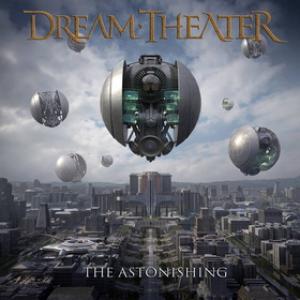
Dream Theater
The Astonishing
Roadrunner Records
2016
Dream Theater have teased their fans for a while about the release of a new album, first with the “announcement” of two factions, on their website, in a rather cryptic front-page post and then with an actual announcement and a promotional video of a double disk featuring some 130 or so minutes of music and some grand concept about a band of rebels, standing defiant against an oppressive empire with music playing an important role, in their “resistance”.
Now it’s true that music from the ancient years has been identified as a way in which human emotions can be manipulated, greatly. A soldier listening to a marching song will feel empowered and more driven and this is but an example… at any rate. Back to the album, the concept sounds like a dodgy convergence of Star Wars and Game Of Thrones with “2112” and up to a point it actually is just that, basing a lot of its lore around similar feudal structures and people in roles similar to those IPs, only really changing the names and setting the whole scene to a post-apocalyptic, but retro-alternative future, some sort of steampunk nightmare or something, where live performances are not allowed.
The whole idea, apart from being unoriginal, sounds like a disaster of titanic proportions in the making. The lyrics/narration are simplistic and read like a teenagers bad attempt at fan fiction. Despite the length of the album, the story is unclear, convoluted and seems rather unlikely altogether, a bad sci-fi melodrama with a lot of metaphysical BS on top of it. Musically, on one hand it’s interesting to see Dream Theater abandoning a “safe” format, but the departure is not towards something original, but towards creating a bloated “Rock Opera” from their own perspective. It feels like they manage to pull the musical part off well enough, being virtuoso musicians and all and fair composers, but because of the grand scope the whole effort seems plagued with issues, like an uneven and slow pace, repetition of themes within songs and an emphasis on ballads and semi-ballads that try to push the story forward, but end up having an odd part in the middle, just to aid in informing the listener on what’s going on, a clear sign of trouble. While early on James Labrie manages to endear the listener, as it all progresses and he takes it upon himself to sing 8 different roles and narrate this, while his performances remain spirited throughout, fatigue soon sets in and it’s not until the second and more “action-packed” act that the listener might feel “engaged” by the story yet again, if he hasn’t lost the plot all together.
To try and sum the whole story up; in the future there’s oppression and tyranny and while the aristocracy lives in cities, in the lap of luxury, the common folk hard pressed for survival, live in small villages, trying to make ends meet and do not indulge into the arts, which are “forgotten”. The only music heard is coming from machines: The Nomacs Now, there are two factions/loyalties, The Ravenskill Rebel Militia, led by brothers Gabriel (The Protagonist/Saviour/Chosen One), who has the “gift of song” and inspires people and Arhys widower of Evangeline and Father to 8 year old Xander as well as the militia’s military leader. These are the “good guys”. On the “not so good guys” side we have the Great Northern Empire of Americas led by a despot, Lord Nafaryus (yeah with that spelling), while his wife, Empress Arabelle, acts like a counterweight and keeps him from going over the edge. Then there’s their daughter, the free spirited, Princess Faythe (yup – correct spelling here too), who falls for the rebels cause and leader and Daryus, the crown prince.
The story is quite predictable, as Nafaryus feels that he’s threatened and his rule challenged by Gabriel, who performs music, “live” (ie “Gift of Music”) and becomes quite popular so he decides to attend one of those performances, to see for himself (“A Savior in the Square”). It’s there that Faythe “falls” for him (“When Your Time Has Come” – which steals a Disney Aladdin song note for note – & “Act of Faythe”). Lord Nafaryus (eponymous song), annoyed that people are so moved by Gabriel, asks for his surrender or threats with violence, then departs allowing three days for Gabriel’s surrender (“Three Days”). Faythe secretly returns to Ravenskill (“Ravenskill”), because she wants to meet Gabriel again (“Chosen”) and despite having trouble at first, she eventually succeeds. Unbeknown to her, her brother Daryus follows her from a distance and spies on her. So while she explains of a plan to Gabriel to meet with her father and reason with him and gets his approval, Daryus in the meantime strong arms Xanter as he enters the house and holds him hostage. Upon Arhys return, he threatens to harm him, unless he betrays his brother (“A Tempting Offer”) and promises as a reward if he does, to take him to the city and provide him with a luxurious life. Arhys is faced with a moral dilemma but finally agrees to Daryus plan. In the meantime Faythe manages to convince her father to grant Gabriel an audience @ an old, now rundown venue.
Daryus is there ready to ambush the hero who will go there to rehearse with Faythe prior to the audience. Mustering up his courage, Ahrys refuses to betray his brother (“Moment of Betrayal” & “Heaven’s Cove”) and in an ensuing fight, loses his life (“The Path that Divides”). Xander who has secretly followed them witnesses that and comes out screaming against his father murderer. Daryus is about to execute him as well when he sees a shadow approaching and suspecting it to be, Gabriel hides away in order to get him as well. Once the figure is within striking distance he attacks, realizing just too late that he’s attacked his own sister Faythe, who he seems to wound mortally (“The Walking Shadow”). Gabriel then arrives at the scene of the crime and shocked releases such an anguished scream that it pierces Daryus eardrums, rendering him deaf and almost destroying his voice in the process, but also alerts a lot of people to come to the place… which begin to show up in hundreds.
Of all, Nafaryus and Arabelle show up and are shocked at the dramatic turn of events (pun intended), hoping and praying that Faythe doesn’t die (“My Last Farewell” up to “Whispers on the Wind”)… Nafaryus pleads to Gabriel to sing, hoping that if Faythe hears it, she’l find a will to live and while the hero agrees, he seems unable to produce any sound resembling singing due to his bloodthirsty scream nearly destroying his voice. It is then that the “crowd” begins to sing, (“Hymn of a Thousand Voices” – the first time there’s soloing fiddle on a DT album?!) thus helping him to regain his voice and miraculously Faythe comes back from the clutches of death. Nafaryus and Arabelle are happy that their daughter is saved and accepting of him and vouch to abolish the Nomacs and to rule in a just way. So Gabriel and Faythe along with Xander, who they have now adopted, live happily ever after, in a better world in a bittersweet, yet “happy end”. (“Our New World” & “The Astonishing”).
Divided in two acts and comprising of some 34 songs (with a few of them however just being minute long Sfx interludes that might have had a place in a visual presentation but only break up the flow of the album, “The Astonishing” has an awful lot of music. It also manages to both sound like Dream Theater (mainly the second act) but also to play out like a score/play/Broadway musical, or accompaniment music a lot of the time. Fair enough, being great musicians these guys could actually pull it off, but I’m afraid to say that in their effort to get “detailed” they spread whatever good ideas they have too thin over 130 or so minutes of music. So I think this album is a little like Pizza. If you like cheese, it’s like a “margarita” or “4 cheeses”… it has tons of it! If you like meat/pepperoni, well there is some, but spread so far apart that it will really not sate your appetite.
There are about 10 minutes of “themes” and another “15 or so” of good vocal melodies, well 2 really good songs, the “Gift of Music” and “Moment of Betrayal” and then the odd passage here and there, either in the form of a ballad that the band “screws up” with an odd part or a nice fanfare with a nice verse, which however feels like a drop in the musical ocean that “The Astonishing” is. Had the band done this as a 74 minute CD or even a double album, but cutting back on the clock, “seriously” this would have been a lot more compact and coherent. Trying to spread a concept over two plus hours is an overkill that actually makes “The Astonishing” collapse under the weight of its own ambition.
Some great concepts like “2112”, “The Wall”, “Operation Mindcrime”, “Streets” or “The Edge” may all be “long” but a) not this long and b) almost every minute in them is exciting and “song oriented” not a big suite that goes on and on. They hardly adapt the “musical” format, or if they do they wrap it around songs and don’t do it in an operatic format, especially if they’re only gonna have a single lead singer. Perhaps if it had multiple performers, “The Astonishing” might have been better, although its fault is not in Labrie’s performances (which are pretty darn good), but rather in its own (up its own arse) delusion of grandeur. A lot of the fans will simply not “get it”, despite the band’s valiant and noble efforts to create something grandiose, so we’ll probably have to expect a “normal” album fairly soon. Artistically, it’s a brave and bold move that however manages to come across as tired and pretentious. Dream Theater should be glad they have such an “astonishing” singer as James Labrie, otherwise this might have not worked at all.
Now it’s true that music from the ancient years has been identified as a way in which human emotions can be manipulated, greatly. A soldier listening to a marching song will feel empowered and more driven and this is but an example… at any rate. Back to the album, the concept sounds like a dodgy convergence of Star Wars and Game Of Thrones with “2112” and up to a point it actually is just that, basing a lot of its lore around similar feudal structures and people in roles similar to those IPs, only really changing the names and setting the whole scene to a post-apocalyptic, but retro-alternative future, some sort of steampunk nightmare or something, where live performances are not allowed.
The whole idea, apart from being unoriginal, sounds like a disaster of titanic proportions in the making. The lyrics/narration are simplistic and read like a teenagers bad attempt at fan fiction. Despite the length of the album, the story is unclear, convoluted and seems rather unlikely altogether, a bad sci-fi melodrama with a lot of metaphysical BS on top of it. Musically, on one hand it’s interesting to see Dream Theater abandoning a “safe” format, but the departure is not towards something original, but towards creating a bloated “Rock Opera” from their own perspective. It feels like they manage to pull the musical part off well enough, being virtuoso musicians and all and fair composers, but because of the grand scope the whole effort seems plagued with issues, like an uneven and slow pace, repetition of themes within songs and an emphasis on ballads and semi-ballads that try to push the story forward, but end up having an odd part in the middle, just to aid in informing the listener on what’s going on, a clear sign of trouble. While early on James Labrie manages to endear the listener, as it all progresses and he takes it upon himself to sing 8 different roles and narrate this, while his performances remain spirited throughout, fatigue soon sets in and it’s not until the second and more “action-packed” act that the listener might feel “engaged” by the story yet again, if he hasn’t lost the plot all together.
To try and sum the whole story up; in the future there’s oppression and tyranny and while the aristocracy lives in cities, in the lap of luxury, the common folk hard pressed for survival, live in small villages, trying to make ends meet and do not indulge into the arts, which are “forgotten”. The only music heard is coming from machines: The Nomacs Now, there are two factions/loyalties, The Ravenskill Rebel Militia, led by brothers Gabriel (The Protagonist/Saviour/Chosen One), who has the “gift of song” and inspires people and Arhys widower of Evangeline and Father to 8 year old Xander as well as the militia’s military leader. These are the “good guys”. On the “not so good guys” side we have the Great Northern Empire of Americas led by a despot, Lord Nafaryus (yeah with that spelling), while his wife, Empress Arabelle, acts like a counterweight and keeps him from going over the edge. Then there’s their daughter, the free spirited, Princess Faythe (yup – correct spelling here too), who falls for the rebels cause and leader and Daryus, the crown prince.
The story is quite predictable, as Nafaryus feels that he’s threatened and his rule challenged by Gabriel, who performs music, “live” (ie “Gift of Music”) and becomes quite popular so he decides to attend one of those performances, to see for himself (“A Savior in the Square”). It’s there that Faythe “falls” for him (“When Your Time Has Come” – which steals a Disney Aladdin song note for note – & “Act of Faythe”). Lord Nafaryus (eponymous song), annoyed that people are so moved by Gabriel, asks for his surrender or threats with violence, then departs allowing three days for Gabriel’s surrender (“Three Days”). Faythe secretly returns to Ravenskill (“Ravenskill”), because she wants to meet Gabriel again (“Chosen”) and despite having trouble at first, she eventually succeeds. Unbeknown to her, her brother Daryus follows her from a distance and spies on her. So while she explains of a plan to Gabriel to meet with her father and reason with him and gets his approval, Daryus in the meantime strong arms Xanter as he enters the house and holds him hostage. Upon Arhys return, he threatens to harm him, unless he betrays his brother (“A Tempting Offer”) and promises as a reward if he does, to take him to the city and provide him with a luxurious life. Arhys is faced with a moral dilemma but finally agrees to Daryus plan. In the meantime Faythe manages to convince her father to grant Gabriel an audience @ an old, now rundown venue.
Daryus is there ready to ambush the hero who will go there to rehearse with Faythe prior to the audience. Mustering up his courage, Ahrys refuses to betray his brother (“Moment of Betrayal” & “Heaven’s Cove”) and in an ensuing fight, loses his life (“The Path that Divides”). Xander who has secretly followed them witnesses that and comes out screaming against his father murderer. Daryus is about to execute him as well when he sees a shadow approaching and suspecting it to be, Gabriel hides away in order to get him as well. Once the figure is within striking distance he attacks, realizing just too late that he’s attacked his own sister Faythe, who he seems to wound mortally (“The Walking Shadow”). Gabriel then arrives at the scene of the crime and shocked releases such an anguished scream that it pierces Daryus eardrums, rendering him deaf and almost destroying his voice in the process, but also alerts a lot of people to come to the place… which begin to show up in hundreds.
Of all, Nafaryus and Arabelle show up and are shocked at the dramatic turn of events (pun intended), hoping and praying that Faythe doesn’t die (“My Last Farewell” up to “Whispers on the Wind”)… Nafaryus pleads to Gabriel to sing, hoping that if Faythe hears it, she’l find a will to live and while the hero agrees, he seems unable to produce any sound resembling singing due to his bloodthirsty scream nearly destroying his voice. It is then that the “crowd” begins to sing, (“Hymn of a Thousand Voices” – the first time there’s soloing fiddle on a DT album?!) thus helping him to regain his voice and miraculously Faythe comes back from the clutches of death. Nafaryus and Arabelle are happy that their daughter is saved and accepting of him and vouch to abolish the Nomacs and to rule in a just way. So Gabriel and Faythe along with Xander, who they have now adopted, live happily ever after, in a better world in a bittersweet, yet “happy end”. (“Our New World” & “The Astonishing”).
Divided in two acts and comprising of some 34 songs (with a few of them however just being minute long Sfx interludes that might have had a place in a visual presentation but only break up the flow of the album, “The Astonishing” has an awful lot of music. It also manages to both sound like Dream Theater (mainly the second act) but also to play out like a score/play/Broadway musical, or accompaniment music a lot of the time. Fair enough, being great musicians these guys could actually pull it off, but I’m afraid to say that in their effort to get “detailed” they spread whatever good ideas they have too thin over 130 or so minutes of music. So I think this album is a little like Pizza. If you like cheese, it’s like a “margarita” or “4 cheeses”… it has tons of it! If you like meat/pepperoni, well there is some, but spread so far apart that it will really not sate your appetite.
There are about 10 minutes of “themes” and another “15 or so” of good vocal melodies, well 2 really good songs, the “Gift of Music” and “Moment of Betrayal” and then the odd passage here and there, either in the form of a ballad that the band “screws up” with an odd part or a nice fanfare with a nice verse, which however feels like a drop in the musical ocean that “The Astonishing” is. Had the band done this as a 74 minute CD or even a double album, but cutting back on the clock, “seriously” this would have been a lot more compact and coherent. Trying to spread a concept over two plus hours is an overkill that actually makes “The Astonishing” collapse under the weight of its own ambition.
Some great concepts like “2112”, “The Wall”, “Operation Mindcrime”, “Streets” or “The Edge” may all be “long” but a) not this long and b) almost every minute in them is exciting and “song oriented” not a big suite that goes on and on. They hardly adapt the “musical” format, or if they do they wrap it around songs and don’t do it in an operatic format, especially if they’re only gonna have a single lead singer. Perhaps if it had multiple performers, “The Astonishing” might have been better, although its fault is not in Labrie’s performances (which are pretty darn good), but rather in its own (up its own arse) delusion of grandeur. A lot of the fans will simply not “get it”, despite the band’s valiant and noble efforts to create something grandiose, so we’ll probably have to expect a “normal” album fairly soon. Artistically, it’s a brave and bold move that however manages to come across as tired and pretentious. Dream Theater should be glad they have such an “astonishing” singer as James Labrie, otherwise this might have not worked at all.