
Every so often a complete work of DVD/CD is out including some of the most intriguing tracks/times of an artist/band. That’s the case here with “The Galactic Collective” DVDs. Erik Norlander did his best and release an amazing package of audio & vision… that will please the ears to those who seek wonderful instrumental, prog-rock, symphonic & electronic music. We felt the need to interview Erik so as to learn as more details as we could for this work… thus, below is what he told to Grande Rock…
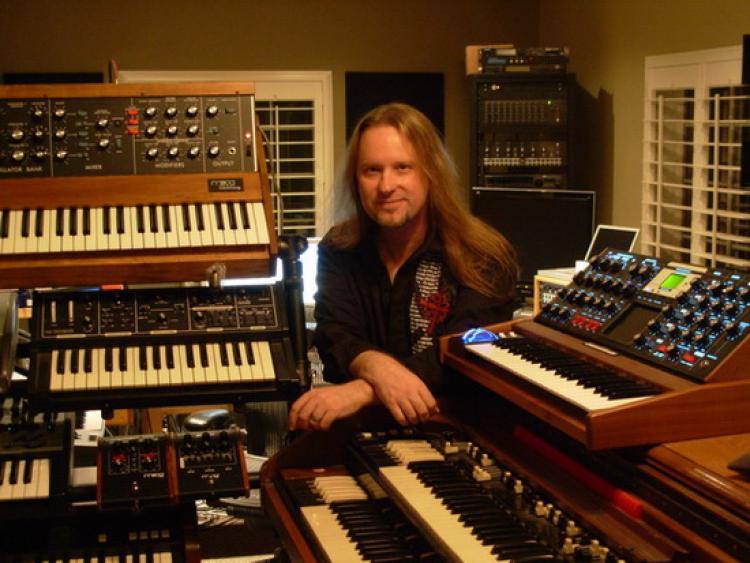
Hi Erik… Congrats on both the “The Galactic Collective” DVDs. We have added to the Grande Rock’s “Hall of Fame”! I’m glad we have the chance to talk for these very special new releases of yours…
E: Many thanks, Thanos. These DVD/CD sets are the realization of a grand, 3-year project, and I’m so happy to finally see them released. Thanks for your help in getting the word out!
First of all, tell us… how did you come up with the idea to tape & re-record the songs for “The Galactic Collective - Definite Edition”?
E: I wear a lot of hats in the music business, from composer to producer, from engineer to keyboardist, and even videographer and graphics designer sometimes! Between all of my various musical projects, Lana Lane, Rocket Scientists, ASIA Featuring John Payne, Big Noize, solo albums and tours, etc., my role is quite varied. There are actually several “parallel careers” going on there.
One of those “careers” is as a keyboardist/composer making this great instrumental progressive rock music that combines the best in synthesizer sounds and techniques with many musical genres from classical to jazz to metal. I reached a summit in 2009 where it was time to represent body of work in a clear and special way. But there was no “clean” way to present this body of work since the music is spread out on so many different albums made with different artists over a period of nearly 20 years. So I came up with the idea of “The Galactic Collective,” a new project where I would re-imagine my 10 favorite instrumental songs as a new, ground-up studio album with a new group of musicians recorded with a singular focus and vision.
With the help of my executive producer, Dena Henry, I worked to assemble a new band in Ohio, then we rehearsed and refined, and finally we went into this beautiful studio in Cleveland to record the project. We then took it on the road, something that moved the project to yet another level. The first set, “The Galactic Collective - Definitive Edition,” is the story of the studio project. The second set, “The Galactic Collective - Live in Gettysburg,” is the next part of the story, the entire album performed live along with some additional songs.
Weren’t you skeptical at any point that offering almost 8 hours (both DVDs) of music would be kinda risky, especially in our times?
E: I released a product back in 2007 with my band, Rocket Scientists, called “Looking Backward.” It was a 5-disc set, and it included a DVD and a CD of all new, live-in-studio performances of older catalog material. I conceived it as a way to re-issue the first three albums of the band – all of which had gone out of print in most countries – in a unique and artistic way, something more than just re-mastering the old albums and adding a bonus track or two. The “Looking Backward” set was a huge success, and the fans really embraced it. So I was not afraid of doing something “big” like this with The Galactic Collective project. It actually seemed like a fairly natural path to take.
I like the first idea of showing what’s going on in the studio; playing the songs live, talking about each one of the songs and generally giving some info that lots of fans long to know. Was it something you had in mind since the CD release of “The Galactic Collective” back in 2010?
E: I did this on the Rocket Scientists “Looking Backward” set, and I even did it before that with the Lana Lane “Storybook” DVD in 2004. I find this to be an interesting format, hearing the artists actually discussing the songs, then immediately seeing those songs performed right in the same context. Recently, we’ve seen great DVDs of some of the older artists discussing classic albums like “Dark Side of the Moon” a “Machine Head.” I really love watching those, and think fans of this kind of prog rock/art rock/whatever you want to call it also enjoy it. It just gives you more insight into the music you love. Albums are not created in a vacuum or in clean lab-like conditions. There’s always a “story” to be told, and that story is what really shapes the albums to sound like they do.
“The Galactic Collective - Definite Edition” is divided in two parts. Firstly, we have “The Galactic Collective” where you perform the songs from the 2010 CD. Did you actually re-record them? When were the videos we saw on the DVD initially recorded?
E: Yes, these are all new recordings done “live in the studio” in Cleveland, Ohio at a studio called Magnetic North. There are a few overdubs that were done at my own studio in California and a couple of other places out of practicality, but the basic tracks of the band playing live in the room there are the heart of the album. When you see those videos, that is the actual album being recorded. I mixed the audio first, then I edited the video footage from that. We took good and thorough notes during the production so that I could match up the right take between the video and audio as we usually recorded several takes of each song.
…and secondly there’s “Echoes from the Collective” which contains 4 songs: “Space: 1999”, “Sky Full of Stars" (piano & vocal version), “Garden of the Moon” (long version) &”The Dark Water” (an extended version from “The Galactic Collective” sessions). How does this bonus material complement the first CD? Were those specific versions available at any of your releases before? The way they are now, I mean…
E: We released a single CD of “The Galactic Collective” in 2010, and it has about as much music as you can fit on a compact disc! I actually had to edit down “Garden of the Moon” and “The Dark Water” to get everything to fit on the disc. And although “Space: 1999” was recorded in those original sessions, I had to cut the song from the disc as there just wasn’t enough room for it. So this second CD, “Echoes from the Collective,” contains the extended versions of those two songs along with “Space: 1999.” Those versions have never been released before.
Then we have the piano and vocal version of “Sky Full of Stars.” I made the decision to record “Sky Full of Stars” with a bit more of an electronic emphasis than it had on the original “Music Machine” album. There I played the main theme on piano, but for “The Galactic Collective”, I played the theme on Moog synthesizer. I had actually played the song live that way for a couple of years, and we even released a special video of Rocket Scientists performing the song that way for the 40th Anniversary of the NASA Apollo Mission Moon Landing in 2009. So I was excited to re-imagine “Sky Full of Stars” this way on the new “Galactic Collective” recording.
However… the studio in Cleveland had this beautiful Steinway grand piano, and of course I used that on several of the other tracks like “Dreamcurrents” and “After the Revolution.” I played the song on that piano while I was working out a few arrangement points with the band. I thought, “Oh, this sounds so good on this piano, I must do a take with it, if nothing else, just for posterity”! So I had the engineer roll another pass of the song, and I played it on that beautiful grand piano. Then shortly after the original album was released in 2010, I played a great concert down in Asheville, North Carolina for The Bob Moog Foundation. I played music from The Galactic Collective with all local Asheville musicians plus my wife, Lana. For “Sky Full of Stars,” we assembled a chorus of 4 fantastic vocalists to sing “ooh” and “ahh” vocal pads in the style of something you would hear on a Pink Floyd or Alan Parsons Project album. So when it came time to assemble “Echoes from the Collective”, I thought it would be brilliant to add this choral part to the piano version of “Sky Full of Stars”. Lana came into the studio and sang all of the parts for me. I think it’s a really special and unique version. (i.n.: it was indeed a brilliant idea…)
I do not mean to flatter you or something… but “The Galactic Collective - Definitive Edition”, DVD & 2 CDs is one hell of a package compared to what I have come across in years. Even if someone if not a fan of yours and happens to see it, I’m quite certain they will totally love it and get it afterwards. How do you feel about this release now that’s on the market?
E: Thank you for that. Honestly, it was a very big project to do as an independent release. I had a lot of help from great engineers, musicians, videographers and graphic designers, but still this was quite an undertaking. However, as a music fan myself, this is the kind of production that I really like to see. Of course great music should stand on its own, but to have all of the stories, all of the visuals, and even the two performances of the album – studio and live – I think really takes the presentation to another level. I would love to do every album like this! Of course, I don’t think that’s really possible or practical, especially for an independent artist like me, but what a great concept that would be, almost like making an album in 3D!
Going to the second DVD… the 21 of May 2011 at RoSFest was a special day for you I can assume, right? The Festival took place in the iconic Civil War battlefield city of Gettysburg, Pennsylvania… and you had gathered two groups of artists from both the North (Akron, Ohio) and the South (Asheville, North Carolina) so as to play “The Galactic Collective” entirely. What are those things that you clearly remember from that night?
E: I remember well the work and the logistics that went into making that performance happen. I had played two dates with Big Noize (a project with vocalist Joe Lynn Turner, Vinny Applice, Phil Soussan and Carlos Cavazo) nearby just a week before the RoSFest event. In fact, I was playing the M3 Festival with Big Noize exactly one week before the RoSFest show, and we were in the middle of playing “Cum On Feel the Noize” from Carlos’ Quiet Riot legacy. I thought how peculiar it was that in exactly one week, at a venue only about an hour or so away, I would be playing this deeply intense progressive music! From 80s hard rock to futuristic prog in just seven days!
From the M3 Festival, Lana and I rented a car and drove to a warehouse in Ohio where we started rehearsals for the RoSFest show. Freddy DeMarco (g), Mark Matthews (b) and Nick LePar (d) had already been rehearsing the set there. I sent them my keyboard tracks along with a click track so that they could prepare in advance without me. Then Debrissa McKinney, one of the vocalists, and August Worley, my keyboard tech, came up to Ohio with my Wall of Doom modular Moog synthesizer. So we truly saw the production grow each day!
Then on the Friday before the show, we had a nice rock ‘n’ roll caravan with the equipment trucks and a couple of cars going from Ohio to Pennsylvania – the next state over – to reach Gettysburg. Friday evening, we met Michelle Moog-Koussa, who flew up from North Carolina, and we all had some drinks in the bar and then some pizzas in our main hotel suite.
RoSFest is a festival, of course – actually “The Rites of Spring Festival” is its full name. So there were several other bands playing on the same stage. As with a lot of festivals, there is a lot of stress with changeover between the bands. The band before us had a lot of people in it, and of course we had to get the Wall of Doom modular Moog synth on stage and tuned up. All of that had to happen in a very short amount of time, and as sometimes happens with festivals, that changeover time was cut even shorter due to festival’s timetable. This was the third time I had played RoSFest, but the logistics of this particular performance were more challenging than previous visits. So it was a bit of a race to get the band staged properly and ready for the performance. I’m sure everyone would have liked to avoid that changeover stress, but that’s part of playing a festival. You really have to be a road warrior! We got through it, and what followed was 2 hours of excellent performances from all of the musicians with a great introduction from Michelle.
Basically, you were asked to play a full two hour set and so in addition to “The Gallactic Collective” album, you added the songs “Capture the Sun” & “Secrets of Astrology” from Lane Lane’s albums. The songs were absolutely fitting the whole celestial & imposing atmosphere of “The Galactic Collective”. The crowd should have enjoyed those songs as well… yeah?
E: Yes, those songs went over really well. When I wrote “Capture the Sun” for Lana in 2007, I remember thinking that the main theme of the song – the part that is played in unison with vocal and guitar on the “Red Planet Boulevard” album – was a bit like “Sky Full of Stars” played backwards! “Sky Full of Stars” has a simple, descending melody, and “Capture the Sun” has the same kind of simple melody that instead ascends at really the same tempo; The band just plays in double time on “Capture,” or in half-time on “Sky Full,” however you want to look at it! So those two are a natural fit. You can hear how I reprise the “Sky Full of Stars” theme in the middle of “Capture the Sun” over the fast rock shuffle groove and then also again at the end for the ride out. I think it’s a great medley.
Adding “Secrets of Astrology” was even more natural. We already were playing the “Astrology Prelude” that we expanded and re-recorded for “The Galactic Collective” album, and since we had Lana in the band this time, it was an easy decision to just continue on with “Secrets” from there. Of course Lana and I had played “Astrology Prelude” and “Secrets of Astrology” together on many tours in past including her 10th Anniversary Tour in 2005 that resulted in the great “Lana Lane 10th Anniversary Concert” DVD. So here we had the grand “Astrology Suite” with both parts. It was a lot of fun to perform this!
How did you decide to perform the “Into the Sunset Suite” live for the first time ever that night? Was it just about time?
E: I really wanted to “represent” all of my solo albums with The Galactic Collective project. I had something special from each album: “Neurosaur” and “Trantor Station” from the “Threshold” album, “Sky Full of Stars” from the “Music Machine” album, and “Fanfare for Absent Friends” from the “Seas of Orion” album. I felt my “Into the Sunset” album was a little under-represented. That’s such a great album, and I am really proud of it. I of course included the piano piece, “Dreamcurrents”, from the “Into the Sunset” album, but that’s kind of a special piece and not really a good representation of the rest of that album. I had considered re-recording the “Sunset Prelude” as part of the original Galactic Collective sessions, but we already had so much music there. However, the guys and I played a release party concert in Ohio in 2010 when the first CD was released, and for that show, we added “Sunset Prelude” as a kind of surprise to end the set. The song came off so well, I thought it would be great to play the whole suite for RoSFest. And Lana sounds so great singing it, too! Plus we had the three singers – Lana, Debrissa and Mark – to properly execute the “Hymn” piece. That was really fantastic.
Which are those songs you enjoy more than the others while playing live on stage?
E: I have probably played “Neurosaur” and “Dreamcurrents” more than any of the others as I usually perform those as a little solo set when I am playing with other bands. So those songs are completely second nature to me. Therefore, it’s easy to be a little bit more aggressive with them and have a little bit of fun stretching out on them. The “Astrology Suite” is also really familiar, so that’s a lot of fun, too. I think for this show, the “Into the Sunset Suite” was the most difficult piece. First, there are a lot of very specific, challenging sections with odd time, precise figures, etc. Second, this was really the first time that the entire suite had been played live! So it was kind of an adventure for all of us.
The production on “The Galactic Collective - Definite Edition” & “The Galactic Collective - Live in Gettysburg” is great by any means. Taking as a fact that you produced & mixed the album… I’m sure that you feel more confident doing things on your own, right? Of course, the mastering by C.S Brown is excellent as well.
E: Thank you. I think I have very identifiable production sound; When you hear an album of mine – whether it’s Lana Lane, Rocket Scientists or even something like the Roswell Six album I did – you know it’s me at the controls. I work with a lot of excellent engineers, of course. But I really hear my albums a certain way, and I want them all to have that certain quality. I cannot define exactly what it is, but it is definitely something. I worked with Chris Brown on the “Roswell Six – Beyond the Horizon” project. In addition to mastering it, Chris also played guitar on the album along with Gary Wehrkamp. I really liked his mastering work, so I asked him to master the first “Galactic Collective” CD in 2010. Fortunately Chris was able to master the entire project, from the extra tracks to the surround sound on the studio DVD to live concert audio. It was so great to have the same mastering of everything. It just gives it all such a nice, unifying polish.
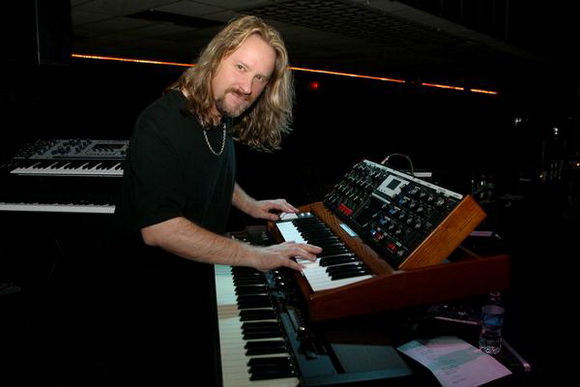
When watching the DVD what makes sense is your Modular Synthesizer “Wall of Doom”. It’s really incredible how you manage your analog sound through this huge machine. Is it easy to be handled and explored in all its capacities as we see on the video?
E: I know it looks like a very imposing machine, but in many ways, it is much more simple and basic than a modern digital synthesizer. Of course, you have to know the basics of subtractive analog synthesis, but I really think that any keyboard player – or at least any keyboard player that plays synths – should have that knowledge. The beautiful thing about the instrument is that each element of the sound, each oscillator, each filter, each envelope, etc. is a discrete module. And that lets you create more interesting and less conventional sounds than you would on even something like a Minimoog. And of course the discrete circuitry makes it just sound better, too. It is a cleaner signal path with a very strong, reliable power supply and only the best components. When you hear the main riff of “Neurosaur,” for example, you can tell that this is something more than just another synth!
Although, you’re using the synth/music technology in your music… you still prefer the analog sound better over the digital one. Why’s that?
E: I think digital instruments are fantastic for recreating acoustic sounds or even electric or electronic sounds when you don’t have the real thing. For most live dates, it is not practical have a grand piano, and even if I did have one, how could I mix it up so as not to hear the loud drums, guitar, etc.? In this case, a digital piano like Yamaha Motif synthesizer that I use is fantastic. Same with the Hammond organ. Sometimes I can take my Hammond out on live dates, but usually not. So a good digital recreation is fantastic to have. But would I rather have the real thing? Of course. There are some remarkable digital models and digital samples of analog synthesizers. But if I have the choice to use those are use the actual instruments that those digital instruments model and sample, why would I use the recreation? The real thing is nearly always better, and I am lucky enough to have many of those real instruments. (i.n.: yeap, I agree the real thing is always better…)
How important is it to work with familiar people that you respect and know what to expect from musically so as to help you explore your musical horizons with every new album you compose/record?
E: I think it’s important to work with familiar people, and you can certainly move faster that way. For example, when my wife, Lana, and I make a record, we get a lot done very quickly. Her recent “El Dorado Hotel” album, for example, took only 3 months to record from start to finish. We’ve worked together for so long, we know exactly to get things done together. But I think it’s also important to work with new people and to step out of your comfort zone. There are so many great artists in the world, and this can really broaden your horizons and spark your creativity. For “The Galactic Collective”, it was important for me to work with some new people so I could truly re-imagine those songs and not accidentally just duplicate what I had done on the past recordings.
I’ve noted: “The whole package is kinda irresistible, even if you do own “The Galactic Collective” CD, for we’re talking about… well almost 8 hours full of progressive, instrumental, theatrical, atmospheric, symphonic, emotional, ambient, keyboard-laden music…” in my review. Do you agree with that?
E: Well, I really appreciate that! I have really worked hard over the last three years to make this project reach its full potential. The original CD was only the first step. I think the second CD and the DVD in the “Definitive Edition” product is well worth the price, even if you do already have the original album. I’m not keen on making fans buy the same thing a second time; I sure hate doing that myself. So I was very conscious of this when putting these sets together.
I’ve also written: “I can’t think of any good reason why someone might miss this incredible music package…” Can you?!
E: Maybe they are trapped on a desert island with no mail delivery? Or maybe they only like truly acoustic music. In that case, they could only enjoy half of one song!
Thus, what’s next for Erik Norlander? Are there any plans for a tour or a new studio album in the near future?
E: I would really like to record a new studio album of all original material. I have so much music demoed already, it would be a real joy to turn it into an album. We shall see what happens!
Is there any news from the Lana Lane camp? Her latest work was actually very enjoyable.
E: Lana had a fairly long break between her newest release, “El Dorado Hotel,” and her previous release from 2007, “Red Planet Boulevard.” She had released so many albums in previous years, it was really time for her to take it a bit easier and focus more on herself and her family. When it was time to make “El Dorado Hotel,” she was really ready for it, and she didn’t feel rushed or pressured to make the album. There was a lot of pressure on her from external sources in previous years, especially from 1998 – 2002, and she had really had enough of that. She wanted to get back to why she made albums in the first place, for her love of singing and her love of music. I think that really shows in the “El Dorado Hotel” album. It was truly one of easiest albums we’ve ever made. (i.n.: and one of the most wonderful as well…)
How do you see the future of instrumental, progressive, symphonic, atmospheric rock music nowadays? Why aren’t there so many musicians dealing with this kind of music as in the 70s and the 80s?
E: The real problem nowadays is how musicians can earn a living making this kind of music, or nearly any music! I am a big fan of Lady Gaga, but what she does has almost nothing in common with what I do. Yes, we are both “musicians” and “artists,” but the similarity really ends there. So much of today’s “successful” music is about commerce, mass-marketing and corporate tie-ins. Making a great album that just stands on its own and makes someone a livable income is nearly a thing of the past. So, we all have to be a little more creative, and we all have to work a little harder. I suppose anything that pushes us to be better artists can be a good force if managed properly, but the overall cultural respect for music and albums is not the same as it was in the 70s, and maybe that’s the hardest thing to deal with.
If I were to spot some major influences you have as a composer then I would say: Vangelis, Rick Wakeman & Jean Michel Jarre. How did those people play a vital role on your musical personality while you were growing up as a person and as a musician?
E: All of those people are great artists. I have covered a Vangelis song, “Hymne” from his “Opera Sauvage,” and also a Rick Wakeman song, “Sir Lancelot and The Black Knight” from his King Arthur album. I have never covered a Jean Michel Jarre song, though. Maybe one day I’ll have to do that! When I was growing up and getting into music, I was always very interested in sounds and production. That’s surely what led me to become a synthesis and a keyboardist. I’m sure if I was a guitar player, I’d be making lots of odds sounds like Robert Fripp and Adrian Belew! It was always the progressive rock bands and the early electronic artists that painted the most interesting soundscapes. But I also have always had a good ear for actual music and musical performance. It drives me crazy when a singer is really out of tune, or an instrumentalist plays wrong notes in a solo or a drummer plays too far out of time. Yes, we all have our stretched, avant-garde moments, but generally you want to perform as well as you possibly can, and that means playing in tune, in time and in the right key! So even though there some other artists using synths and sound in interesting ways, if the music was not composed or performed well, that just didn’t interest me. I’d always go back to something like Procol Harum or Jethro Tull or even Deep Purple. Those albums were always rock-solid musically.
We see that labels and bands/musicians are suffering from people that are only downloading and not buying. Even though there are some guys (like myself) that still buy music… that’s not enough for the music industry and the bands/musicians to survive nowadays… right? Will the CDs and LPs be left only for the romantics in the end? We are on a terminal point here. What will the future bring though?
E: I surely thank you for buying the music you love. That is indeed an important distinction nowadays! We can find almost every album for free. I remember that when Lana’s “El Dorado Hotel” was about to come out, we released our promos – both CDs and mp3s – on a certain day, and the very next day, you could find the album on 100 pirate sites for free, or worse, paid (to the pirate) download! One approach in combatting that is to do something like these two Galactic Collective sets. You can’t download the 16-page color booklet with the beautiful printing, photos, design and liner notes. And even if you download the CDs and the DVD data in its full-quality state, you still have to store that somewhere. I work hard to give you a nice package to put it all in. So yes, maybe this sort of thing is only for the collectors and the die-hard fans, but as long as those people exist, we can continue to make these sorts of products.
As far as piracy and file sharing, until there are real, binding international laws and treaties against this, we will continue to fight the absurd level of pirating that goes on every day. The problem there is that it is in the large electronics companies’ best interest – computer companies, network companies, etc. – is to make content freely available. You need to buy a faster computer or a bigger hard drive to download and store all of this great stuff, so those companies benefit by the free distribution of content. The more content that is out there, the better it is for them. So there is this real divide with content creators – such as musicians – in this way.
And some weird Questions now!! Who are those musicians that defined the instrumental, progressive, symphonic, atmospheric rock music?
E: Wow, probably there are too many to list, but let’s mention Keith Emerson, Rick Wakeman, Jon Lord (R.I.P.!), Patrick Moraz, Mike Pinder, Alan Parsons, of course all the guys in Pink Floyd, Jethro Tull, Procol Harum, King Crimson, and then the electronic pioneers like Klaus Schulze, Edgar Froese and the Tangerine Dream guys, Vangelis, Jean-Michel Jarre, Kitaro and many others.
I bet you have watched/listened to Vangelis’ “Mythodea” which took place in the Temple of Olympian Zeus in Athens in 2001. I consider it to be an astonishing & legendary music work. If you had the chance to perform in an ancient temple/place where would it be and why? Would you choose to compose totally new music that would fit the ancient atmosphere of the place as well?
E: Yes, that is a great performance of Vangelis for sure. I would love to perform in such an epic setting, and it would be wonderful to have the opportunity to compose music as the soundtrack for the place. I played a nice concert in St. Petersburg, Russia several years ago (there is a DVD of it), and one of the greatest compliments I received after the show was from Russian fans telling me that my music really suited the architecture and feeling of the city.
Is fiction part of reality… or reality is fiction’s flaw?
E: Wow. I probably would have to smoke something before answering that question! (i.n.: hehehe…)
Which is the record you wish you had written and why?
E: I wish I had written “The Galactic Collective” as one original album right from the start. That would have been something pretty amazing! But of course, it was the experience and energy of working on all of those different albums with different artists that led to the creation of that catalog of material. And it’s of course life experience that makes the best compositions and performances. (i.n.: I didn’t see that coming…)
How can computers affect and help music? Will there be humans playing musical instruments in the next decades?
E: Computers are wonderful tools for recording music and even as a platform for instruments. There are of course many “entertainment-style” applications that let people play with other people’s music and link together and alter musical performances and recordings of music, this kind of “loop-based” production stuff. But in the end, it’s the artist that actually creates music, not the tools. What would you rather listen to: Keith Emerson playing the cheapest Casio synth we could find, or some unschooled kid playing a million dollars worth of the finest synthesizers and computers? There is an old, silly-but-true American expression, “It ain’t the fiddle, it’s the fiddler”. (i.n.: yeah I totally agree…)
There are people who support that even if we have everything we would still find or invent flaws in our life. Do you believe people need troubles so as to appreciate blessings given to them?
E: Yes, that’s certainly true. Think about your favorite books or films. The critical part of those is conflict. Without conflict, they wouldn’t be interesting.
What are the mistakes that humanity has done and suddenly stopped travelling in the moon & space generally? Probably, we are meant to be only in Earth… so that was kind of inevitable huh? Does humanity have boundaries? Is outer space our natural environment after all?
E: This is turning into quite the philosophy discussion! I think the decline in space exploration is due to the economic crises around the world that are the result of extreme greed and the disregard for the greater human condition. No individual needs a billion dollars or Euros. How can we have billionaires when there are people starving in the world? I don’t advocate communism, but it is wrong to see so much personal greed prevail. There should be a better balance. You can apply that to the arts, too. The arts should be much more of a priority around the world, but especially in my country where art education is fading away. (i.n.: art education is fading away in thw hole planet I think… and the rich are getting richer etc…)
Which are those Stars that you’d like to travel to and why?
E: I would be happy just to visit the Moon in my lifetime.
Is The Galactic Federation of Worlds truth? Do we need one as humans or we’re too small to get involved in their plans?
E: I think we first need to unite Earth before we move on to that idea! (i.n.: so hard to do that… let’s move to that idea better…)
Which will be the best soundtrack to play in the day we will be forced to evacuate planet earth?
E: Pink Floyd’s “Run Like Hell,” maybe?...
If we have two options: one to go deep inside earth and live down there (Hollow Earth theory) and the other to travel to new Stars and get started there… which one would you choose and why?
E: I suppose the latter. The first is finite, the latter is infinite.
Planet Earth is full of violence, death, wars, misbehavior, and battle for everyday life… just to extend your time of leaving… There has to be something more than that… which humans can’t see and comprehend right? Possibly, those who take care of our fate have only given us these ways out. What do you think?
E: There are surely powerful people in the world who shape much of the planet’s fate, and often not for the best. But we as individuals have a lot of power, too. We have the power to create, to do something on a personal level, to have an impact on others – even if only a few – that makes their lives better than they were before.
Can music re-unite the whole world and make humans respect each other, respect life and live together without evil in their hearts and, if so, which music style?
E: I think music is the ultimate universal language, and above any religion, it is the best proof that God exists. (i.n.: 100% true…)
Imagine that your wife (in this case, it would be Lana – hope I am pardoned J) is selling your whole album-collection just to buy an expensive ring for herself. How would you react?
E: Well, Lana has some pretty nice and expensive rings already. I have a lot of albums, but I don’t think selling those would raise enough money! (i.n.: hahaha…)
Thx very much for this extensive and “weird” interview Erik. Thx for the music as well. The last words of this interview belong to you… Take care!
E: Many thanks, Thanos! This may be the longest interview I have ever done. I hope you and your readers find it interesting.
E: Many thanks, Thanos. These DVD/CD sets are the realization of a grand, 3-year project, and I’m so happy to finally see them released. Thanks for your help in getting the word out!
First of all, tell us… how did you come up with the idea to tape & re-record the songs for “The Galactic Collective - Definite Edition”?
E: I wear a lot of hats in the music business, from composer to producer, from engineer to keyboardist, and even videographer and graphics designer sometimes! Between all of my various musical projects, Lana Lane, Rocket Scientists, ASIA Featuring John Payne, Big Noize, solo albums and tours, etc., my role is quite varied. There are actually several “parallel careers” going on there.
One of those “careers” is as a keyboardist/composer making this great instrumental progressive rock music that combines the best in synthesizer sounds and techniques with many musical genres from classical to jazz to metal. I reached a summit in 2009 where it was time to represent body of work in a clear and special way. But there was no “clean” way to present this body of work since the music is spread out on so many different albums made with different artists over a period of nearly 20 years. So I came up with the idea of “The Galactic Collective,” a new project where I would re-imagine my 10 favorite instrumental songs as a new, ground-up studio album with a new group of musicians recorded with a singular focus and vision.
With the help of my executive producer, Dena Henry, I worked to assemble a new band in Ohio, then we rehearsed and refined, and finally we went into this beautiful studio in Cleveland to record the project. We then took it on the road, something that moved the project to yet another level. The first set, “The Galactic Collective - Definitive Edition,” is the story of the studio project. The second set, “The Galactic Collective - Live in Gettysburg,” is the next part of the story, the entire album performed live along with some additional songs.
Weren’t you skeptical at any point that offering almost 8 hours (both DVDs) of music would be kinda risky, especially in our times?
E: I released a product back in 2007 with my band, Rocket Scientists, called “Looking Backward.” It was a 5-disc set, and it included a DVD and a CD of all new, live-in-studio performances of older catalog material. I conceived it as a way to re-issue the first three albums of the band – all of which had gone out of print in most countries – in a unique and artistic way, something more than just re-mastering the old albums and adding a bonus track or two. The “Looking Backward” set was a huge success, and the fans really embraced it. So I was not afraid of doing something “big” like this with The Galactic Collective project. It actually seemed like a fairly natural path to take.
I like the first idea of showing what’s going on in the studio; playing the songs live, talking about each one of the songs and generally giving some info that lots of fans long to know. Was it something you had in mind since the CD release of “The Galactic Collective” back in 2010?
E: I did this on the Rocket Scientists “Looking Backward” set, and I even did it before that with the Lana Lane “Storybook” DVD in 2004. I find this to be an interesting format, hearing the artists actually discussing the songs, then immediately seeing those songs performed right in the same context. Recently, we’ve seen great DVDs of some of the older artists discussing classic albums like “Dark Side of the Moon” a “Machine Head.” I really love watching those, and think fans of this kind of prog rock/art rock/whatever you want to call it also enjoy it. It just gives you more insight into the music you love. Albums are not created in a vacuum or in clean lab-like conditions. There’s always a “story” to be told, and that story is what really shapes the albums to sound like they do.
“The Galactic Collective - Definite Edition” is divided in two parts. Firstly, we have “The Galactic Collective” where you perform the songs from the 2010 CD. Did you actually re-record them? When were the videos we saw on the DVD initially recorded?
E: Yes, these are all new recordings done “live in the studio” in Cleveland, Ohio at a studio called Magnetic North. There are a few overdubs that were done at my own studio in California and a couple of other places out of practicality, but the basic tracks of the band playing live in the room there are the heart of the album. When you see those videos, that is the actual album being recorded. I mixed the audio first, then I edited the video footage from that. We took good and thorough notes during the production so that I could match up the right take between the video and audio as we usually recorded several takes of each song.
…and secondly there’s “Echoes from the Collective” which contains 4 songs: “Space: 1999”, “Sky Full of Stars" (piano & vocal version), “Garden of the Moon” (long version) &”The Dark Water” (an extended version from “The Galactic Collective” sessions). How does this bonus material complement the first CD? Were those specific versions available at any of your releases before? The way they are now, I mean…
E: We released a single CD of “The Galactic Collective” in 2010, and it has about as much music as you can fit on a compact disc! I actually had to edit down “Garden of the Moon” and “The Dark Water” to get everything to fit on the disc. And although “Space: 1999” was recorded in those original sessions, I had to cut the song from the disc as there just wasn’t enough room for it. So this second CD, “Echoes from the Collective,” contains the extended versions of those two songs along with “Space: 1999.” Those versions have never been released before.
Then we have the piano and vocal version of “Sky Full of Stars.” I made the decision to record “Sky Full of Stars” with a bit more of an electronic emphasis than it had on the original “Music Machine” album. There I played the main theme on piano, but for “The Galactic Collective”, I played the theme on Moog synthesizer. I had actually played the song live that way for a couple of years, and we even released a special video of Rocket Scientists performing the song that way for the 40th Anniversary of the NASA Apollo Mission Moon Landing in 2009. So I was excited to re-imagine “Sky Full of Stars” this way on the new “Galactic Collective” recording.
However… the studio in Cleveland had this beautiful Steinway grand piano, and of course I used that on several of the other tracks like “Dreamcurrents” and “After the Revolution.” I played the song on that piano while I was working out a few arrangement points with the band. I thought, “Oh, this sounds so good on this piano, I must do a take with it, if nothing else, just for posterity”! So I had the engineer roll another pass of the song, and I played it on that beautiful grand piano. Then shortly after the original album was released in 2010, I played a great concert down in Asheville, North Carolina for The Bob Moog Foundation. I played music from The Galactic Collective with all local Asheville musicians plus my wife, Lana. For “Sky Full of Stars,” we assembled a chorus of 4 fantastic vocalists to sing “ooh” and “ahh” vocal pads in the style of something you would hear on a Pink Floyd or Alan Parsons Project album. So when it came time to assemble “Echoes from the Collective”, I thought it would be brilliant to add this choral part to the piano version of “Sky Full of Stars”. Lana came into the studio and sang all of the parts for me. I think it’s a really special and unique version. (i.n.: it was indeed a brilliant idea…)
I do not mean to flatter you or something… but “The Galactic Collective - Definitive Edition”, DVD & 2 CDs is one hell of a package compared to what I have come across in years. Even if someone if not a fan of yours and happens to see it, I’m quite certain they will totally love it and get it afterwards. How do you feel about this release now that’s on the market?
E: Thank you for that. Honestly, it was a very big project to do as an independent release. I had a lot of help from great engineers, musicians, videographers and graphic designers, but still this was quite an undertaking. However, as a music fan myself, this is the kind of production that I really like to see. Of course great music should stand on its own, but to have all of the stories, all of the visuals, and even the two performances of the album – studio and live – I think really takes the presentation to another level. I would love to do every album like this! Of course, I don’t think that’s really possible or practical, especially for an independent artist like me, but what a great concept that would be, almost like making an album in 3D!
Going to the second DVD… the 21 of May 2011 at RoSFest was a special day for you I can assume, right? The Festival took place in the iconic Civil War battlefield city of Gettysburg, Pennsylvania… and you had gathered two groups of artists from both the North (Akron, Ohio) and the South (Asheville, North Carolina) so as to play “The Galactic Collective” entirely. What are those things that you clearly remember from that night?
E: I remember well the work and the logistics that went into making that performance happen. I had played two dates with Big Noize (a project with vocalist Joe Lynn Turner, Vinny Applice, Phil Soussan and Carlos Cavazo) nearby just a week before the RoSFest event. In fact, I was playing the M3 Festival with Big Noize exactly one week before the RoSFest show, and we were in the middle of playing “Cum On Feel the Noize” from Carlos’ Quiet Riot legacy. I thought how peculiar it was that in exactly one week, at a venue only about an hour or so away, I would be playing this deeply intense progressive music! From 80s hard rock to futuristic prog in just seven days!
From the M3 Festival, Lana and I rented a car and drove to a warehouse in Ohio where we started rehearsals for the RoSFest show. Freddy DeMarco (g), Mark Matthews (b) and Nick LePar (d) had already been rehearsing the set there. I sent them my keyboard tracks along with a click track so that they could prepare in advance without me. Then Debrissa McKinney, one of the vocalists, and August Worley, my keyboard tech, came up to Ohio with my Wall of Doom modular Moog synthesizer. So we truly saw the production grow each day!
Then on the Friday before the show, we had a nice rock ‘n’ roll caravan with the equipment trucks and a couple of cars going from Ohio to Pennsylvania – the next state over – to reach Gettysburg. Friday evening, we met Michelle Moog-Koussa, who flew up from North Carolina, and we all had some drinks in the bar and then some pizzas in our main hotel suite.
RoSFest is a festival, of course – actually “The Rites of Spring Festival” is its full name. So there were several other bands playing on the same stage. As with a lot of festivals, there is a lot of stress with changeover between the bands. The band before us had a lot of people in it, and of course we had to get the Wall of Doom modular Moog synth on stage and tuned up. All of that had to happen in a very short amount of time, and as sometimes happens with festivals, that changeover time was cut even shorter due to festival’s timetable. This was the third time I had played RoSFest, but the logistics of this particular performance were more challenging than previous visits. So it was a bit of a race to get the band staged properly and ready for the performance. I’m sure everyone would have liked to avoid that changeover stress, but that’s part of playing a festival. You really have to be a road warrior! We got through it, and what followed was 2 hours of excellent performances from all of the musicians with a great introduction from Michelle.
Basically, you were asked to play a full two hour set and so in addition to “The Gallactic Collective” album, you added the songs “Capture the Sun” & “Secrets of Astrology” from Lane Lane’s albums. The songs were absolutely fitting the whole celestial & imposing atmosphere of “The Galactic Collective”. The crowd should have enjoyed those songs as well… yeah?
E: Yes, those songs went over really well. When I wrote “Capture the Sun” for Lana in 2007, I remember thinking that the main theme of the song – the part that is played in unison with vocal and guitar on the “Red Planet Boulevard” album – was a bit like “Sky Full of Stars” played backwards! “Sky Full of Stars” has a simple, descending melody, and “Capture the Sun” has the same kind of simple melody that instead ascends at really the same tempo; The band just plays in double time on “Capture,” or in half-time on “Sky Full,” however you want to look at it! So those two are a natural fit. You can hear how I reprise the “Sky Full of Stars” theme in the middle of “Capture the Sun” over the fast rock shuffle groove and then also again at the end for the ride out. I think it’s a great medley.
Adding “Secrets of Astrology” was even more natural. We already were playing the “Astrology Prelude” that we expanded and re-recorded for “The Galactic Collective” album, and since we had Lana in the band this time, it was an easy decision to just continue on with “Secrets” from there. Of course Lana and I had played “Astrology Prelude” and “Secrets of Astrology” together on many tours in past including her 10th Anniversary Tour in 2005 that resulted in the great “Lana Lane 10th Anniversary Concert” DVD. So here we had the grand “Astrology Suite” with both parts. It was a lot of fun to perform this!
How did you decide to perform the “Into the Sunset Suite” live for the first time ever that night? Was it just about time?
E: I really wanted to “represent” all of my solo albums with The Galactic Collective project. I had something special from each album: “Neurosaur” and “Trantor Station” from the “Threshold” album, “Sky Full of Stars” from the “Music Machine” album, and “Fanfare for Absent Friends” from the “Seas of Orion” album. I felt my “Into the Sunset” album was a little under-represented. That’s such a great album, and I am really proud of it. I of course included the piano piece, “Dreamcurrents”, from the “Into the Sunset” album, but that’s kind of a special piece and not really a good representation of the rest of that album. I had considered re-recording the “Sunset Prelude” as part of the original Galactic Collective sessions, but we already had so much music there. However, the guys and I played a release party concert in Ohio in 2010 when the first CD was released, and for that show, we added “Sunset Prelude” as a kind of surprise to end the set. The song came off so well, I thought it would be great to play the whole suite for RoSFest. And Lana sounds so great singing it, too! Plus we had the three singers – Lana, Debrissa and Mark – to properly execute the “Hymn” piece. That was really fantastic.
Which are those songs you enjoy more than the others while playing live on stage?
E: I have probably played “Neurosaur” and “Dreamcurrents” more than any of the others as I usually perform those as a little solo set when I am playing with other bands. So those songs are completely second nature to me. Therefore, it’s easy to be a little bit more aggressive with them and have a little bit of fun stretching out on them. The “Astrology Suite” is also really familiar, so that’s a lot of fun, too. I think for this show, the “Into the Sunset Suite” was the most difficult piece. First, there are a lot of very specific, challenging sections with odd time, precise figures, etc. Second, this was really the first time that the entire suite had been played live! So it was kind of an adventure for all of us.
The production on “The Galactic Collective - Definite Edition” & “The Galactic Collective - Live in Gettysburg” is great by any means. Taking as a fact that you produced & mixed the album… I’m sure that you feel more confident doing things on your own, right? Of course, the mastering by C.S Brown is excellent as well.
E: Thank you. I think I have very identifiable production sound; When you hear an album of mine – whether it’s Lana Lane, Rocket Scientists or even something like the Roswell Six album I did – you know it’s me at the controls. I work with a lot of excellent engineers, of course. But I really hear my albums a certain way, and I want them all to have that certain quality. I cannot define exactly what it is, but it is definitely something. I worked with Chris Brown on the “Roswell Six – Beyond the Horizon” project. In addition to mastering it, Chris also played guitar on the album along with Gary Wehrkamp. I really liked his mastering work, so I asked him to master the first “Galactic Collective” CD in 2010. Fortunately Chris was able to master the entire project, from the extra tracks to the surround sound on the studio DVD to live concert audio. It was so great to have the same mastering of everything. It just gives it all such a nice, unifying polish.
When watching the DVD what makes sense is your Modular Synthesizer “Wall of Doom”. It’s really incredible how you manage your analog sound through this huge machine. Is it easy to be handled and explored in all its capacities as we see on the video?
E: I know it looks like a very imposing machine, but in many ways, it is much more simple and basic than a modern digital synthesizer. Of course, you have to know the basics of subtractive analog synthesis, but I really think that any keyboard player – or at least any keyboard player that plays synths – should have that knowledge. The beautiful thing about the instrument is that each element of the sound, each oscillator, each filter, each envelope, etc. is a discrete module. And that lets you create more interesting and less conventional sounds than you would on even something like a Minimoog. And of course the discrete circuitry makes it just sound better, too. It is a cleaner signal path with a very strong, reliable power supply and only the best components. When you hear the main riff of “Neurosaur,” for example, you can tell that this is something more than just another synth!
Although, you’re using the synth/music technology in your music… you still prefer the analog sound better over the digital one. Why’s that?
E: I think digital instruments are fantastic for recreating acoustic sounds or even electric or electronic sounds when you don’t have the real thing. For most live dates, it is not practical have a grand piano, and even if I did have one, how could I mix it up so as not to hear the loud drums, guitar, etc.? In this case, a digital piano like Yamaha Motif synthesizer that I use is fantastic. Same with the Hammond organ. Sometimes I can take my Hammond out on live dates, but usually not. So a good digital recreation is fantastic to have. But would I rather have the real thing? Of course. There are some remarkable digital models and digital samples of analog synthesizers. But if I have the choice to use those are use the actual instruments that those digital instruments model and sample, why would I use the recreation? The real thing is nearly always better, and I am lucky enough to have many of those real instruments. (i.n.: yeap, I agree the real thing is always better…)
How important is it to work with familiar people that you respect and know what to expect from musically so as to help you explore your musical horizons with every new album you compose/record?
E: I think it’s important to work with familiar people, and you can certainly move faster that way. For example, when my wife, Lana, and I make a record, we get a lot done very quickly. Her recent “El Dorado Hotel” album, for example, took only 3 months to record from start to finish. We’ve worked together for so long, we know exactly to get things done together. But I think it’s also important to work with new people and to step out of your comfort zone. There are so many great artists in the world, and this can really broaden your horizons and spark your creativity. For “The Galactic Collective”, it was important for me to work with some new people so I could truly re-imagine those songs and not accidentally just duplicate what I had done on the past recordings.
I’ve noted: “The whole package is kinda irresistible, even if you do own “The Galactic Collective” CD, for we’re talking about… well almost 8 hours full of progressive, instrumental, theatrical, atmospheric, symphonic, emotional, ambient, keyboard-laden music…” in my review. Do you agree with that?
E: Well, I really appreciate that! I have really worked hard over the last three years to make this project reach its full potential. The original CD was only the first step. I think the second CD and the DVD in the “Definitive Edition” product is well worth the price, even if you do already have the original album. I’m not keen on making fans buy the same thing a second time; I sure hate doing that myself. So I was very conscious of this when putting these sets together.
I’ve also written: “I can’t think of any good reason why someone might miss this incredible music package…” Can you?!
E: Maybe they are trapped on a desert island with no mail delivery? Or maybe they only like truly acoustic music. In that case, they could only enjoy half of one song!
Thus, what’s next for Erik Norlander? Are there any plans for a tour or a new studio album in the near future?
E: I would really like to record a new studio album of all original material. I have so much music demoed already, it would be a real joy to turn it into an album. We shall see what happens!
Is there any news from the Lana Lane camp? Her latest work was actually very enjoyable.
E: Lana had a fairly long break between her newest release, “El Dorado Hotel,” and her previous release from 2007, “Red Planet Boulevard.” She had released so many albums in previous years, it was really time for her to take it a bit easier and focus more on herself and her family. When it was time to make “El Dorado Hotel,” she was really ready for it, and she didn’t feel rushed or pressured to make the album. There was a lot of pressure on her from external sources in previous years, especially from 1998 – 2002, and she had really had enough of that. She wanted to get back to why she made albums in the first place, for her love of singing and her love of music. I think that really shows in the “El Dorado Hotel” album. It was truly one of easiest albums we’ve ever made. (i.n.: and one of the most wonderful as well…)
How do you see the future of instrumental, progressive, symphonic, atmospheric rock music nowadays? Why aren’t there so many musicians dealing with this kind of music as in the 70s and the 80s?
E: The real problem nowadays is how musicians can earn a living making this kind of music, or nearly any music! I am a big fan of Lady Gaga, but what she does has almost nothing in common with what I do. Yes, we are both “musicians” and “artists,” but the similarity really ends there. So much of today’s “successful” music is about commerce, mass-marketing and corporate tie-ins. Making a great album that just stands on its own and makes someone a livable income is nearly a thing of the past. So, we all have to be a little more creative, and we all have to work a little harder. I suppose anything that pushes us to be better artists can be a good force if managed properly, but the overall cultural respect for music and albums is not the same as it was in the 70s, and maybe that’s the hardest thing to deal with.
If I were to spot some major influences you have as a composer then I would say: Vangelis, Rick Wakeman & Jean Michel Jarre. How did those people play a vital role on your musical personality while you were growing up as a person and as a musician?
E: All of those people are great artists. I have covered a Vangelis song, “Hymne” from his “Opera Sauvage,” and also a Rick Wakeman song, “Sir Lancelot and The Black Knight” from his King Arthur album. I have never covered a Jean Michel Jarre song, though. Maybe one day I’ll have to do that! When I was growing up and getting into music, I was always very interested in sounds and production. That’s surely what led me to become a synthesis and a keyboardist. I’m sure if I was a guitar player, I’d be making lots of odds sounds like Robert Fripp and Adrian Belew! It was always the progressive rock bands and the early electronic artists that painted the most interesting soundscapes. But I also have always had a good ear for actual music and musical performance. It drives me crazy when a singer is really out of tune, or an instrumentalist plays wrong notes in a solo or a drummer plays too far out of time. Yes, we all have our stretched, avant-garde moments, but generally you want to perform as well as you possibly can, and that means playing in tune, in time and in the right key! So even though there some other artists using synths and sound in interesting ways, if the music was not composed or performed well, that just didn’t interest me. I’d always go back to something like Procol Harum or Jethro Tull or even Deep Purple. Those albums were always rock-solid musically.
We see that labels and bands/musicians are suffering from people that are only downloading and not buying. Even though there are some guys (like myself) that still buy music… that’s not enough for the music industry and the bands/musicians to survive nowadays… right? Will the CDs and LPs be left only for the romantics in the end? We are on a terminal point here. What will the future bring though?
E: I surely thank you for buying the music you love. That is indeed an important distinction nowadays! We can find almost every album for free. I remember that when Lana’s “El Dorado Hotel” was about to come out, we released our promos – both CDs and mp3s – on a certain day, and the very next day, you could find the album on 100 pirate sites for free, or worse, paid (to the pirate) download! One approach in combatting that is to do something like these two Galactic Collective sets. You can’t download the 16-page color booklet with the beautiful printing, photos, design and liner notes. And even if you download the CDs and the DVD data in its full-quality state, you still have to store that somewhere. I work hard to give you a nice package to put it all in. So yes, maybe this sort of thing is only for the collectors and the die-hard fans, but as long as those people exist, we can continue to make these sorts of products.
As far as piracy and file sharing, until there are real, binding international laws and treaties against this, we will continue to fight the absurd level of pirating that goes on every day. The problem there is that it is in the large electronics companies’ best interest – computer companies, network companies, etc. – is to make content freely available. You need to buy a faster computer or a bigger hard drive to download and store all of this great stuff, so those companies benefit by the free distribution of content. The more content that is out there, the better it is for them. So there is this real divide with content creators – such as musicians – in this way.
And some weird Questions now!! Who are those musicians that defined the instrumental, progressive, symphonic, atmospheric rock music?
E: Wow, probably there are too many to list, but let’s mention Keith Emerson, Rick Wakeman, Jon Lord (R.I.P.!), Patrick Moraz, Mike Pinder, Alan Parsons, of course all the guys in Pink Floyd, Jethro Tull, Procol Harum, King Crimson, and then the electronic pioneers like Klaus Schulze, Edgar Froese and the Tangerine Dream guys, Vangelis, Jean-Michel Jarre, Kitaro and many others.
I bet you have watched/listened to Vangelis’ “Mythodea” which took place in the Temple of Olympian Zeus in Athens in 2001. I consider it to be an astonishing & legendary music work. If you had the chance to perform in an ancient temple/place where would it be and why? Would you choose to compose totally new music that would fit the ancient atmosphere of the place as well?
E: Yes, that is a great performance of Vangelis for sure. I would love to perform in such an epic setting, and it would be wonderful to have the opportunity to compose music as the soundtrack for the place. I played a nice concert in St. Petersburg, Russia several years ago (there is a DVD of it), and one of the greatest compliments I received after the show was from Russian fans telling me that my music really suited the architecture and feeling of the city.
Is fiction part of reality… or reality is fiction’s flaw?
E: Wow. I probably would have to smoke something before answering that question! (i.n.: hehehe…)
Which is the record you wish you had written and why?
E: I wish I had written “The Galactic Collective” as one original album right from the start. That would have been something pretty amazing! But of course, it was the experience and energy of working on all of those different albums with different artists that led to the creation of that catalog of material. And it’s of course life experience that makes the best compositions and performances. (i.n.: I didn’t see that coming…)
How can computers affect and help music? Will there be humans playing musical instruments in the next decades?
E: Computers are wonderful tools for recording music and even as a platform for instruments. There are of course many “entertainment-style” applications that let people play with other people’s music and link together and alter musical performances and recordings of music, this kind of “loop-based” production stuff. But in the end, it’s the artist that actually creates music, not the tools. What would you rather listen to: Keith Emerson playing the cheapest Casio synth we could find, or some unschooled kid playing a million dollars worth of the finest synthesizers and computers? There is an old, silly-but-true American expression, “It ain’t the fiddle, it’s the fiddler”. (i.n.: yeah I totally agree…)
There are people who support that even if we have everything we would still find or invent flaws in our life. Do you believe people need troubles so as to appreciate blessings given to them?
E: Yes, that’s certainly true. Think about your favorite books or films. The critical part of those is conflict. Without conflict, they wouldn’t be interesting.
What are the mistakes that humanity has done and suddenly stopped travelling in the moon & space generally? Probably, we are meant to be only in Earth… so that was kind of inevitable huh? Does humanity have boundaries? Is outer space our natural environment after all?
E: This is turning into quite the philosophy discussion! I think the decline in space exploration is due to the economic crises around the world that are the result of extreme greed and the disregard for the greater human condition. No individual needs a billion dollars or Euros. How can we have billionaires when there are people starving in the world? I don’t advocate communism, but it is wrong to see so much personal greed prevail. There should be a better balance. You can apply that to the arts, too. The arts should be much more of a priority around the world, but especially in my country where art education is fading away. (i.n.: art education is fading away in thw hole planet I think… and the rich are getting richer etc…)
Which are those Stars that you’d like to travel to and why?
E: I would be happy just to visit the Moon in my lifetime.
Is The Galactic Federation of Worlds truth? Do we need one as humans or we’re too small to get involved in their plans?
E: I think we first need to unite Earth before we move on to that idea! (i.n.: so hard to do that… let’s move to that idea better…)
Which will be the best soundtrack to play in the day we will be forced to evacuate planet earth?
E: Pink Floyd’s “Run Like Hell,” maybe?...
If we have two options: one to go deep inside earth and live down there (Hollow Earth theory) and the other to travel to new Stars and get started there… which one would you choose and why?
E: I suppose the latter. The first is finite, the latter is infinite.
Planet Earth is full of violence, death, wars, misbehavior, and battle for everyday life… just to extend your time of leaving… There has to be something more than that… which humans can’t see and comprehend right? Possibly, those who take care of our fate have only given us these ways out. What do you think?
E: There are surely powerful people in the world who shape much of the planet’s fate, and often not for the best. But we as individuals have a lot of power, too. We have the power to create, to do something on a personal level, to have an impact on others – even if only a few – that makes their lives better than they were before.
Can music re-unite the whole world and make humans respect each other, respect life and live together without evil in their hearts and, if so, which music style?
E: I think music is the ultimate universal language, and above any religion, it is the best proof that God exists. (i.n.: 100% true…)
Imagine that your wife (in this case, it would be Lana – hope I am pardoned J) is selling your whole album-collection just to buy an expensive ring for herself. How would you react?
E: Well, Lana has some pretty nice and expensive rings already. I have a lot of albums, but I don’t think selling those would raise enough money! (i.n.: hahaha…)
Thx very much for this extensive and “weird” interview Erik. Thx for the music as well. The last words of this interview belong to you… Take care!
E: Many thanks, Thanos! This may be the longest interview I have ever done. I hope you and your readers find it interesting.