
Coming from a country that has a great tradition in black metal & extreme music in general, Wallachia is not new around. Although, they’ve been in the scene from almost 20 years this is just their third full-length release. The mastermind, vocalist, guitarist & bassist of the band, Lars Stavdal, told Grande Rock about the new work “Shunya” and metal music at large…
Hi Lars. I’m glad we have the chance to talk about your new album. “Shunya” is a truly impressive work of black/atmospheric/melodic metal music.
L: Thank you for the kind words, Thanos, and the pleasure is mine.
Although you’ve been around for almost 2 decades, that is your third work so far. Why’s that?
L: The main reason for the big gap between the 1st and 2nd album was that I had to build Wallachia from scratch again after the demise of our first label, Velvet Music International, and I was without a drummer at the time, and also needed the funds to finance a recording and so on. I wanted to do everything properly and that’s why it took a bit longer than expected. But now with a 3-year gap between the previous album and the new opus, I feel that I’m back on track, finally.
What are the advantages & the disadvantages of working alone? Are you feeling better now that Wallachia is not a one man’s project but has a steady line-up where others are contributing as well?
L: The advantages of working alone are that you have total control of the artistic vision and musical expression, and don’t need to make any compromises with that. And also you work in a natural pace according to how you feel, and in periods I’m working heavily on ideas, and sometimes it’s also needed to take a little bit of distance and reflect over the material, to digest it slowly and live with the songs through different stages before recording.
The disadvantages would mainly be that you’re not fully able to test the arrangements properly, as far as harmonies, melody lines and so on, but then on the other hand, I find that also a bit rewarding, when you finally hear the songs take shape layer by layer in the studio.
And of course it’s a lot to pay attention to, being solely responsible for the compositions, the lyrics and most of the performance too, and every aspect of the music holds an equal importance, be it the lyrics as much as the music itself, the artwork and everything put together.
The musicians that help me out in the studio definitely adds their personal flavor to the songs, although they don’t contribute to the writing of the material, but their different takes on ideas and slight changes of arrangements takes it to a new level from how I imagined it at first.
3 years after “Ceremony of Ascension”, what do you have in mind while starting writing music and recording the songs for an upcoming album?
L: I was already working on some ideas for the new album even before “Ceremony of Ascension” was recorded, and I had a clear vision that this album would be deeper, personal, gloomy, melancholic and also more cohesive as a whole.
I usually have a basic idea for each song, thematically, which triggers how the music and lyrics naturally take shape. Sometimes it can be the music that comes first and then inspires the mood of the lyrics, while other times it can be the opposite way around.
So, what are those new things that “Shunya” is introducing us to?
L: “Shunya” introduces the use of cello, violin and viola being featured on 5 out of the 8 songs on the album, and that really gave the album a lot more depth, dynamics and organic feel. The cello parts were performed by an Austrian girl named Caroline Oblasser, who also recorded some parts on the latest Golden Dawn album. And the violin and viola was done by a Polish girl, Anna Oklejewicz, who’s recorded with Lord Wind, Graveland, Munruthel, Kroda…
Since “Shunya” is a gloomier album, it was just a natural choice to have those real string elements involved, and I’m very pleased with how it turned out. (i.n.: It actually turned out to be a great idea!)
What does “Shunya” mean and why did you choose to name your album after that word?
L: “Shunya” is a word that comes from Sanskrit language and it basically translates as “empty” or “void”, and it also represents “zero” from Indian numerology terms. And I feel that the word has a symbolic effect and mystic touch that covers the lyrical themes and musical atmosphere of the album. (i.n.: Very interesting indeed!)
I must also comment on the wonderful cover artwork. Where’s that place and how it is related with “Shunya”?
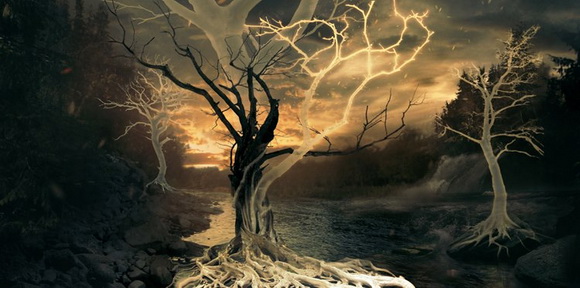
L: The artwork is done by the Romanian artist Laura Sava, and the cover is put together with using different elements and techniques. The background is a photograph that Laura took herself in Transylvania, then the veiled person figure is made out of boxes and clothing before being photographed and blended with the background image. Then it’s the same with the white tree and the falling leaves which were cut out and shaped from paper, and the leaves were spray-painted. In the end she edited all these parts together, added some effects and final touches. The cover art is related to the lyrics and in particular the last song “Emotional Ground Zero”, as I feel that this whole album represents for me a new beginning.
Do give us a hint about each one of the songs…
L: “Dual Nothingness”: A straight to the point opening of the album. Epic and raw.
“Gloria in Excelsis Ego”: Fast and melodic, blends in some new and experimental elements.
“Ksatriya”: A doomy ballad song that was written in a difficult time of my life.
“Enlightened by Deception”: Fast, raw, and also the most eclectic song on the album.
“Hypotheist”: The oldest song on the album (written in 2001). It has some folky elements.
“Nostalgia Among The Ruins Of Common”: Another song which carries some folk influences. Catchy and mid-tempo based.
“Harbinger Of Vacuumanity”: A song that takes a surprising turn midway through and out.
“Emotional Ground Zero”: A deeply personal and gloomy song. A beautiful ending of the album.
Where did you record the new album and who took care of the recording, the mixing, the mastering and the production?
L: The album was recorded in Soundtempel Studios in Freilassing, Germany, near the Austrian border and 15 minutes away from the lovely city of Salzburg. The same studio as I used on the previous album too. And once again it was engineered, mixed and mastered by Stefan Traunmüller from Golden Dawn.
I like how the album sounds; it has a 90s/00s feeling. It’s not that over-polished as generally albums are in our time. What do you think?
L: Thanks, and yeah, that’s what I’m trying to get across. I want to capture a bit of that roughness and spontaneity from the early 90’s type of albums, the stuff that influenced me in the first place. I think we have an organic and powerful sound on this album.
The problem with a lot of albums nowadays is that they are way too edited and “perfect” sounding, just from how the drums are triggered and quite often sound flat and lifeless, and also I see that more and more bands record a lot of stuff at home or in the rehearsal place, which allows them to take all the time needed in order to perfect every little detail. It loses some of that spontaneity and “first take magic” that you can’t re-capture. I think it’s just good that there are some minor flaws and that not necessarily everything has to be perfect, if you know what I mean. (i.n.: I feel you dude ad I totally agree with you…)
I’ve written: “…The use of instruments like: violin, viola & cello is offering an extra elusive & gloomy atmosphere and that’s what separates this album from other relative releases…”. Do you agree?
L: That’s what I wanted to achieve with this album, to give it a more live and real sound, and that’s why it also helps a lot to have the dynamics from the string orchestra elements rather than to only use keyboards. Every stroke with the cello/violin bow is different in velocity and feeling, and that’s what makes it so great, because you can build it up and tone it down much more. And these instruments do invoke a special melancholic vibe. (i.n.: You did achieve it eventually…)
Is there a chance to release any videos and if yes for which one of the songs?
L: Mysteriis from the Swedish band Setherial edited a video trailer for “Shunya” that turned out very cool, I think. So it’s possible that we’ll also do something like this for an entire track and make a storyline based from the lyrics. We’ll see if it happens now or if we will do something like this in the future. I think I would have picked “Hypotheist” for a possible video track as the song was written with some clear images in my mind and there’s a lot of symbolism that could be used for that one.
Will you give any live shows in the future? Will the fans get the chance to see you live?
L: We have talked about the possibility for doing live shows during next year, so it basically depends on having at least one more member in order to make it work, so we’ll see. As it also takes a lot of time and effort in order to make an international line-up function, but as long as we are determined and focused then I think it’s possible. We’ll see what happens ahead, if getting any offers and so on.
What are your expectations from the new album? Do you believe that it can introduce you to a wider audience?
L: I just hope that the people who enjoyed the previous albums will also embrace “Shunya”, as I personally feel that this album takes the music closer to the early material with the atmosphere and melancholy. I think that Wallachia will always be deeply rooted in the underground, no matter that the sound is more bombastic and vast now, and I always let the music speak for itself without having any circus around it.
So, what has changed since the early 90s in this kind of music? I think black metal once had sorta become “mainstream” in a way… but that thing has passed now. What’s your say?
L: Black Metal, like any (sub) genres were exploited and watered out and it pretty much had the same fate as Death Metal had towards the mid ‘90’s. I think it needed to “die out” and lose some of the dead weight and slowly resurrect itself with the artists who were into it for the right reasons in the first place. The bands that willingly went out to reach a wider and more mainstream audience have ended up losing touch with their true artistic intentions, as they end up being driven by the business side of the music industry rather than their own artistic integrity.
L: Thank you for the kind words, Thanos, and the pleasure is mine.
Although you’ve been around for almost 2 decades, that is your third work so far. Why’s that?
L: The main reason for the big gap between the 1st and 2nd album was that I had to build Wallachia from scratch again after the demise of our first label, Velvet Music International, and I was without a drummer at the time, and also needed the funds to finance a recording and so on. I wanted to do everything properly and that’s why it took a bit longer than expected. But now with a 3-year gap between the previous album and the new opus, I feel that I’m back on track, finally.
What are the advantages & the disadvantages of working alone? Are you feeling better now that Wallachia is not a one man’s project but has a steady line-up where others are contributing as well?
L: The advantages of working alone are that you have total control of the artistic vision and musical expression, and don’t need to make any compromises with that. And also you work in a natural pace according to how you feel, and in periods I’m working heavily on ideas, and sometimes it’s also needed to take a little bit of distance and reflect over the material, to digest it slowly and live with the songs through different stages before recording.
The disadvantages would mainly be that you’re not fully able to test the arrangements properly, as far as harmonies, melody lines and so on, but then on the other hand, I find that also a bit rewarding, when you finally hear the songs take shape layer by layer in the studio.
And of course it’s a lot to pay attention to, being solely responsible for the compositions, the lyrics and most of the performance too, and every aspect of the music holds an equal importance, be it the lyrics as much as the music itself, the artwork and everything put together.
The musicians that help me out in the studio definitely adds their personal flavor to the songs, although they don’t contribute to the writing of the material, but their different takes on ideas and slight changes of arrangements takes it to a new level from how I imagined it at first.
3 years after “Ceremony of Ascension”, what do you have in mind while starting writing music and recording the songs for an upcoming album?
L: I was already working on some ideas for the new album even before “Ceremony of Ascension” was recorded, and I had a clear vision that this album would be deeper, personal, gloomy, melancholic and also more cohesive as a whole.
I usually have a basic idea for each song, thematically, which triggers how the music and lyrics naturally take shape. Sometimes it can be the music that comes first and then inspires the mood of the lyrics, while other times it can be the opposite way around.
So, what are those new things that “Shunya” is introducing us to?
L: “Shunya” introduces the use of cello, violin and viola being featured on 5 out of the 8 songs on the album, and that really gave the album a lot more depth, dynamics and organic feel. The cello parts were performed by an Austrian girl named Caroline Oblasser, who also recorded some parts on the latest Golden Dawn album. And the violin and viola was done by a Polish girl, Anna Oklejewicz, who’s recorded with Lord Wind, Graveland, Munruthel, Kroda…
Since “Shunya” is a gloomier album, it was just a natural choice to have those real string elements involved, and I’m very pleased with how it turned out. (i.n.: It actually turned out to be a great idea!)
What does “Shunya” mean and why did you choose to name your album after that word?
L: “Shunya” is a word that comes from Sanskrit language and it basically translates as “empty” or “void”, and it also represents “zero” from Indian numerology terms. And I feel that the word has a symbolic effect and mystic touch that covers the lyrical themes and musical atmosphere of the album. (i.n.: Very interesting indeed!)
I must also comment on the wonderful cover artwork. Where’s that place and how it is related with “Shunya”?
L: The artwork is done by the Romanian artist Laura Sava, and the cover is put together with using different elements and techniques. The background is a photograph that Laura took herself in Transylvania, then the veiled person figure is made out of boxes and clothing before being photographed and blended with the background image. Then it’s the same with the white tree and the falling leaves which were cut out and shaped from paper, and the leaves were spray-painted. In the end she edited all these parts together, added some effects and final touches. The cover art is related to the lyrics and in particular the last song “Emotional Ground Zero”, as I feel that this whole album represents for me a new beginning.
Do give us a hint about each one of the songs…
L: “Dual Nothingness”: A straight to the point opening of the album. Epic and raw.
“Gloria in Excelsis Ego”: Fast and melodic, blends in some new and experimental elements.
“Ksatriya”: A doomy ballad song that was written in a difficult time of my life.
“Enlightened by Deception”: Fast, raw, and also the most eclectic song on the album.
“Hypotheist”: The oldest song on the album (written in 2001). It has some folky elements.
“Nostalgia Among The Ruins Of Common”: Another song which carries some folk influences. Catchy and mid-tempo based.
“Harbinger Of Vacuumanity”: A song that takes a surprising turn midway through and out.
“Emotional Ground Zero”: A deeply personal and gloomy song. A beautiful ending of the album.
Where did you record the new album and who took care of the recording, the mixing, the mastering and the production?
L: The album was recorded in Soundtempel Studios in Freilassing, Germany, near the Austrian border and 15 minutes away from the lovely city of Salzburg. The same studio as I used on the previous album too. And once again it was engineered, mixed and mastered by Stefan Traunmüller from Golden Dawn.
I like how the album sounds; it has a 90s/00s feeling. It’s not that over-polished as generally albums are in our time. What do you think?
L: Thanks, and yeah, that’s what I’m trying to get across. I want to capture a bit of that roughness and spontaneity from the early 90’s type of albums, the stuff that influenced me in the first place. I think we have an organic and powerful sound on this album.
The problem with a lot of albums nowadays is that they are way too edited and “perfect” sounding, just from how the drums are triggered and quite often sound flat and lifeless, and also I see that more and more bands record a lot of stuff at home or in the rehearsal place, which allows them to take all the time needed in order to perfect every little detail. It loses some of that spontaneity and “first take magic” that you can’t re-capture. I think it’s just good that there are some minor flaws and that not necessarily everything has to be perfect, if you know what I mean. (i.n.: I feel you dude ad I totally agree with you…)
I’ve written: “…The use of instruments like: violin, viola & cello is offering an extra elusive & gloomy atmosphere and that’s what separates this album from other relative releases…”. Do you agree?
L: That’s what I wanted to achieve with this album, to give it a more live and real sound, and that’s why it also helps a lot to have the dynamics from the string orchestra elements rather than to only use keyboards. Every stroke with the cello/violin bow is different in velocity and feeling, and that’s what makes it so great, because you can build it up and tone it down much more. And these instruments do invoke a special melancholic vibe. (i.n.: You did achieve it eventually…)
Is there a chance to release any videos and if yes for which one of the songs?
L: Mysteriis from the Swedish band Setherial edited a video trailer for “Shunya” that turned out very cool, I think. So it’s possible that we’ll also do something like this for an entire track and make a storyline based from the lyrics. We’ll see if it happens now or if we will do something like this in the future. I think I would have picked “Hypotheist” for a possible video track as the song was written with some clear images in my mind and there’s a lot of symbolism that could be used for that one.
Will you give any live shows in the future? Will the fans get the chance to see you live?
L: We have talked about the possibility for doing live shows during next year, so it basically depends on having at least one more member in order to make it work, so we’ll see. As it also takes a lot of time and effort in order to make an international line-up function, but as long as we are determined and focused then I think it’s possible. We’ll see what happens ahead, if getting any offers and so on.
What are your expectations from the new album? Do you believe that it can introduce you to a wider audience?
L: I just hope that the people who enjoyed the previous albums will also embrace “Shunya”, as I personally feel that this album takes the music closer to the early material with the atmosphere and melancholy. I think that Wallachia will always be deeply rooted in the underground, no matter that the sound is more bombastic and vast now, and I always let the music speak for itself without having any circus around it.
So, what has changed since the early 90s in this kind of music? I think black metal once had sorta become “mainstream” in a way… but that thing has passed now. What’s your say?
L: Black Metal, like any (sub) genres were exploited and watered out and it pretty much had the same fate as Death Metal had towards the mid ‘90’s. I think it needed to “die out” and lose some of the dead weight and slowly resurrect itself with the artists who were into it for the right reasons in the first place. The bands that willingly went out to reach a wider and more mainstream audience have ended up losing touch with their true artistic intentions, as they end up being driven by the business side of the music industry rather than their own artistic integrity.
How do you see this new mp3-digital-free-dowloading culture of the 21st century? Would you offer the whole album or some songs from it for free to the fans at any time?
L: There’s no point for me personally to offer it for free as it’s already leaked out on the internet for “free download” since the time of release, and this is something none of us can control. So basically anyone with a little bit of computer experience and knowing how to use google can easily find the album “for free”, as with pretty much every other album, EP, demo, etc.
In a way you can see this as comparable with how the tape-trading used to function in the underground, as it was a good way of discovering new bands and coming across rare material. But even with that you had to invest time and money to buy tapes, postage costs and so on. So, the difference with the internet culture is that you can have everything conveniently downloaded straight to your computer within the matter of a few minutes. What worries me the most about this development is that people are getting more and more distanced from the true meaning of art and I think it’s only a good thing that you have to be selective with what you purchase. When you have only 15 € in your pocket and can afford only one album, then of course you become careful with what you invest your time and hard earned cash on, as opposed with the internet culture were you can take it all for free and just as easily dismiss it the same. People might download the whole back-catalogue of whatever artist and give a couple of songs a spin or two and then move on the next, as they didn’t invest anything (in spirit and with time just as much as with money) into it. So, my main concern is that people develop this shallow relation to music and have no conscience about taking it “for free”.
It’s kinda different to have a music file on your pc desktop rather than a CD with a booklet or a vinyl in your hands. Are those things bygones? How do you see the future of music generally?
L: Music is first and foremost something you listen to regardless of which format it comes in. But I must say that I value to have my music in a physical condition, be it CD or vinyl, that I feel that I own the actual product, and have that extra information, the lyrics, being able to touch and see the artwork in all its glory. Those things are important to me. I’ve always liked to collect music and enjoy the whole process of pre-ordering an album and waiting for the day that it arrives in your mailbox, to wrap it out and see the artwork for the first time, and that joy is still the same for me.
We see evident changes with the music industry and how bands think about alternate ways to reach out to their fans, and I think that many bands now depend more on their live and touring performances rather than album sales.
The music has to come from somewhere and someone has to pay for it, and I really wonder how this will evolve when we see labels having to close their biz because of decreasing album sales, studios shut down because bands get no recording budget and choose to do a “home recording” instead. It’s a vicious cycle all this, and I think that most people aren’t aware of these facts, as they are just happy as long as they find their “free download”.
I think that artists shouldn’t surrender completely and choose to go for easier and cheaper solutions just because they know their album will end up on the internet. It’s important to make the albums attractive and make people feel that they get their money’s worth if purchasing it.
We see now that vinyl has come back stronger again and maybe there will be a general revival of collecting music and seeing people take pride in owning the authentic thing. (i.n.: Let’s hope so…)
And some weird Questions now!!! Why did you name the band Wallachia at first?
L: I chose the name Wallachia because I was deeply into the stories about Vlad Tepes III (1431 – 1476), the notorious Prince of Wallachia, better known as the true historical Dracula – Vlad the Impaler. As a kid growing up I had this fascination with the Dracula character and myth, and when I was in my early teens I came across a book that told about the legend of this Romanian Prince, I became even more interested as I found it both so savage, cruel and also with a deep sense of patriotism and bravery. It was the perfect source of inspiration to create dramatic and raw music filled with majestic atmosphere.
Being a part of the Norwegian scene since the 90s… what do you believe about those incidents back then? How did you experience the whole thing? Did it hurt the black metal scene or helped it to grow bigger eventually?
L: Since Norway is and has always been a small and rather conservative country, it was interesting to see the how the Black Metal scene evolved both with the musical side and also the more outlaw activities that happened. It quickly became a phenomenon mostly due to the criminal activities and the characters involved, and it took many years before the actual music was rewarded for its quality and innovation. Norwegian Black Metal grew more successful in the rest of the world compared to here in Norway, simply because the Medias here focused on the church burnings, the murder case of Euronymous and those things, digging up every weirdo who told about sleeping in coffins and what not.
I do think that the crime wave helped to give a certain boost around the scene, that reached far outside of Norway. It created a myth that somehow still exists and you see people going to certain locations such as where the Helvete store used to be where you still can find the infamous “Black Metal” tagging on the concrete wall in the cellar.
If Varg hadn’t killed Euronymous, and Dead hadn’t committed suicide… how would that have affected Mayhem and the whole Norwegian black metal scene over the years?
L: I don’t know, but I sure think that things would be different had not any of those incidents happened. Euronymous had such a big influence and grip on the underground scene, but somehow I think that those incidents were inevitable because things were pushed to the extreme and there was a lot of rivalry going on.
Maybe the black metal scene would have remained more in the underground and not have evolved in such a liberated and avant-garde way as it did towards the late ‘90’s.
Can you actually say that Norway is the “mother” of extreme metal music? Is this kind of music so popular inland as it is outland?
L: I wouldn’t say that Norway is the mother of extreme metal music, but I would say that Norway is the home of the 2nd wave of Black Metal since it established in a more solid manner here. You already had bands like Rotting Christ, Necromantia, Varathron, Samael, Tormentor, Master’s Hammer, Sigh, Marduk, Blasphemy, Von, all who were doing their own unique take on Black Metal. But the Norwegian scene added a more primitive and cold take on this form of music, and also incorporated a more National romantic and folkloric influence at the same time. Sweden were already a successful country for Death Metal bands, while Norway expanded the same way with the Black Metal scene.
What are those things that you do not like in the music industry nowadays?
L: In a general sense I would say that it’s how we see a lot of music today is being manufactured and sold as a simple form of entertainment. As you see with all these TV-shows such as American Idol, The X-Factor and so on, basically “artists” who belong behind the microphone in a karaoke bar or on a cruise ship, but who are being manufactured by a simple money-making industry. And this is not only within pop music, but we see it also within metal music and other sub genres the same.
I like to think that if you strip it down to the actual music and lyric, and take away all the outside circus elements, then what are you left with. Would even 80% of the “artists” we see on MTV make it if they didn’t have those flashy choreographed videos and the media focus on their private lives? Would the music survive on its own? I think not. And I think the same way about a lot of these “scandalous” characters within the extreme metal scene too. (i.n.: You’re right Lars…)
Heaven or Hell and why? What are the similarities and the differences?
L: I don’t believe in any of the concepts about Heaven or Hell and what awaits when we pass away from our mortal life. I just think that the idea of Paradise as opposed to Hell is the oldest way of keeping people has a certain awe and respect for life, and for the karma that is being affected from how we live, think and act. I mean, according to religion it appears that we are all going to Hell because we choose reason, common sense, knowledge, science, individuality and freedom in favor of dogmas and scriptures from a time when the earth was still flat. All I know is that I have an “unspecified ticket”.
Is fiction part of reality… or reality is fiction’s flaw?
L: Fiction in the shape of religion is a big part of reality and our world today, as we see parts of the world being in endless chaos and war because of that. In that sense reality can be seen as a flaw from fiction, because some people can’t handle the real world.
Which is the record you wish you had written and why?
L: Emperor’s “Anthems to the Welkin at Dusk”, simply because I think it’s perfect when it comes to the craftsmanship of both the music and lyrics, the complex arrangements, the fine balance of rawness and bone chilling atmosphere.
Which music kind can’t you bear to hear at all?
L: Any kind of nonsense verse-chorus-verse-chorus boring formula “entertainment” music, just switch on MTV at any time of the day and you know what I mean.
Were you obliged to give just one album to extraterrestrials that would represent the whole human music evolution, which album would it be and from which band/artist?
L: I would simply give them a collection of Ludwig Van Beethoven’s sonatas, simply because I think that the musical evolution was at the highest peak already a couple of centuries ago.
What would you to say to all those that claim that black metal music is sound pollution and has no meaning at all?
L: Black Metal music isn’t meant for everyone to understand, and even if people manage to penetrate the wall of sound and grasp the musical qualities that lie beyond the intense blast beats, the screaming vocals and sharp guitars, I think it’s just as important to have an emotional and spiritual connection to this form of music.
Imagine that your girlfriend/wife is selling your whole album-collection just to buy an expensive ring for herself. How would you react? J
L: I love her more than anything, but I would rather hope she would ask me to rob a bank or something, hehe. (i.n.: hehe… she’d better!)
I think we’re done Lars … Please leave a note to Grande Rock readers… Take care!
L: Thank you Thanos for the interview, and to all the readers of Grande Rock I thank you for the time and feel free to check out “Shunya” that is now released since November 16th on Debemur Morti Productions. Check it out at: www.facebook.com/wallachiaband.