
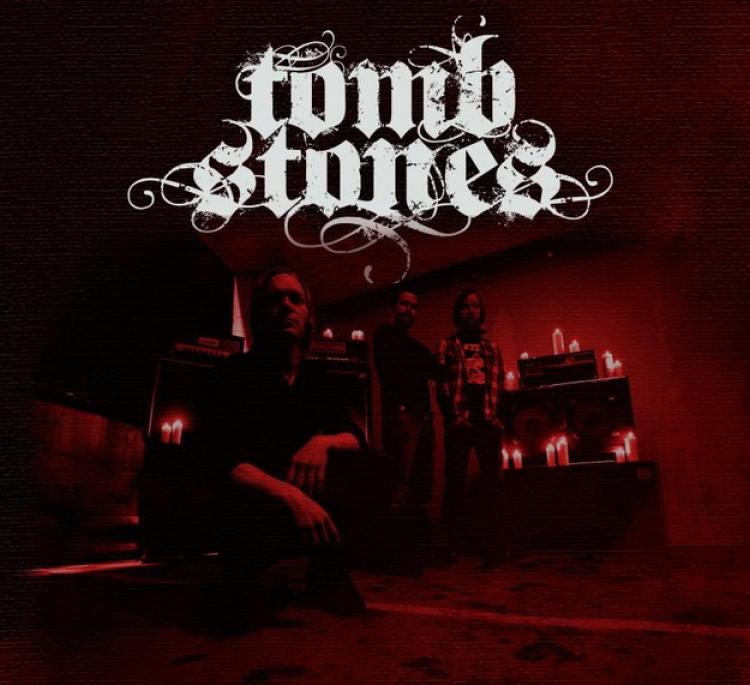
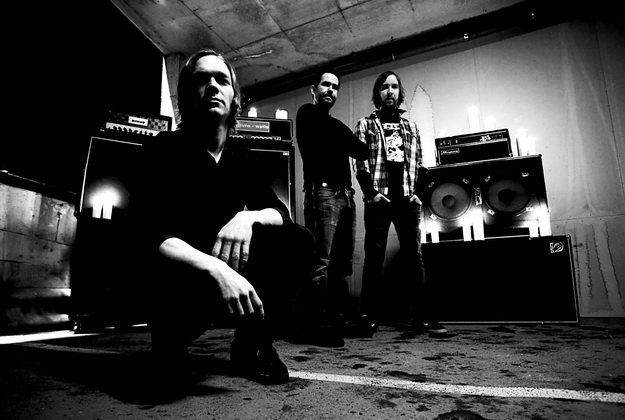
Tombstones are responsible for the darkest, heaviest and doom-est release I’ve heard this year. “Red Skies and Dead Eyes” is the band’s third full length album after “Volume II” (2010) and “Year of the Burial” (2012). We got in touch with Ole Christian Helstad, the band’s bass player and vocalist to talk a little bit about the history of the Tombstones, the new album, the band’s future plans and finally the future of music and the music industry in general.
Hello and welcome to Grande Rock. First of all, I’d like to thank you for this interview; it’s great to have you here.
O: Thank you! The pleasure is all ours!
Some people describe your music as sludge metal while others as doom metal. Forgetting for a minute all the labels that listeners and record companies give to artists, how would you describe your sound in your own words?
O: Yeah, we see a lot of labels put to our music. We describe it as dark and heavy doom, with a somewhat catchy stoner drive to it.
This is your second release with Soulseller Records, how did this collaboration occur and how is it working with them?
O: It’s been all good so far. It started prior to the release of “Year of the Burial”. We had just got offered a deal with Transubstans, but since we weren’t totally happy with the communication with them on “Volume II”, we sent some raw-mixes around. Soulseller got back to us, and the ball kept rolling from there. It’s a small label, with limited financial opportunities of course, but the dialogue is very good, and we feel we are in good hands. Lately their roster has got some great additions as well, so let’s hope we can grow bigger together.
You mention in your press release that the album was made with live-recording sessions in May of 2013. For those who don’t know what exactly that means, take us through your recording process.
O: This means we geared up and recorded all the basics live. Meaning drums, bass and one guitar-track. We have recorded all our albums like this. It generates the right feeling of our band and allows us to add authentic and dynamic tempos within each song. It would never work for us to track an album instrument by instrument with a click-track as prisoned guidelines. It would not be fair to our music. We would like the listener to sense the vibe and feeling we try to accomplish during concerts. Additional guitars and vocals are recorded separately afterwards.
Care to say a few words about the title of the new album? What exactly does the phrase “Red Skies and Dead Eyes” mean to you and why did you choose that to describe the album?
O: It has no deeper meaning actually. It’s a phrase from the title track, and it’s a badly hidden wordplay towards some substance-side-effects in there. On the other hand, it really suits the atmosphere we constantly aim for, and that is the most important thing. It can also be looked upon as side A on the vinyl being “Red Skies”, and side B being “Dead Eyes”...
Tell us a couple of things about the cover art by Glyn Smyth. What does that cover represent for you?
O: It’s Glyn’s interpretation of our album. It obviously goes well with the title, given his use of colours and the skeletal war-lord, which are quite different compared to most of his other works, especially the colour-scheme. We like how it stands out with its strong appearance and insane details. He is an extremely talented and unique artist. I love all his work.
Are there any interesting or funny stories that you would like to share about any of the songs in “Red Skies and Dead Eyes”?
O: Hehe, actually there is. The file we sent to the mastering-studio, with the complete album, was 666 MB. Quite evil, right? And to me it’s always funny to see how the songs end up, compared to how they have been visualized in my head. We struggled a bit with the main riff in the title-track, to get the groove right. Jørn Inge started playing a beat, which to me sounded totally off at first, but it’s the beat we kept, and today I love it. The approach to the riff in my head has been turned upside down. Those kind of things are one of the key-elements of being in a band.
Are you planning to release any music videos for any of the songs?
O: No, I don’t think so. We haven’t got the budget to do a full-scale, professional video recording. If anyone out there wants to do give it a go, drop us a line…
Any plans for touring in the near future?
O: Yeah! In February we are touring Europe again. We’re on the road February 1st through February 9th, visiting Netherlands, Belgium, France, Switzerland and Germany. It’s gonna be swell to get on the road again. There’s another small tour in the UK happening in 2014 as well. More news on that later.
“Volume II” came out one year after “Volume I”, your self-released demo. “Year of the Burial” followed two years after that, and now only one year later you released “Red Skies And Dead Eyes”. Is it safe to say that you guys like to keep busy?
O: Yeah, so far I think it’s fair to draw that conclusion. As soon as “Volume II” was released we entered a creative period, as we kind of re-invented our sound a little bit, being the outcome shown on “Year of the Burial” and the current “Red Skies and Dead Eyes”.
So can we expect another album by Tombstones next year?
O: It’s difficult to foresee the future, but at the moment we don’t have any immediate plans for a new recording. Let’s see what happens. This was the case after “Year of the Burial” as well. We will continue writing more music though, that is certain.
Calling your music dark, I think, would be an understatement, but I detect a primal element to your sound. Also, you often make references to “demons from ancient caves” and stuff on your Facebook page. What influences your song writing? Is it legends from the past, current events or is it just the state you happen to be in at that specific time?
O: That detection is quite accurate. We like to keep that primal feel to both riffs, songs and sound. We’re not that into the proggy side of things, and like the music to be felt as a fist punched in your solar plexus, never stopping to hit. It has to be a heart-felt drive and groove there, mixed in between the crushing heaviness. The inspirational sources can differ a lot, but for me personally, I like to write music during the cold and dark winters, when daylight loses against darkness. That’s the creative highlight of the year for me. It can also be a particular occasion, as it was for “Year of the Burial”... when most lyrics especially, can be linked to the death of our former guitarist. That is still the case for a lot of lyrics on “Red Skies and Dead Eyes”.
“Volume II” had also featured a dark undertone, but had a much more stoner and post-grunge sound in it. Was the shift to a full-on doom/sludge one a conscious change or did it happen as an inadvertent evolutionary process? Which were the reasons for that shift?
O: The occasion mentioned in your last question had a major impact on that matter. Both lyric-wise, but maybe even more when comes to our instrumental approach. Suddenly we were three, not four, and the synced and compact riffery focusing on pure and primal earth-shattering riffs felt fresh to us. We felt we brought something new to the Tombstones-table, which the three of us felt comfortable doing. It kind of snowballed from there.
I found all your albums on Spotify. Do you think that this kind of music sharing programs is the future of music distribution as opposed to the old-fashioned road through a record company and record stores?
O: Yeah, absolutely. Nowadays you can access whatever music you’d like from wherever you are. It’s a blessing in my opinion. It’s way easier to get your music out there, but that also toughens the situation, as there are so many good and unknown bands around. The main priority for musicians nowadays needs to be touring. The biggest drawback with this new world is the lack of sales of the physical format, which again leads to labels having less money between their hands, and forcing artists to cover a bigger part of the cake themselves. Hopefully there will be some financial benefits through sources like YouTube and streaming in general, which finally reach the artists. That part is a joke toady…
So, do you think that LPs and CDs will at some point become obsolete and people will just download all their music? How do you feel about this happening in the years to come?
O: No, the physical format will always be there. There will forever be music lovers who prefer the best way of enjoying music. It’s an undisputed fact that music sound much better on vinyl than the digital files accessible online. You can never beat the sound of the needle dropping on your favourite album.
O: Thank you! The pleasure is all ours!
Some people describe your music as sludge metal while others as doom metal. Forgetting for a minute all the labels that listeners and record companies give to artists, how would you describe your sound in your own words?
O: Yeah, we see a lot of labels put to our music. We describe it as dark and heavy doom, with a somewhat catchy stoner drive to it.
This is your second release with Soulseller Records, how did this collaboration occur and how is it working with them?
O: It’s been all good so far. It started prior to the release of “Year of the Burial”. We had just got offered a deal with Transubstans, but since we weren’t totally happy with the communication with them on “Volume II”, we sent some raw-mixes around. Soulseller got back to us, and the ball kept rolling from there. It’s a small label, with limited financial opportunities of course, but the dialogue is very good, and we feel we are in good hands. Lately their roster has got some great additions as well, so let’s hope we can grow bigger together.
You mention in your press release that the album was made with live-recording sessions in May of 2013. For those who don’t know what exactly that means, take us through your recording process.
O: This means we geared up and recorded all the basics live. Meaning drums, bass and one guitar-track. We have recorded all our albums like this. It generates the right feeling of our band and allows us to add authentic and dynamic tempos within each song. It would never work for us to track an album instrument by instrument with a click-track as prisoned guidelines. It would not be fair to our music. We would like the listener to sense the vibe and feeling we try to accomplish during concerts. Additional guitars and vocals are recorded separately afterwards.
Care to say a few words about the title of the new album? What exactly does the phrase “Red Skies and Dead Eyes” mean to you and why did you choose that to describe the album?
O: It has no deeper meaning actually. It’s a phrase from the title track, and it’s a badly hidden wordplay towards some substance-side-effects in there. On the other hand, it really suits the atmosphere we constantly aim for, and that is the most important thing. It can also be looked upon as side A on the vinyl being “Red Skies”, and side B being “Dead Eyes”...
Tell us a couple of things about the cover art by Glyn Smyth. What does that cover represent for you?
O: It’s Glyn’s interpretation of our album. It obviously goes well with the title, given his use of colours and the skeletal war-lord, which are quite different compared to most of his other works, especially the colour-scheme. We like how it stands out with its strong appearance and insane details. He is an extremely talented and unique artist. I love all his work.
Are there any interesting or funny stories that you would like to share about any of the songs in “Red Skies and Dead Eyes”?
O: Hehe, actually there is. The file we sent to the mastering-studio, with the complete album, was 666 MB. Quite evil, right? And to me it’s always funny to see how the songs end up, compared to how they have been visualized in my head. We struggled a bit with the main riff in the title-track, to get the groove right. Jørn Inge started playing a beat, which to me sounded totally off at first, but it’s the beat we kept, and today I love it. The approach to the riff in my head has been turned upside down. Those kind of things are one of the key-elements of being in a band.
Are you planning to release any music videos for any of the songs?
O: No, I don’t think so. We haven’t got the budget to do a full-scale, professional video recording. If anyone out there wants to do give it a go, drop us a line…
Any plans for touring in the near future?
O: Yeah! In February we are touring Europe again. We’re on the road February 1st through February 9th, visiting Netherlands, Belgium, France, Switzerland and Germany. It’s gonna be swell to get on the road again. There’s another small tour in the UK happening in 2014 as well. More news on that later.
“Volume II” came out one year after “Volume I”, your self-released demo. “Year of the Burial” followed two years after that, and now only one year later you released “Red Skies And Dead Eyes”. Is it safe to say that you guys like to keep busy?
O: Yeah, so far I think it’s fair to draw that conclusion. As soon as “Volume II” was released we entered a creative period, as we kind of re-invented our sound a little bit, being the outcome shown on “Year of the Burial” and the current “Red Skies and Dead Eyes”.
So can we expect another album by Tombstones next year?
O: It’s difficult to foresee the future, but at the moment we don’t have any immediate plans for a new recording. Let’s see what happens. This was the case after “Year of the Burial” as well. We will continue writing more music though, that is certain.
Calling your music dark, I think, would be an understatement, but I detect a primal element to your sound. Also, you often make references to “demons from ancient caves” and stuff on your Facebook page. What influences your song writing? Is it legends from the past, current events or is it just the state you happen to be in at that specific time?
O: That detection is quite accurate. We like to keep that primal feel to both riffs, songs and sound. We’re not that into the proggy side of things, and like the music to be felt as a fist punched in your solar plexus, never stopping to hit. It has to be a heart-felt drive and groove there, mixed in between the crushing heaviness. The inspirational sources can differ a lot, but for me personally, I like to write music during the cold and dark winters, when daylight loses against darkness. That’s the creative highlight of the year for me. It can also be a particular occasion, as it was for “Year of the Burial”... when most lyrics especially, can be linked to the death of our former guitarist. That is still the case for a lot of lyrics on “Red Skies and Dead Eyes”.
“Volume II” had also featured a dark undertone, but had a much more stoner and post-grunge sound in it. Was the shift to a full-on doom/sludge one a conscious change or did it happen as an inadvertent evolutionary process? Which were the reasons for that shift?
O: The occasion mentioned in your last question had a major impact on that matter. Both lyric-wise, but maybe even more when comes to our instrumental approach. Suddenly we were three, not four, and the synced and compact riffery focusing on pure and primal earth-shattering riffs felt fresh to us. We felt we brought something new to the Tombstones-table, which the three of us felt comfortable doing. It kind of snowballed from there.
I found all your albums on Spotify. Do you think that this kind of music sharing programs is the future of music distribution as opposed to the old-fashioned road through a record company and record stores?
O: Yeah, absolutely. Nowadays you can access whatever music you’d like from wherever you are. It’s a blessing in my opinion. It’s way easier to get your music out there, but that also toughens the situation, as there are so many good and unknown bands around. The main priority for musicians nowadays needs to be touring. The biggest drawback with this new world is the lack of sales of the physical format, which again leads to labels having less money between their hands, and forcing artists to cover a bigger part of the cake themselves. Hopefully there will be some financial benefits through sources like YouTube and streaming in general, which finally reach the artists. That part is a joke toady…
So, do you think that LPs and CDs will at some point become obsolete and people will just download all their music? How do you feel about this happening in the years to come?
O: No, the physical format will always be there. There will forever be music lovers who prefer the best way of enjoying music. It’s an undisputed fact that music sound much better on vinyl than the digital files accessible online. You can never beat the sound of the needle dropping on your favourite album.
Do you still buy CDs and LPs? What was the last album you bought?
O: Yeah, of course. The last LP I bought was “Volume II” by Spelljammer.
Which band or album was the one that really got you involved with music? In other words, what made you think to yourselves “this is what I wanna do for the rest of my life”?
O: Hmm, I think I need to go back over 20 years here… when skate-punk blew up, and I was a teenager skateboarding all day long. Maybe Bad Religion’s “No Control” was the gateway to wanting to start a band. Can’t narrow it down to one album. But bands as Lagwagon, NOFX, Millencolin, Raised Fist and the mentioned Bad Religion. Pretty much everything released on Burning Heart, Fat Wreck or Epitaph Records in the early nineties.
OK time for our “weird questions! If all your records were to be destroyed and you could only keep three which would those be?
O: Wow, that is almost impossible. I’ll go with OM – “God is Good” or “Advaitic Songs”, Weezer – “Blue Album” and Sleep’s “Holy Mountain”.
If you could work with any musician or band (alive or not) who would they be?
O: Buzz Osborne and the Melvins.
If you were not musicians what do you picture yourselves being?
O: I’m far from being a full-time musician, wish I could though. I would probably do the same as I’m doing today… I work with shopfitting. Haha, that’s rock and roll!!
If you could travel through time what time would you go back to? Or would you choose to go to the future? Either way, please tell us why.
O: Definately back. I think i would have enjoyed San Francisco in the mid and late sixties.
Please describe what these bands mean to you with no more than 5 words.
O: Black Sabbath: Godfathers of doom. Iommi’s riffs.
Electric Wizard: Fresh approach to doom.
Melvins: The Melvins rule. Period!
Naam: Nam Naam Nam Naam S/T…
Isis: Dug them 10 years ago.
Sleep: I love Sleep. Huge inspiration.
Alice in Chains: Amazing band, miss Layne. Unplugged!
Yob: Live monster, throne of doom!
Soundgarden: Chris Cornell and Timberland.
Acid King: Amazingly mesmerizing, laid-back stoner doom..
Cough: Extremely heavy live band. Love them!
Kyuss: “Sky Valley”, “Gardenia”, “Supa Scoopa”.
Spiritual Beggars: Not the biggest fan…
Orange Goblin: Good live band.
Tombstones: 80% of my mind, always.
Last question… what are your plans for the near future? Playing live shows? Writing new songs? Or relaxing with your favourite sport (according to your Facebook page) domestic couch surfing?
O: Hehe, we’re couch-surfing at home all year long, so yeah, probably a lot of that. We have two gigs coming up in Norway before 2014. I will definitely aim at writing new songs these coming months, and there’s the European Tour coming up in February. Good times ahead!
I want to thank you for taking the time to speak with us, and wish you all the best for the future. Good luck guys and keep up the good work.
O: Thank you very much for showing interest in Tombstones. Highly appreciated. Hopefully we’ll be able to enter a stage in Greece in the not too distant future! Hails from Norway!
O: Yeah, of course. The last LP I bought was “Volume II” by Spelljammer.
Which band or album was the one that really got you involved with music? In other words, what made you think to yourselves “this is what I wanna do for the rest of my life”?
O: Hmm, I think I need to go back over 20 years here… when skate-punk blew up, and I was a teenager skateboarding all day long. Maybe Bad Religion’s “No Control” was the gateway to wanting to start a band. Can’t narrow it down to one album. But bands as Lagwagon, NOFX, Millencolin, Raised Fist and the mentioned Bad Religion. Pretty much everything released on Burning Heart, Fat Wreck or Epitaph Records in the early nineties.
OK time for our “weird questions! If all your records were to be destroyed and you could only keep three which would those be?
O: Wow, that is almost impossible. I’ll go with OM – “God is Good” or “Advaitic Songs”, Weezer – “Blue Album” and Sleep’s “Holy Mountain”.
If you could work with any musician or band (alive or not) who would they be?
O: Buzz Osborne and the Melvins.
If you were not musicians what do you picture yourselves being?
O: I’m far from being a full-time musician, wish I could though. I would probably do the same as I’m doing today… I work with shopfitting. Haha, that’s rock and roll!!
If you could travel through time what time would you go back to? Or would you choose to go to the future? Either way, please tell us why.
O: Definately back. I think i would have enjoyed San Francisco in the mid and late sixties.
Please describe what these bands mean to you with no more than 5 words.
O: Black Sabbath: Godfathers of doom. Iommi’s riffs.
Electric Wizard: Fresh approach to doom.
Melvins: The Melvins rule. Period!
Naam: Nam Naam Nam Naam S/T…
Isis: Dug them 10 years ago.
Sleep: I love Sleep. Huge inspiration.
Alice in Chains: Amazing band, miss Layne. Unplugged!
Yob: Live monster, throne of doom!
Soundgarden: Chris Cornell and Timberland.
Acid King: Amazingly mesmerizing, laid-back stoner doom..
Cough: Extremely heavy live band. Love them!
Kyuss: “Sky Valley”, “Gardenia”, “Supa Scoopa”.
Spiritual Beggars: Not the biggest fan…
Orange Goblin: Good live band.
Tombstones: 80% of my mind, always.
Last question… what are your plans for the near future? Playing live shows? Writing new songs? Or relaxing with your favourite sport (according to your Facebook page) domestic couch surfing?
O: Hehe, we’re couch-surfing at home all year long, so yeah, probably a lot of that. We have two gigs coming up in Norway before 2014. I will definitely aim at writing new songs these coming months, and there’s the European Tour coming up in February. Good times ahead!
I want to thank you for taking the time to speak with us, and wish you all the best for the future. Good luck guys and keep up the good work.
O: Thank you very much for showing interest in Tombstones. Highly appreciated. Hopefully we’ll be able to enter a stage in Greece in the not too distant future! Hails from Norway!