
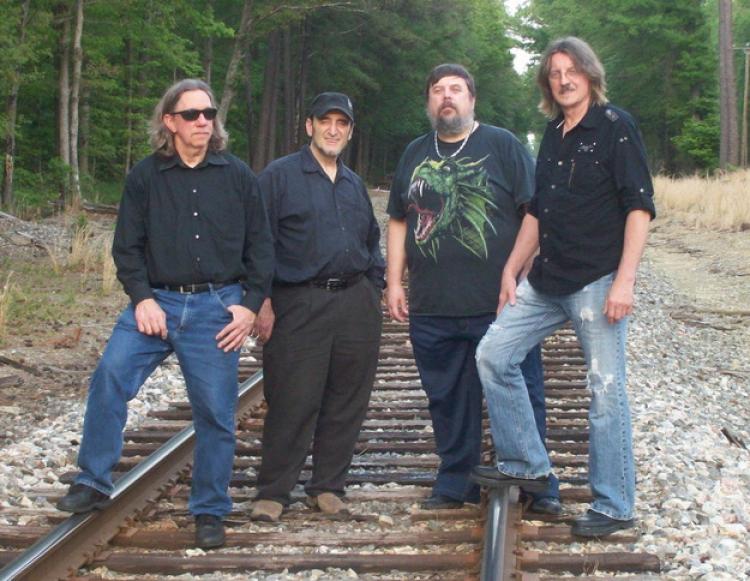
Kinetic Element is taking their second step into the prog rock scene. This “weird” band from the US, whose album -“Travelog”- contains a handful but long tracks, has really taken my mind with its “experimental yet complex music”. The band’s mastermind, composer & vocalist Mike Visaggio opened his heart to Grande Rock and explained all things regarding their new album, the difficulties they face, how they overcame them and so on…
Hi Mike… It’s great to have you on Grande Rock. “Travelog” gave me a hard time at first but after some time and various repeated listens, I finally got into it (or I think I did so!)…
M: Hi Thanos. Thanks for offering to interview Old Mikey. I wish you could tell me what threw you off during the first few listens. And greeting from my guitarist Todd Russell, drummer Michael Murray and bassist Mark Tupko.
First of all, do tell us … why did it take you 6 years to come up with a new album and what happened in the meantime?
M: Man, that is a story. Financial situations in the band, people who came into the band who persuaded me, Todd and Michael to try a different path and go into being a Richmond, Virginia cover band and play the bars, ostensibly to make money for the studio, personality clashes with those members, disagreements about a direction for the prog music. When Tony quit the difficulties began. And we had to let two people go to free ourselves, and that meant trashing some material they were contributing, and start working on a new album, finally, at the end of 2013. It took about eighteen months until April of 2015 to finish it. It was terribly frustrating to watch other bands come out with two to four albums in the same time period.
Did the departure of Tony D’Amato take things a bit backwards? By the way, why did he leave the band?
M: Tony had some changes in his life and his day job that would take him away from the band and so he felt it was best he step aside so we could find someone who would be here for us. Of course, that was another excruciating process and we went through several players who either couldn’t cut it or messed with our heads, one who did very well for us but lived in Nashville and did not think he could join, and one who felt we were not adequate enough as players, to play his more jazz-fusion style compositions. He stuck it out for over two years while we were doing the covers, but finally he too felt it was needful to depart. For a while we had no bassist at all and were playing out with me doing left hand bass on the keyboards. In fact you can see some of that on YouTube.
When did the recordings for “Travelog” start? Did you intentionally take your time so as to have the best result you could have?
M: As I said, it was late in 2013 when Todd and I made the commitment to put our heads together, get some writing done, and for Michael to get committed to breaking out the recording software and learning how to use it. So yes, we did not rush it, and the exhilaration of finally getting a bunch of new material composed and arranged gave way to the somewhat tedious process of learning how to use the software while getting the pieces recorded. It was only when we got offered a couple of real prog gigs for May and June of 2015 that we kind of stepped on the gas pedal to get it into manufacturing so we’d have it in hand when we went to play Orion Studios and New Jersey Proghouse.
How easy was it to find a bass-player like Mark Tupko? Did you wait for the bass-player in order to conclude the recordings in a way?
M: We started the recordings with no bassist and had a commitment from the fellow in Nashville (Jaymi Millard) to do the bass via file sharing, but Mark really came on board as an accident from sharing birthday greetings on Facebook. We had been chatting on and off for a couple of years, and when he told me he’d like to audition, Todd didn’t even want to bother since Jaymi had said he’d play. But something about Mark’s demeanor persuaded me that he should get an audition, and since he lives here in Richmond it was easy to do. So he showed up and played two songs from “Powered by Light” without a mistake and I knew we had us a bass player. By the way, Mark was born in Poland and gives us a bit of an Eastern European flavor on the bottom. He played prog in Poland before coming to America in the mid-90s.
I read that your drummer Michael Murray performed some engineer duties on the album. Did you want to have a first idea of how you wanted things to be musically before you moved on to the actual mixing, production and mastering?
M: Michael was kind of goaded into breaking out the software by the singer we fired, and he began getting the hang of doing the recording process. We started to think maybe we could actually record ourselves like everyone else does nowadays, and we got definite arrangements of all the pieces, put down click tracks, and played to them, and as we did that, the “how” of doing it was replaced by the art of the music. It was almost an evolutionary process and once we realized we could do it, we got all the basic tracks down the way we wanted them, and started talking about the next step. So Michael is the recording engineer for the whole album.
And how did Fred Schendel and Steve Babb (Glass Hammer) handle the album’s mixing & mastering initially? I think they did a great job on the whole. Do you agree?
M: They did a phenomenal job!! And they approached us! I was amazed. I had put it out on Facebook that I was looking for someone in prog to mix, and I communicated with Billy Sherwood, Brett Kull, Matt Brookins and a few others about it and was discussing mostly with Brett how to continue, but Brett really wasn’t impressed with us and I was about to contact Billy again when the Glass Hammer guys contacted me soliciting the job. It turns out that I had not noticed that they had been aware of us for a few years and had some curiosity about the project, and besides, they are Christian brothers, and knowing how Glass Hammer albums sound, I was bursting with excitement at the prospect. So they actually did a little demo mix for us and the improvement on the sound of the drums and bass was so dramatic we agreed to give them the job. We sent files back and forth and they were very understanding and professional about turning the “Travelog” album into a modern-sounding prog record. It was a great pleasure to work with them and start getting to know them.
In comparison to your debut album, this time you didn’t handle the vocals. Why’s that? Did you search for a full-time singer at that time but you didn’t find the apt one? Are you still in search of a vocalist?
M: Well, the truth is that although I can do an adequate job in the studio if I have a lot of help from the engineer, when I get out in front of an audience, playing five keyboards and singing causes me to go off-pitch and become very nasal. This was OK for the cover band aspect where you don’t have the discerning ears of progheads listening, but for a prog album, my guys put their foot down and told me they would neither record nor play out as a prog band with me doing the singing. If you read the reviews of “Powered by Light” you will find the appraisals of my singing lukewarm at best. We looked high and low in Richmond for a singer, but in vain. We needed a “plan B” or there would not be a new album.
How did the cooperation with vocalists Dimetrius LaFavors (Odin’s Court), Michelle Schrotz (Brave) and Mike Florio occur? Did you have in mind to use several singers on the album or it just came about?
M: I met Michelle at a show in January 2014 when Brave and Odin’s Court came to Richmond to do a show. She was semi-interested but told me she could not join another band. Dimetrius fairly well blew my mind with his four-octave range but I knew how busy he was and did not approach him until late in 2014 when we were frankly desperate. Actually I checked with Matt Brookins (OC’s leader) first, and got an OK to contact Dimetrius, who live in the Baltimore area, and we hit it off right away. He really loved the music and was going to join the band and be one of those people who are in more than one band, but the situation in Odin’s Court changed, and he got a different job, and realized he could not continue with us after recording three of the songs. So I called Michelle, who lives in the Fredericksburg area, to persuade her to help us finish, and she agreed to record one song. That left another song! Mike Florio, who is a friend of several years’ standing and has three great solo CDs, and who lives north of New York City, volunteered to help us by singing the remaining piece. So we had to have guest vocalists in order to get the album finished. Needless to say this presents some other problems about playing out live and we will deal with those as we can. Mike and Michelle sang with us at the springtime shows. To answer the last part of the previous question, we are still looking for a singer who lives in or near Richmond so we can play out more often. Although we are not looking very hard because Mike and Michelle are great and willing to help us.
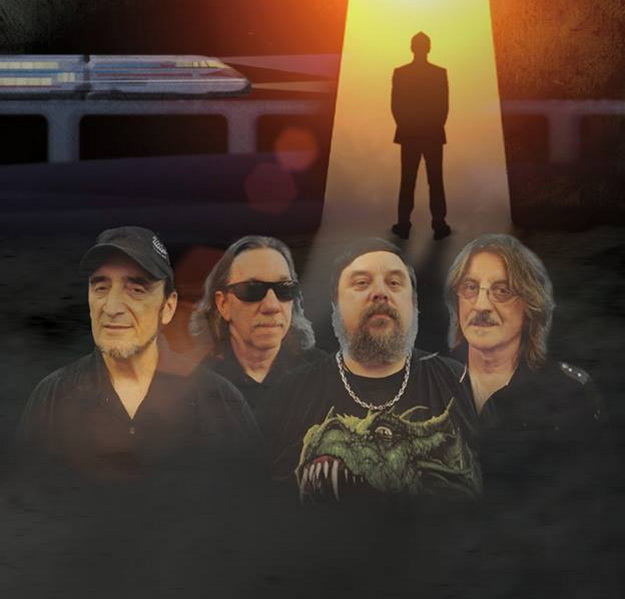
What does the album title “Travelog” declare? And how is it related with the keyhole, the sun & the human figure that we see on the cover artwork?
M: “Travelog” (the album as a whole) is an allegory to an individual's search for liberty after a realization that it is in retreat all over the world. The keyhole is the opportunity to unlock this liberty if only one could find the key. The sun is the light of liberty, the train is a route to that place. There was an old song years ago about getting on a train to freedom and it all just clicked. The artwork, done by the amazing Martin Kornick of Man in the Mountain fame, was something he did as a flash of inspiration when I contacted him back in 2013 about a new logo. Somehow I found the artwork to be very inspiring, and in my mind it represented the very thing the lyrics of “Travelog” communicate. I have become very concerned about situations in the world that I believe threaten the continuance of individual liberty both as an idea and in practice. We tried to convey this in the tone of being an observer who is alarmed but hopeful.
I’d like you to comment on each track…
M: “War Song”: This is a huge and varied piece in several movements that deals lyrically with how people used to feel about liberty, that it was worth any price because it is priceless. It uses several inter-relating musical themes. Todd and I co-wrote this and tried to make sure that all the sections complement one another. It uses some prog/jazz riffs, a Scottish-sounding song, some baroque-era style interplay, some hard rock in 6/8, and a huge orchestral finish that’s kind of “Yes meets Rhapsody in Blue”. It introduces the incredible vocal range of Dimetrius LaFavors.
“Travelog”: Todd's classical guitar piece, employing a revisiting of the lyrics to "America the Beautiful." To me, it is like the realization of what's happening in the world and trying to figure out why. Todd says that's not it, but that is what it says to me and that's why it's the title track. We have a very unusual (for us) instrumental section using flute and choir keyboards, and hand percussion, that created almost a midieval feel for the instrumental part. Dimetrius sings this one also.
“Into the Lair”: I wanted to have something a little heavier, and I had this 5/4 riff, that grew into a piece with some unusual modulations, and a song that deals with the notion that government can fix everything by force of law. It features a fugue that Todd composed out of a crazy unison riff I came up with that burst out into the heavy mellotron choir and 5/4 thing from the beginning of the song. The cacophony of conflict at the end of the piece that encompasses guitar, mini-moog, disjointed bass patterns, Michelle’s wail of despair, the maniacal laughter of the dictator, work together to bring the listener into an awareness of what is afoot in the world. Michelle Schrotz sang this excellently.
“Her”: The other piece Todd wrote. This is an allegory that lyrically compares a totalitarian state to an abusive lover. The victim of the state can’t tear himself away from “he” because “she” lays another benefit on him every time he tries, but “she” squashes his self-determination to get him to submit to “her” will every time. We got several unusual ideas combined here, a jazzy pop song with very tortured yet lilting melody that has, for a foil, a gigantic symphonic-style guitar solo section. This is the song Mike Florio sang.
“Vision of a New Dawn”: The other big epic and it’s my piece. It’s in four movements, a jazz/rock melding of compound harmonies and a succession of different time signatures and moods in the opening section, a more mainstream sounding song section with a few more of those compound chords, a big keyboard/guitar concerto in 5/8 that some have said reminds them of “Cinema Show” by Genesis, and a closing section to reprise the musical feel of the second. The lyrics basically say, if you see what I am seeing in the world, stand up and proclaim that liberty comes first in civil society, Dimetrius’ vocals convey this in a rather exciting fashion!
Which are your personal and the band’s music influences?
M: I make no bones about saying that for me, it is Wakeman, Emerson and Banks, with a host of other great keyboardists from Felix Cavaliere to Steve Winwood to Brian Auger to Patrick Moraz. I learned from them all and although I know their influence can be heard in my playing I strive to make something my own out of it all. Todd is a big Steve Howe and Andres Segovia fan. Michael loves Neal Peart. As for Mark, well I hear a lot of Mike Rutherford in him. So for the band it’s undoubtedly Yes, ELP, early Genesis, Rush, King Crimson, but we like modern bands like Transatlantic, The Flower Kings, Spock’s Beard, Knight Area, IQ and the like.
How would you describe your music style to someone that has never heard of the band before?
M: I think I just did that.
Do you plan to release a lyric or a concept video anytime soon and if yes for which one of the tracks?
M: We have no video plans in the works. We are hoping to get some video from our live show at New Jersey Proghouse out there soon, but we know we need a video and I’m sure we will begin concocting something soon.
Do you believe that 70s inspired prog rock music with long instrumental parts and long tracks in general can still arouse people’s fantasy & interest like it once did? Or music today is more into “plastic cliché popy tracks” for fast TV/radio/web consumption?
M: If we didn’t believe in that kind of music we wouldn’t be doing it! And the audience is still there who loves it. And we know we’re bringing at least a few newbies to the genre. The music coming out today just does not inspire me because it’s about image instead of music, although there are a lot of talented young songwriters. The music industry had to find a way to adjust to the social media phenomenon and I must say, I do not hear the soul in pop music that I think it once had.
Is it kinda of “risky” to release prog rock albums which feature more than 70 minutes of music these days or not?
M: I don’t know that it’s risky at all in our genre. The biggest names in the genre have epic tracks aplenty. But if you’re going to have epics they’d better be great. The wonderful thing about progheads is that they are patient listeners who know that their patience will be rewarded. On the other hand, they won’t put up with a whole lot of “filler” on the whole. We put out two 70-minute albums and we endeavored to give every piece substance and dispense with the fluff.
What are your expectations from “Travelog” and what do you wish to achieve with Kinetic Element in long-term?
M: Expectations? How can anybody have expectations when you’re dealing with something as subjective as “what is prog?”. Aspirations, though, those we have, and our ambition is simple: reach the audience with some quality music and get on a few festivals so we can sell enough product to justify making more records. What else is there? Prog will never make anyone wealthy, but knowing you have touched the hearts of a bunch of other prog lovers is just the sweetest thing I know of.
OK time for our “weird questions”!!! I’d like to know how you came up with the name Kinetic Element in the first place.
M: When I started the project it was via a solo CD called “Starship Universe”. I wanted to perform it, and Michael and bassist Matt Harris joined with me. I was going to call it the Mike Visaggio Trio or something like that, but Michael wasn’t having any of that “it’s his band” stuff, and thought up the name Kinetic Element, which I liked, and we went with it.
What are those things that you do not like in the music industry nowadays?
M: Simple. They put prog on the sidelines instead of working with the old radio model to let big audiences hear it. I can forgive a lot of their practices, and I even understand some exploitation of artists for profit, but the music those business people chose for their drastically altered business model precluded prog artists. If they were more adventurous they’d have prog labels like they have classical and jazz labels. They’d find the audience. Even the millennials I know are fed up with the music coming out.
Which is the most underrated musician of all time?
M: Would you believe it if I said Arthur Brown?
Which are the best 3 prog rock albums of all time according to you?
M: “The Yes Album”, “Tarkus” by ELP and Genesis’ “The Lamb Lies Down on Broadway”.
What does the term “progressive” means for you?
M: Tales of the unexpected. I do not think music has to “progress” in the way that some “prog snobs” do. Rather it has to take you where you haven’t been yet, even if the tools are old school. And it can even take you where you have been if it does so in a way that is generally unfamiliar, so to speak. The main thing is that it be the most heartfelt and emotional music you can make, using the compositional tools of the prog genre to the best of your ability.
Which do you consider to be the best vocalist in prog rock history?
M: Hands down Jon Anderson. He is unique in his originality, style, tone, delivery, artistic approach and ethos.
Which is the record you wish you had written and why?
M: “She Loves You” by the Beatles. I could have retired. Artistically it would be “The Yes Album” because it totally remade my whole perspective on what was possible in a rock group’s music.
Were you obliged to give just one album to extraterrestrials that would represent the whole human music, which album would it be and from which band/artist?
M: I believe I just said “The Yes Album”. That would keep them busy all the way back to the center of the galaxy. I might slip in a disc of Bach or Mozart while they weren’t looking.
Fill in the phrase… “Prog Rock music wouldn’t have evolved the way it did, if it hadn’t been for…”
M: Yes. They are the answer to so many of these questions.
If you could be any historical person, which one would you be and why?
M: George Washington. He was at the center of a vortex of so many confluent events in the course of one lifetime! His must be one of the most incredible lives ever lived.
What would the world be like without religions… can you imagine?
M: It would be much poorer in spirit, in spite of what people have done with it. Mankind needs a connection with the infinite, with the eternal. We are wired for it. I just think the human spirit yearns for its Creator and it suffers when no connection can be made. The mess that fallen human beings have made out of faith is not the fault of God. He’s always there waiting for us to turn back to Him.
Put together the best prog rock line-up. Who plays what?
M: Well. Could it be Jon Anderson, Chris Squire, Rick Wakeman, Alan White and Steve Howe? Mmmmm..... could be!
But for a fantasy line-up... how about Mike Portnoy, Stanley Clarke, Kerry Minnear, Steve Hackett and Peter Gabriel?
Imagine that your girlfriend/wife/life partner is selling your whole album-collection just to buy an expensive ring for herself. How would you react?
M: Imagine I am showing her the door. Thankfully, my better half humors my obsession! And she likes the rings I have bought for her. Lucky me!
I’d like to thank you Mike for taking the time to do this interview. Say anything you feel like saying before we close. Wish you the best for the future… take care!
M: Two things. Prog Lives... it keeps us young. And, liberty is too precious to let it fall without standing up for it. Keep living, keep standing. Much love to all our prog brothers and sisters from all of us in Kinetic Element.
M: Hi Thanos. Thanks for offering to interview Old Mikey. I wish you could tell me what threw you off during the first few listens. And greeting from my guitarist Todd Russell, drummer Michael Murray and bassist Mark Tupko.
First of all, do tell us … why did it take you 6 years to come up with a new album and what happened in the meantime?
M: Man, that is a story. Financial situations in the band, people who came into the band who persuaded me, Todd and Michael to try a different path and go into being a Richmond, Virginia cover band and play the bars, ostensibly to make money for the studio, personality clashes with those members, disagreements about a direction for the prog music. When Tony quit the difficulties began. And we had to let two people go to free ourselves, and that meant trashing some material they were contributing, and start working on a new album, finally, at the end of 2013. It took about eighteen months until April of 2015 to finish it. It was terribly frustrating to watch other bands come out with two to four albums in the same time period.
Did the departure of Tony D’Amato take things a bit backwards? By the way, why did he leave the band?
M: Tony had some changes in his life and his day job that would take him away from the band and so he felt it was best he step aside so we could find someone who would be here for us. Of course, that was another excruciating process and we went through several players who either couldn’t cut it or messed with our heads, one who did very well for us but lived in Nashville and did not think he could join, and one who felt we were not adequate enough as players, to play his more jazz-fusion style compositions. He stuck it out for over two years while we were doing the covers, but finally he too felt it was needful to depart. For a while we had no bassist at all and were playing out with me doing left hand bass on the keyboards. In fact you can see some of that on YouTube.
When did the recordings for “Travelog” start? Did you intentionally take your time so as to have the best result you could have?
M: As I said, it was late in 2013 when Todd and I made the commitment to put our heads together, get some writing done, and for Michael to get committed to breaking out the recording software and learning how to use it. So yes, we did not rush it, and the exhilaration of finally getting a bunch of new material composed and arranged gave way to the somewhat tedious process of learning how to use the software while getting the pieces recorded. It was only when we got offered a couple of real prog gigs for May and June of 2015 that we kind of stepped on the gas pedal to get it into manufacturing so we’d have it in hand when we went to play Orion Studios and New Jersey Proghouse.
How easy was it to find a bass-player like Mark Tupko? Did you wait for the bass-player in order to conclude the recordings in a way?
M: We started the recordings with no bassist and had a commitment from the fellow in Nashville (Jaymi Millard) to do the bass via file sharing, but Mark really came on board as an accident from sharing birthday greetings on Facebook. We had been chatting on and off for a couple of years, and when he told me he’d like to audition, Todd didn’t even want to bother since Jaymi had said he’d play. But something about Mark’s demeanor persuaded me that he should get an audition, and since he lives here in Richmond it was easy to do. So he showed up and played two songs from “Powered by Light” without a mistake and I knew we had us a bass player. By the way, Mark was born in Poland and gives us a bit of an Eastern European flavor on the bottom. He played prog in Poland before coming to America in the mid-90s.
I read that your drummer Michael Murray performed some engineer duties on the album. Did you want to have a first idea of how you wanted things to be musically before you moved on to the actual mixing, production and mastering?
M: Michael was kind of goaded into breaking out the software by the singer we fired, and he began getting the hang of doing the recording process. We started to think maybe we could actually record ourselves like everyone else does nowadays, and we got definite arrangements of all the pieces, put down click tracks, and played to them, and as we did that, the “how” of doing it was replaced by the art of the music. It was almost an evolutionary process and once we realized we could do it, we got all the basic tracks down the way we wanted them, and started talking about the next step. So Michael is the recording engineer for the whole album.
And how did Fred Schendel and Steve Babb (Glass Hammer) handle the album’s mixing & mastering initially? I think they did a great job on the whole. Do you agree?
M: They did a phenomenal job!! And they approached us! I was amazed. I had put it out on Facebook that I was looking for someone in prog to mix, and I communicated with Billy Sherwood, Brett Kull, Matt Brookins and a few others about it and was discussing mostly with Brett how to continue, but Brett really wasn’t impressed with us and I was about to contact Billy again when the Glass Hammer guys contacted me soliciting the job. It turns out that I had not noticed that they had been aware of us for a few years and had some curiosity about the project, and besides, they are Christian brothers, and knowing how Glass Hammer albums sound, I was bursting with excitement at the prospect. So they actually did a little demo mix for us and the improvement on the sound of the drums and bass was so dramatic we agreed to give them the job. We sent files back and forth and they were very understanding and professional about turning the “Travelog” album into a modern-sounding prog record. It was a great pleasure to work with them and start getting to know them.
In comparison to your debut album, this time you didn’t handle the vocals. Why’s that? Did you search for a full-time singer at that time but you didn’t find the apt one? Are you still in search of a vocalist?
M: Well, the truth is that although I can do an adequate job in the studio if I have a lot of help from the engineer, when I get out in front of an audience, playing five keyboards and singing causes me to go off-pitch and become very nasal. This was OK for the cover band aspect where you don’t have the discerning ears of progheads listening, but for a prog album, my guys put their foot down and told me they would neither record nor play out as a prog band with me doing the singing. If you read the reviews of “Powered by Light” you will find the appraisals of my singing lukewarm at best. We looked high and low in Richmond for a singer, but in vain. We needed a “plan B” or there would not be a new album.
How did the cooperation with vocalists Dimetrius LaFavors (Odin’s Court), Michelle Schrotz (Brave) and Mike Florio occur? Did you have in mind to use several singers on the album or it just came about?
M: I met Michelle at a show in January 2014 when Brave and Odin’s Court came to Richmond to do a show. She was semi-interested but told me she could not join another band. Dimetrius fairly well blew my mind with his four-octave range but I knew how busy he was and did not approach him until late in 2014 when we were frankly desperate. Actually I checked with Matt Brookins (OC’s leader) first, and got an OK to contact Dimetrius, who live in the Baltimore area, and we hit it off right away. He really loved the music and was going to join the band and be one of those people who are in more than one band, but the situation in Odin’s Court changed, and he got a different job, and realized he could not continue with us after recording three of the songs. So I called Michelle, who lives in the Fredericksburg area, to persuade her to help us finish, and she agreed to record one song. That left another song! Mike Florio, who is a friend of several years’ standing and has three great solo CDs, and who lives north of New York City, volunteered to help us by singing the remaining piece. So we had to have guest vocalists in order to get the album finished. Needless to say this presents some other problems about playing out live and we will deal with those as we can. Mike and Michelle sang with us at the springtime shows. To answer the last part of the previous question, we are still looking for a singer who lives in or near Richmond so we can play out more often. Although we are not looking very hard because Mike and Michelle are great and willing to help us.
What does the album title “Travelog” declare? And how is it related with the keyhole, the sun & the human figure that we see on the cover artwork?
M: “Travelog” (the album as a whole) is an allegory to an individual's search for liberty after a realization that it is in retreat all over the world. The keyhole is the opportunity to unlock this liberty if only one could find the key. The sun is the light of liberty, the train is a route to that place. There was an old song years ago about getting on a train to freedom and it all just clicked. The artwork, done by the amazing Martin Kornick of Man in the Mountain fame, was something he did as a flash of inspiration when I contacted him back in 2013 about a new logo. Somehow I found the artwork to be very inspiring, and in my mind it represented the very thing the lyrics of “Travelog” communicate. I have become very concerned about situations in the world that I believe threaten the continuance of individual liberty both as an idea and in practice. We tried to convey this in the tone of being an observer who is alarmed but hopeful.
I’d like you to comment on each track…
M: “War Song”: This is a huge and varied piece in several movements that deals lyrically with how people used to feel about liberty, that it was worth any price because it is priceless. It uses several inter-relating musical themes. Todd and I co-wrote this and tried to make sure that all the sections complement one another. It uses some prog/jazz riffs, a Scottish-sounding song, some baroque-era style interplay, some hard rock in 6/8, and a huge orchestral finish that’s kind of “Yes meets Rhapsody in Blue”. It introduces the incredible vocal range of Dimetrius LaFavors.
“Travelog”: Todd's classical guitar piece, employing a revisiting of the lyrics to "America the Beautiful." To me, it is like the realization of what's happening in the world and trying to figure out why. Todd says that's not it, but that is what it says to me and that's why it's the title track. We have a very unusual (for us) instrumental section using flute and choir keyboards, and hand percussion, that created almost a midieval feel for the instrumental part. Dimetrius sings this one also.
“Into the Lair”: I wanted to have something a little heavier, and I had this 5/4 riff, that grew into a piece with some unusual modulations, and a song that deals with the notion that government can fix everything by force of law. It features a fugue that Todd composed out of a crazy unison riff I came up with that burst out into the heavy mellotron choir and 5/4 thing from the beginning of the song. The cacophony of conflict at the end of the piece that encompasses guitar, mini-moog, disjointed bass patterns, Michelle’s wail of despair, the maniacal laughter of the dictator, work together to bring the listener into an awareness of what is afoot in the world. Michelle Schrotz sang this excellently.
“Her”: The other piece Todd wrote. This is an allegory that lyrically compares a totalitarian state to an abusive lover. The victim of the state can’t tear himself away from “he” because “she” lays another benefit on him every time he tries, but “she” squashes his self-determination to get him to submit to “her” will every time. We got several unusual ideas combined here, a jazzy pop song with very tortured yet lilting melody that has, for a foil, a gigantic symphonic-style guitar solo section. This is the song Mike Florio sang.
“Vision of a New Dawn”: The other big epic and it’s my piece. It’s in four movements, a jazz/rock melding of compound harmonies and a succession of different time signatures and moods in the opening section, a more mainstream sounding song section with a few more of those compound chords, a big keyboard/guitar concerto in 5/8 that some have said reminds them of “Cinema Show” by Genesis, and a closing section to reprise the musical feel of the second. The lyrics basically say, if you see what I am seeing in the world, stand up and proclaim that liberty comes first in civil society, Dimetrius’ vocals convey this in a rather exciting fashion!
Which are your personal and the band’s music influences?
M: I make no bones about saying that for me, it is Wakeman, Emerson and Banks, with a host of other great keyboardists from Felix Cavaliere to Steve Winwood to Brian Auger to Patrick Moraz. I learned from them all and although I know their influence can be heard in my playing I strive to make something my own out of it all. Todd is a big Steve Howe and Andres Segovia fan. Michael loves Neal Peart. As for Mark, well I hear a lot of Mike Rutherford in him. So for the band it’s undoubtedly Yes, ELP, early Genesis, Rush, King Crimson, but we like modern bands like Transatlantic, The Flower Kings, Spock’s Beard, Knight Area, IQ and the like.
How would you describe your music style to someone that has never heard of the band before?
M: I think I just did that.
Do you plan to release a lyric or a concept video anytime soon and if yes for which one of the tracks?
M: We have no video plans in the works. We are hoping to get some video from our live show at New Jersey Proghouse out there soon, but we know we need a video and I’m sure we will begin concocting something soon.
Do you believe that 70s inspired prog rock music with long instrumental parts and long tracks in general can still arouse people’s fantasy & interest like it once did? Or music today is more into “plastic cliché popy tracks” for fast TV/radio/web consumption?
M: If we didn’t believe in that kind of music we wouldn’t be doing it! And the audience is still there who loves it. And we know we’re bringing at least a few newbies to the genre. The music coming out today just does not inspire me because it’s about image instead of music, although there are a lot of talented young songwriters. The music industry had to find a way to adjust to the social media phenomenon and I must say, I do not hear the soul in pop music that I think it once had.
Is it kinda of “risky” to release prog rock albums which feature more than 70 minutes of music these days or not?
M: I don’t know that it’s risky at all in our genre. The biggest names in the genre have epic tracks aplenty. But if you’re going to have epics they’d better be great. The wonderful thing about progheads is that they are patient listeners who know that their patience will be rewarded. On the other hand, they won’t put up with a whole lot of “filler” on the whole. We put out two 70-minute albums and we endeavored to give every piece substance and dispense with the fluff.
What are your expectations from “Travelog” and what do you wish to achieve with Kinetic Element in long-term?
M: Expectations? How can anybody have expectations when you’re dealing with something as subjective as “what is prog?”. Aspirations, though, those we have, and our ambition is simple: reach the audience with some quality music and get on a few festivals so we can sell enough product to justify making more records. What else is there? Prog will never make anyone wealthy, but knowing you have touched the hearts of a bunch of other prog lovers is just the sweetest thing I know of.
OK time for our “weird questions”!!! I’d like to know how you came up with the name Kinetic Element in the first place.
M: When I started the project it was via a solo CD called “Starship Universe”. I wanted to perform it, and Michael and bassist Matt Harris joined with me. I was going to call it the Mike Visaggio Trio or something like that, but Michael wasn’t having any of that “it’s his band” stuff, and thought up the name Kinetic Element, which I liked, and we went with it.
What are those things that you do not like in the music industry nowadays?
M: Simple. They put prog on the sidelines instead of working with the old radio model to let big audiences hear it. I can forgive a lot of their practices, and I even understand some exploitation of artists for profit, but the music those business people chose for their drastically altered business model precluded prog artists. If they were more adventurous they’d have prog labels like they have classical and jazz labels. They’d find the audience. Even the millennials I know are fed up with the music coming out.
Which is the most underrated musician of all time?
M: Would you believe it if I said Arthur Brown?
Which are the best 3 prog rock albums of all time according to you?
M: “The Yes Album”, “Tarkus” by ELP and Genesis’ “The Lamb Lies Down on Broadway”.
What does the term “progressive” means for you?
M: Tales of the unexpected. I do not think music has to “progress” in the way that some “prog snobs” do. Rather it has to take you where you haven’t been yet, even if the tools are old school. And it can even take you where you have been if it does so in a way that is generally unfamiliar, so to speak. The main thing is that it be the most heartfelt and emotional music you can make, using the compositional tools of the prog genre to the best of your ability.
Which do you consider to be the best vocalist in prog rock history?
M: Hands down Jon Anderson. He is unique in his originality, style, tone, delivery, artistic approach and ethos.
Which is the record you wish you had written and why?
M: “She Loves You” by the Beatles. I could have retired. Artistically it would be “The Yes Album” because it totally remade my whole perspective on what was possible in a rock group’s music.
Were you obliged to give just one album to extraterrestrials that would represent the whole human music, which album would it be and from which band/artist?
M: I believe I just said “The Yes Album”. That would keep them busy all the way back to the center of the galaxy. I might slip in a disc of Bach or Mozart while they weren’t looking.
Fill in the phrase… “Prog Rock music wouldn’t have evolved the way it did, if it hadn’t been for…”
M: Yes. They are the answer to so many of these questions.
If you could be any historical person, which one would you be and why?
M: George Washington. He was at the center of a vortex of so many confluent events in the course of one lifetime! His must be one of the most incredible lives ever lived.
What would the world be like without religions… can you imagine?
M: It would be much poorer in spirit, in spite of what people have done with it. Mankind needs a connection with the infinite, with the eternal. We are wired for it. I just think the human spirit yearns for its Creator and it suffers when no connection can be made. The mess that fallen human beings have made out of faith is not the fault of God. He’s always there waiting for us to turn back to Him.
Put together the best prog rock line-up. Who plays what?
M: Well. Could it be Jon Anderson, Chris Squire, Rick Wakeman, Alan White and Steve Howe? Mmmmm..... could be!
But for a fantasy line-up... how about Mike Portnoy, Stanley Clarke, Kerry Minnear, Steve Hackett and Peter Gabriel?
Imagine that your girlfriend/wife/life partner is selling your whole album-collection just to buy an expensive ring for herself. How would you react?
M: Imagine I am showing her the door. Thankfully, my better half humors my obsession! And she likes the rings I have bought for her. Lucky me!
I’d like to thank you Mike for taking the time to do this interview. Say anything you feel like saying before we close. Wish you the best for the future… take care!
M: Two things. Prog Lives... it keeps us young. And, liberty is too precious to let it fall without standing up for it. Keep living, keep standing. Much love to all our prog brothers and sisters from all of us in Kinetic Element.