
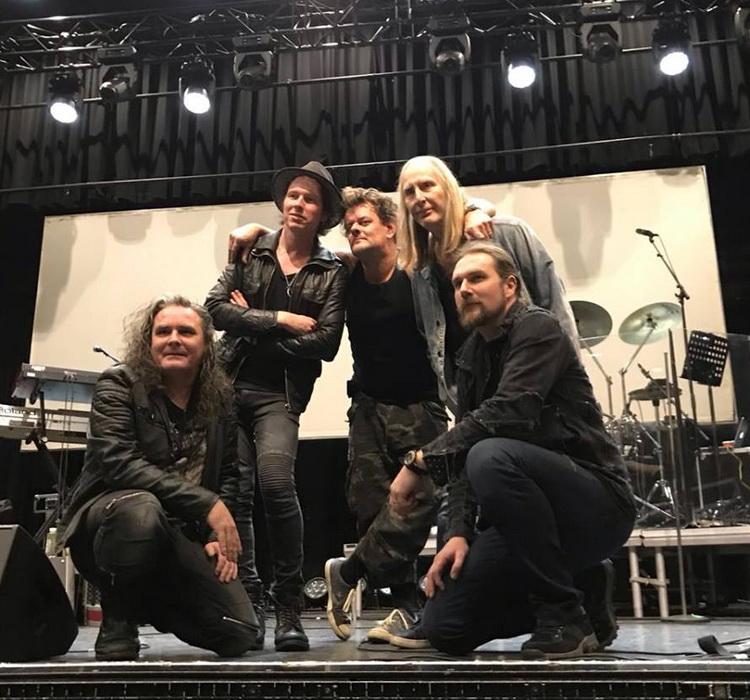
Kayak are back with a new album, a new line-up and a new label. Founding member, composer and keyboardist Ton Scherpenzeel talked to Grande Rock about the new release, all the line-up changes of the recent years and of course the future of the band, among other interesting things. More below…
Hi Ton and welcome to Grande Rock. I’m glad we’re given the chance to talk about your new amazing album “Seventeen”. Undoubtedly it’s one of the best albums of 2018!
T: Thank you. The album has been very well received overall, and of course I am very glad about that.
4 have years have passed since your previous album “Cleopatra – The Crown of Isis”. What happened in the meantime? Were you working on the new tracks or what?
T: Leading up to, during and after the release of Cleopatra we had major band issues, which almost meant the end of Kayak. Two lead vocalists left and the whole personal situation within the band had deteriorated. In fact we had a band within a band and for me that became an unworkable situation.
We (Irene Linders, co-lyricist and me) had been working hard on this ambitious project for 2,5 years, and I was so disappointed about what happened within the band and to project that I felt like stopping completely. Then, after quite some reflection, I decided I could continue the band but only with other band members that were new and positive. Once I made that decision, creativity came back and I wrote the new album in 6 months.
How did the cooperation with new lead vocalist Bart Schwertmann occur and why did you decide to make that change?
T: As I had to look for a whole new band, I concentrated on searching a vocalist first. There are many capable guitar players, drummers and bass players. But the lead vocalist is essential because he sort of represents the whole sound and feel of the songs. If I wouldn’t find a lead vocalist suitable for the job, there would be no new band. Bart was, in fact, the first one who auditioned. I found it hard to believe that my quest for a lead singer would have ended already after the first audition, so tried others. I wasn’t looking for a special sound or type vocalist – but I know that Kayak songs are difficult to sing. Lots of lyrics, unexpected melodies and pretty diverse material ranging from intimate to energetic. You need to have a good technique as well as be able to express the right emotion – not to forget a good stage presence. After having heard many other candidates I listened to his audition and realized that he would be a great singer for Kayak, so I asked if he was still interested, He was, so that was it. Then I focused on looking for the other members.
There’s also a new guitarist, Marcel Singor on board. Likewise what has happened with the drummers? Lean Robbemont played on the album only? You’ve parted ways with (live drummer) Collin Leijenaar and Hans Eijkenaar is back again. Why’s that?
T: As for the drummers: I asked Collin first, but he couldn’t make time for the “Seventeen” album in the period I wanted. So I looked further and found Lean, who then played on the album. But when we wanted to plan a tour, it appeared that Lean’s schedule also did not allow him to do it, so I again asked Collin, who joined us for the concerts. As time went on and we played more and more concerts, we did not feel very comfortable with him. He is a good drummer, but it became clear that his style and approach weren’t really what was needed for Kayak. Then you have to face the facts, and do what is right for the band, so we decided not to continue with him and look for someone else. Lean again wasn’t available (all these drummers seem to be too busy) and I then called Hans Eijkenaar who had been with the band before. Knowing how hectic his working schedule always is I did not even ask him directly and just informed if he perhaps knew a good drummer. Then he said: what do you think about me? I would love to do it. I had already hoped he’d say that. And after rescheduling a few concerts, he appeared to be available. So, now Hans is back and since then the energy level of the whole band has gone up 200%.
As for Marcel, I heard his guitar playing after being introduced to him by our manager Rob Palmen and he instantly blew me away. On top of that he has a very characteristic voice; he can sing lead as well. For variation sake and not to have all pressure on Bart, that’s good.
Tell us about the cooperation with Andy Latimer (electric & acoustic guitars), Izak Boom (banjo & ukulele), Rens Van Der Zalm (fiddle) and Nico Outhuijse (percussion, backing vocals, mixing) on “Seventeen”.
T: Andy Latimer of course I know from Camel, I have done several tours with him and that band since 1984 till 2015. I always admired his incredible emotional playing and while I was writing “Ripples on the Water” I immediately had him in mind. I could hear him play it, even before he did it. This was before the new line up of Kayak was known, it wasn’t even certain then if Kayak would return. I asked Andy, sent him the track and he played his guitar parts. So, now we have him as a guest player on “Seventeen”.
With Izak and Rens I have been working for many years in a totally other genre: cabaret, Dutch songs and musicals. It’s my ‘other’ life. Both of them have a folky back ground and especially Rens plays like 1000 instruments.
Nico Outhuijse, who is also a drummer by the way, has his own studio and had been remixing several Kayak albums in the past, like “Letters from Utopia”. I like his approach. He connects with the music and understands the essentials and layered arrangements. I am not even there when he mixes, he does it on his own. He just sends me MP3s of rough mixes every now and then, and then I answer something like: more bass, or less reverb, that sort of thing. I trust him and as I hate mixing anyway, I am glad this works out so well.
Is Kristoffer Gildenlöw (bass) a permanent member of the band now or not?
T: Yes, I sincerely hope so, but that goes for everyone. Kayak is not a full time profession, for nobody. Everyone needs to do other things, jobs, teaching, and so on. If someone has to give priorities to those things, that’s out of my control and I need to respect that.
I am a bass player too (I even prefer playing bass to keyboards) and as I was writing and recording the new songs, I played the bass on the demos and kept most of it. But then I had to look for a bass player for the live shows, and came across Kristoffer who is phenomenal and especially on fretless. So, I asked him for the song “Cracks”and he played most of it on fretless, which he does so precise and well that it’s almost impossible to hear whether it’s fretless or fretted bass. Having heard that, I asked him if he would join the band.
After all those line-up changes and since you’re the only founding member of the band can you say that this is a “new era” for Kayak?
T: We have had many lineup changes; I think we had over 21 band members now. We’re back to a five piece since a very long time (we had been with 6 or 7 from 1979) and have no female singers this time. That feels different. On stage it certainly does, we have to fill some gaps on the arrangements.
Many people refer to our early seventies period when commenting on “Seventeen”, which I do not really understand but OK, it is how they feel it, so there must be something that makes them think so. The new album seems to echo some of that early energy and spirit, and I see that as a great compliment, after 45 years of playing in Kayak. Funny, how that works. For me it is not so much a new era but a logical next step, a new development, while some other people hear the past in what we do. But it is certainly a different band, inside and outward, compared to the last line up.
Which are the similarities and the differences among the new album and your previous releases?
T: As I said, to me it is a logical next step, and especially as far as my songwriting concerns, a further development. I believe that almost every song on every album of the past could be placed on other albums without problems; even tracks from the rock operas would be fine on other albums. Some may sound different because of the production or the lead vocals but it is still Kayak, in all its diversity from “The Secret Study” to “Most Underrated Band in the World”. I see every thing that we recorded and made as one whole work, one journey, and one organism. It is like a tree, with all these year rings. All the year rings are different, but together they make one tree.
What has changed in your songwriting formula or the way you approached the songs this time?
T:
There is no formula; I always try to avoid that because there is a big risk of repeating yourself, especially after so many years and so many songs. That’s the hard part and almost a paradox: it is as if you have to learn to sound spontaneous. I know that some songs have the same sort of build-up, basic arrangement, but well, that’s my trademark and it works for my songs. Do you ask a trumpet player to sound like a violin? No. As long as I don’t literally repeat my own melodies, that’s the most important thing.
Two things did change throughout the years: first it is the fact that in the early years, so till 1980, I used to write the music first, and then the lyrics. There could be a phrase, a few words, or a title, that would help, but usually the lyrics always came after the music. That has changed, both are possible. Now I often have only half of the song ready and think about a title, or the lyrics, and let me be inspired by that. Then the song is shaped in a different way.
Second, it is the computer. I can write and record the whole arrangement without anybody else. What I have recorded on synths and samplers will usually be replaced by the real thing, to make it sound more like a band and more real, but it really helps while you’re writing. In the seventies I only had my piano, and maybe a 4 track cassette recorder and one extra keyboard, no drum machines. I cannot imagine anymore how I did that, remembered all those ideas and then turned it into whole songs and albums with a whole band. It was much more exciting because you didn’t really know what was going to happen until you went into the studio. Now, it is pre-produced, pre-arranged and many tracks are added in everyone’s home recording studio. What I like is that with the computer I can also easily save half-baked ideas for later, and after several years have another listen and decide to use it for this or that, or throw it away.
You’ve signed to InsideOut Music. How important is it for you to work with a big label?
T: Exposure, exposure and exposure. I think we have reached a wider audience because of that: more reviews, more interviews, and more countries where the album is available. It’s not enough yet, but certainly better than before when we released the albums ourselves.
Is there any other meaning behind the title “Seventeen”, apart from being your seventeen studio release?
T: No, it’s what it is, but it was also triggered by the release of the Complete works Box by Universal in May 2017 that featured the 16 studio albums, as well as an empty space for “Seventeen” that still had to be released then. Originally “Seventeen” was also planned as a release in 2017 (on October 17th to be precise) to make that number even more special. But when we could sign with InsideOut Music, it appeared to be better to postpone the release till the beginning of 2018 for promotional reasons so the title lost some of its meaning. But the next one will not be called “Eighteen”. Too easy.
You did the album’s production and you’ve also worked with Patrick Drabe and Nico Outhuijse, during the recordings. Has the final outcome lived up to your expectations?
T: Patrick was involved with the drum recording only. After the recordings and overdubs were done, I asked Nico to mix the album. I knew him and trusted him, as I said I dislike mixing, I always get depressed along the way and lose my drive. Pim Koopman co-founder, composer and drummer of the band died in 2009, he always loved mixing. That’s where the fun for him started. But I need someone else to do that so I only have to give basic comments and suggest adjustments when it’s about 80% ready. And yes, he made it sound great and put a lot of effort in it. Mixing Kayak isn’t easy with all those layers, different sections and dynamics.
What are your touring plans 2019?
T: We’ll be playing till mid-May, mostly in Holland but we’ll pop over to England for two shows in April, Brexit or not Brexit. That’s the first time in 42 years we’ll be doing concerts over there, so that is pretty exciting. I live in Greece from May to October and usually do a lot of writing there. Then maybe in the late autumn we may do some concerts outside Holland, like Germany and Poland and whoever wants us. But we will also have to concentrate on recording a new album.
What are your expectations from “Seventeen” and what do you wish to achieve with Kayak over the next years?
T: It’s been out for some time now, and as I had hoped for the response to the album was great. We even made it to the Dutch top-10, which had not happened since 1980. In general I hope it will bring Kayak more international recognition. We have always been a band that mainly played and worked in the Netherlands, and only had the odd gig in the rest of Europe every now and then. Holland is fine, but too small for bands like us, as the market for our kind of music is already niche. We need to go abroad. I never understood why we didn’t more often. Maybe it was the money, management, the promoters, I don’t know. I believe we had and have the qualities to bring a strong performance and good songs so I hope this time around we will make more people aware of our music. That’s our, and certainly my goal.
Time for our “weird questions”!!! How did you come up with the name Kayak initially?
T: It was simply one of the names on our list but we couldn’t make up our minds and it was written on a demo tape provisionally just to have a name on it. Then someone suggested it was a palindrome and a logo was made, so we decided to keep it as it was easy to remember and visually attractive. And in hindsight: kayaks do go under but never sink. But we didn’t know back then how appropriate the name would turn out to be in the band’s career.
What is the first thing that comes to mind when you hear the words:
T: Rockstar: Cliché.. Spinal Tap.
Prog Rock: 45 years playing the same stuff and still call it progressive?
Sci-fi: Hmm…
Eurovision: Hmm too. Get that orchestra back.
Music Realities: Do not start a music career for the money, unless you’re a manager or lawyer.
Which music kind can’t you bear to listen to at all?
T: Bad music. There’s only good music and bad music, as Zappa once said. It’s easy to name house or hip-hop because of my age and education, and generally I do find it very boring to listen to, but I guess I must be missing something.
Is there a particular book you can’t recommend enough?
T: I recently read “Sapiens” and “Homo Deus” (two books) by Yuval Noah Harari, a sort of mix of science and history. About the past and future of mankind. Fascinating and well written, very understandable for non-scientists like me.
Fill in the phrase… “Prog Rock wouldn’t have evolved the way it did, if it hadn’t been for…”
T: Yes, possibly. But that’s mainly because they influenced me in the early 70s.
Which are the best 3 Prog Rock albums of all time according to you?
T: I do not listen to prog rock much, sorry. I hadn’t even heard any Genesis stuff when we started in the early 70s, although everyone said we sounded like them (because of the vocals, probably). For me the essential prog one was the “Yes” album. After “Tales” I got lost. I couldn’t name the three best ones because I don’t know enough albums to choose from.
Who is the sexiest female Rock Star of all time?
T: That’s a hard one…
Which do you consider to be the best female & male vocalist in rock history?
T: They’re both called Wilson, isn’t that remarkable?! Carl (Beach Boys) and Ann (Heart).
Which is the record you wish you had written and why?
T: It is one of the questions that I am being asked a lot in interviews for some reason. Financially, well, then I would have liked having written “Thriller”. Or Abba’s “Greatest Hits”, or “White Christmas”, even better. Artistically, perhaps “Revolver” or “Pet Sounds” just because they are among my favourite albums, and who wouldn’t like to write his own favourite album? I wish I could write a proper classical piece though. Compared to the big composers I feel like a child with his first box of toys to accomplished architects.
If you had the chance to travel in time… where would you choose to go? To the past or the future and why?
T: Providing I could get back: I’d prefer the past, around 1500-1600 or so. Europe was sort of waking up, discovering this and that and there was brilliant music around and, more importantly, yet to come and I’d already know it! But I’d rather skip dying of the Plague or being interrogated by the Inquisition, please. If that has to be the case, I’d then opt for the future and hopefully laugh about what’s happening in this day and age.
Were you obliged to give just one album to extraterrestrials that would represent the whole human music, which album would it be and from which band/artist?
T: That has to be a Kayak album of course. No, just joking. Bach’s “Hohe Messe”. It doesn’t get much better in this universe than that and if these ET’s do not appreciate it, they still have a long way to go. Sorry, no prog rock.
That’s all for now Ton! Thank you very much for taking the time to do this interview. Wish you the best for the future to come. Take care dude!
T: Thanks, my pleasure.
T: Thank you. The album has been very well received overall, and of course I am very glad about that.
4 have years have passed since your previous album “Cleopatra – The Crown of Isis”. What happened in the meantime? Were you working on the new tracks or what?
T: Leading up to, during and after the release of Cleopatra we had major band issues, which almost meant the end of Kayak. Two lead vocalists left and the whole personal situation within the band had deteriorated. In fact we had a band within a band and for me that became an unworkable situation.
We (Irene Linders, co-lyricist and me) had been working hard on this ambitious project for 2,5 years, and I was so disappointed about what happened within the band and to project that I felt like stopping completely. Then, after quite some reflection, I decided I could continue the band but only with other band members that were new and positive. Once I made that decision, creativity came back and I wrote the new album in 6 months.
How did the cooperation with new lead vocalist Bart Schwertmann occur and why did you decide to make that change?
T: As I had to look for a whole new band, I concentrated on searching a vocalist first. There are many capable guitar players, drummers and bass players. But the lead vocalist is essential because he sort of represents the whole sound and feel of the songs. If I wouldn’t find a lead vocalist suitable for the job, there would be no new band. Bart was, in fact, the first one who auditioned. I found it hard to believe that my quest for a lead singer would have ended already after the first audition, so tried others. I wasn’t looking for a special sound or type vocalist – but I know that Kayak songs are difficult to sing. Lots of lyrics, unexpected melodies and pretty diverse material ranging from intimate to energetic. You need to have a good technique as well as be able to express the right emotion – not to forget a good stage presence. After having heard many other candidates I listened to his audition and realized that he would be a great singer for Kayak, so I asked if he was still interested, He was, so that was it. Then I focused on looking for the other members.
There’s also a new guitarist, Marcel Singor on board. Likewise what has happened with the drummers? Lean Robbemont played on the album only? You’ve parted ways with (live drummer) Collin Leijenaar and Hans Eijkenaar is back again. Why’s that?
T: As for the drummers: I asked Collin first, but he couldn’t make time for the “Seventeen” album in the period I wanted. So I looked further and found Lean, who then played on the album. But when we wanted to plan a tour, it appeared that Lean’s schedule also did not allow him to do it, so I again asked Collin, who joined us for the concerts. As time went on and we played more and more concerts, we did not feel very comfortable with him. He is a good drummer, but it became clear that his style and approach weren’t really what was needed for Kayak. Then you have to face the facts, and do what is right for the band, so we decided not to continue with him and look for someone else. Lean again wasn’t available (all these drummers seem to be too busy) and I then called Hans Eijkenaar who had been with the band before. Knowing how hectic his working schedule always is I did not even ask him directly and just informed if he perhaps knew a good drummer. Then he said: what do you think about me? I would love to do it. I had already hoped he’d say that. And after rescheduling a few concerts, he appeared to be available. So, now Hans is back and since then the energy level of the whole band has gone up 200%.
As for Marcel, I heard his guitar playing after being introduced to him by our manager Rob Palmen and he instantly blew me away. On top of that he has a very characteristic voice; he can sing lead as well. For variation sake and not to have all pressure on Bart, that’s good.
Tell us about the cooperation with Andy Latimer (electric & acoustic guitars), Izak Boom (banjo & ukulele), Rens Van Der Zalm (fiddle) and Nico Outhuijse (percussion, backing vocals, mixing) on “Seventeen”.
T: Andy Latimer of course I know from Camel, I have done several tours with him and that band since 1984 till 2015. I always admired his incredible emotional playing and while I was writing “Ripples on the Water” I immediately had him in mind. I could hear him play it, even before he did it. This was before the new line up of Kayak was known, it wasn’t even certain then if Kayak would return. I asked Andy, sent him the track and he played his guitar parts. So, now we have him as a guest player on “Seventeen”.
With Izak and Rens I have been working for many years in a totally other genre: cabaret, Dutch songs and musicals. It’s my ‘other’ life. Both of them have a folky back ground and especially Rens plays like 1000 instruments.
Nico Outhuijse, who is also a drummer by the way, has his own studio and had been remixing several Kayak albums in the past, like “Letters from Utopia”. I like his approach. He connects with the music and understands the essentials and layered arrangements. I am not even there when he mixes, he does it on his own. He just sends me MP3s of rough mixes every now and then, and then I answer something like: more bass, or less reverb, that sort of thing. I trust him and as I hate mixing anyway, I am glad this works out so well.
Is Kristoffer Gildenlöw (bass) a permanent member of the band now or not?
T: Yes, I sincerely hope so, but that goes for everyone. Kayak is not a full time profession, for nobody. Everyone needs to do other things, jobs, teaching, and so on. If someone has to give priorities to those things, that’s out of my control and I need to respect that.
I am a bass player too (I even prefer playing bass to keyboards) and as I was writing and recording the new songs, I played the bass on the demos and kept most of it. But then I had to look for a bass player for the live shows, and came across Kristoffer who is phenomenal and especially on fretless. So, I asked him for the song “Cracks”and he played most of it on fretless, which he does so precise and well that it’s almost impossible to hear whether it’s fretless or fretted bass. Having heard that, I asked him if he would join the band.
After all those line-up changes and since you’re the only founding member of the band can you say that this is a “new era” for Kayak?
T: We have had many lineup changes; I think we had over 21 band members now. We’re back to a five piece since a very long time (we had been with 6 or 7 from 1979) and have no female singers this time. That feels different. On stage it certainly does, we have to fill some gaps on the arrangements.
Many people refer to our early seventies period when commenting on “Seventeen”, which I do not really understand but OK, it is how they feel it, so there must be something that makes them think so. The new album seems to echo some of that early energy and spirit, and I see that as a great compliment, after 45 years of playing in Kayak. Funny, how that works. For me it is not so much a new era but a logical next step, a new development, while some other people hear the past in what we do. But it is certainly a different band, inside and outward, compared to the last line up.
Which are the similarities and the differences among the new album and your previous releases?
T: As I said, to me it is a logical next step, and especially as far as my songwriting concerns, a further development. I believe that almost every song on every album of the past could be placed on other albums without problems; even tracks from the rock operas would be fine on other albums. Some may sound different because of the production or the lead vocals but it is still Kayak, in all its diversity from “The Secret Study” to “Most Underrated Band in the World”. I see every thing that we recorded and made as one whole work, one journey, and one organism. It is like a tree, with all these year rings. All the year rings are different, but together they make one tree.
What has changed in your songwriting formula or the way you approached the songs this time?
T:
There is no formula; I always try to avoid that because there is a big risk of repeating yourself, especially after so many years and so many songs. That’s the hard part and almost a paradox: it is as if you have to learn to sound spontaneous. I know that some songs have the same sort of build-up, basic arrangement, but well, that’s my trademark and it works for my songs. Do you ask a trumpet player to sound like a violin? No. As long as I don’t literally repeat my own melodies, that’s the most important thing.
Two things did change throughout the years: first it is the fact that in the early years, so till 1980, I used to write the music first, and then the lyrics. There could be a phrase, a few words, or a title, that would help, but usually the lyrics always came after the music. That has changed, both are possible. Now I often have only half of the song ready and think about a title, or the lyrics, and let me be inspired by that. Then the song is shaped in a different way.
Second, it is the computer. I can write and record the whole arrangement without anybody else. What I have recorded on synths and samplers will usually be replaced by the real thing, to make it sound more like a band and more real, but it really helps while you’re writing. In the seventies I only had my piano, and maybe a 4 track cassette recorder and one extra keyboard, no drum machines. I cannot imagine anymore how I did that, remembered all those ideas and then turned it into whole songs and albums with a whole band. It was much more exciting because you didn’t really know what was going to happen until you went into the studio. Now, it is pre-produced, pre-arranged and many tracks are added in everyone’s home recording studio. What I like is that with the computer I can also easily save half-baked ideas for later, and after several years have another listen and decide to use it for this or that, or throw it away.
You’ve signed to InsideOut Music. How important is it for you to work with a big label?
T: Exposure, exposure and exposure. I think we have reached a wider audience because of that: more reviews, more interviews, and more countries where the album is available. It’s not enough yet, but certainly better than before when we released the albums ourselves.
Is there any other meaning behind the title “Seventeen”, apart from being your seventeen studio release?
T: No, it’s what it is, but it was also triggered by the release of the Complete works Box by Universal in May 2017 that featured the 16 studio albums, as well as an empty space for “Seventeen” that still had to be released then. Originally “Seventeen” was also planned as a release in 2017 (on October 17th to be precise) to make that number even more special. But when we could sign with InsideOut Music, it appeared to be better to postpone the release till the beginning of 2018 for promotional reasons so the title lost some of its meaning. But the next one will not be called “Eighteen”. Too easy.
You did the album’s production and you’ve also worked with Patrick Drabe and Nico Outhuijse, during the recordings. Has the final outcome lived up to your expectations?
T: Patrick was involved with the drum recording only. After the recordings and overdubs were done, I asked Nico to mix the album. I knew him and trusted him, as I said I dislike mixing, I always get depressed along the way and lose my drive. Pim Koopman co-founder, composer and drummer of the band died in 2009, he always loved mixing. That’s where the fun for him started. But I need someone else to do that so I only have to give basic comments and suggest adjustments when it’s about 80% ready. And yes, he made it sound great and put a lot of effort in it. Mixing Kayak isn’t easy with all those layers, different sections and dynamics.
What are your touring plans 2019?
T: We’ll be playing till mid-May, mostly in Holland but we’ll pop over to England for two shows in April, Brexit or not Brexit. That’s the first time in 42 years we’ll be doing concerts over there, so that is pretty exciting. I live in Greece from May to October and usually do a lot of writing there. Then maybe in the late autumn we may do some concerts outside Holland, like Germany and Poland and whoever wants us. But we will also have to concentrate on recording a new album.
What are your expectations from “Seventeen” and what do you wish to achieve with Kayak over the next years?
T: It’s been out for some time now, and as I had hoped for the response to the album was great. We even made it to the Dutch top-10, which had not happened since 1980. In general I hope it will bring Kayak more international recognition. We have always been a band that mainly played and worked in the Netherlands, and only had the odd gig in the rest of Europe every now and then. Holland is fine, but too small for bands like us, as the market for our kind of music is already niche. We need to go abroad. I never understood why we didn’t more often. Maybe it was the money, management, the promoters, I don’t know. I believe we had and have the qualities to bring a strong performance and good songs so I hope this time around we will make more people aware of our music. That’s our, and certainly my goal.
Time for our “weird questions”!!! How did you come up with the name Kayak initially?
T: It was simply one of the names on our list but we couldn’t make up our minds and it was written on a demo tape provisionally just to have a name on it. Then someone suggested it was a palindrome and a logo was made, so we decided to keep it as it was easy to remember and visually attractive. And in hindsight: kayaks do go under but never sink. But we didn’t know back then how appropriate the name would turn out to be in the band’s career.
What is the first thing that comes to mind when you hear the words:
T: Rockstar: Cliché.. Spinal Tap.
Prog Rock: 45 years playing the same stuff and still call it progressive?
Sci-fi: Hmm…
Eurovision: Hmm too. Get that orchestra back.
Music Realities: Do not start a music career for the money, unless you’re a manager or lawyer.
Which music kind can’t you bear to listen to at all?
T: Bad music. There’s only good music and bad music, as Zappa once said. It’s easy to name house or hip-hop because of my age and education, and generally I do find it very boring to listen to, but I guess I must be missing something.
Is there a particular book you can’t recommend enough?
T: I recently read “Sapiens” and “Homo Deus” (two books) by Yuval Noah Harari, a sort of mix of science and history. About the past and future of mankind. Fascinating and well written, very understandable for non-scientists like me.
Fill in the phrase… “Prog Rock wouldn’t have evolved the way it did, if it hadn’t been for…”
T: Yes, possibly. But that’s mainly because they influenced me in the early 70s.
Which are the best 3 Prog Rock albums of all time according to you?
T: I do not listen to prog rock much, sorry. I hadn’t even heard any Genesis stuff when we started in the early 70s, although everyone said we sounded like them (because of the vocals, probably). For me the essential prog one was the “Yes” album. After “Tales” I got lost. I couldn’t name the three best ones because I don’t know enough albums to choose from.
Who is the sexiest female Rock Star of all time?
T: That’s a hard one…
Which do you consider to be the best female & male vocalist in rock history?
T: They’re both called Wilson, isn’t that remarkable?! Carl (Beach Boys) and Ann (Heart).
Which is the record you wish you had written and why?
T: It is one of the questions that I am being asked a lot in interviews for some reason. Financially, well, then I would have liked having written “Thriller”. Or Abba’s “Greatest Hits”, or “White Christmas”, even better. Artistically, perhaps “Revolver” or “Pet Sounds” just because they are among my favourite albums, and who wouldn’t like to write his own favourite album? I wish I could write a proper classical piece though. Compared to the big composers I feel like a child with his first box of toys to accomplished architects.
If you had the chance to travel in time… where would you choose to go? To the past or the future and why?
T: Providing I could get back: I’d prefer the past, around 1500-1600 or so. Europe was sort of waking up, discovering this and that and there was brilliant music around and, more importantly, yet to come and I’d already know it! But I’d rather skip dying of the Plague or being interrogated by the Inquisition, please. If that has to be the case, I’d then opt for the future and hopefully laugh about what’s happening in this day and age.
Were you obliged to give just one album to extraterrestrials that would represent the whole human music, which album would it be and from which band/artist?
T: That has to be a Kayak album of course. No, just joking. Bach’s “Hohe Messe”. It doesn’t get much better in this universe than that and if these ET’s do not appreciate it, they still have a long way to go. Sorry, no prog rock.
That’s all for now Ton! Thank you very much for taking the time to do this interview. Wish you the best for the future to come. Take care dude!
T: Thanks, my pleasure.