
Exovex is the brainchild of the composer, producer and multi-instrumentalist Dale Simmons. Dale’s project has just released its debut album which is influenced by the 70s & 80s atmospheric prog rock music. Grande Rock conducted a very interesting interview with the mastermind Dale so as to learn every little thing about this up-and-coming new prog rock project…
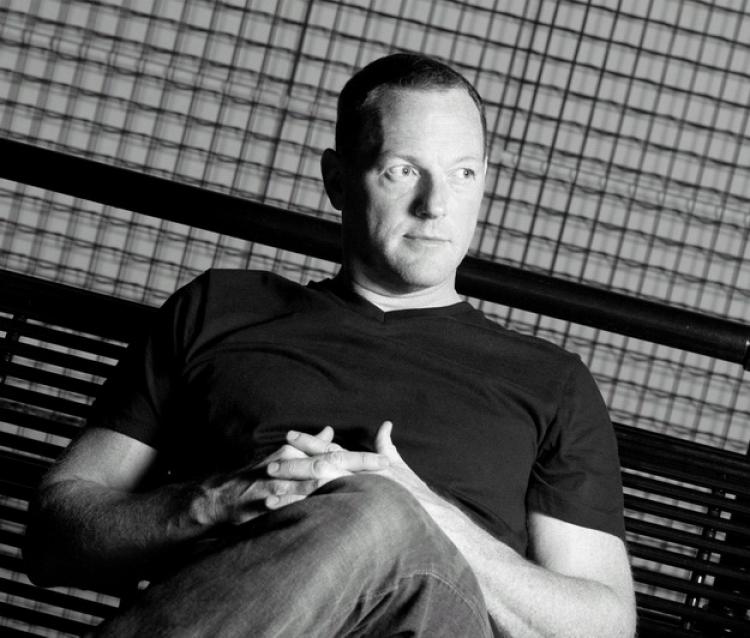
Hi Dale, welcome to Grande Rock. Please tell us when and under which circumstances the band, Exovex, took shape.
D: Sure… and thanks for the warm welcome. Exovex has been evolving for a long time, but the idea really began to take shape about three years ago. For the better part of my songwriting life I’ve written songs that fit the persona of whichever band I was in at the time. That approach is a bit limiting because I had to write music that the band could pull off in a live setting. Exovex is a departure from that mindset. I view songwriting these days more like painting a picture. Things develop naturally and freely without concerns for how I would perform the song live. It’s very liberating artistically.
How did you come up with the name Exovex?
D: The idea of “the known creative variable” is central to Exovex. In mathematics, a function can be defined as “f(x)”... pronounced “f of x”. So, when you put a number through that function, the same things happens to it because the function is what it is… like a logarithm. If the functional is undefined “x”, then the expression would be written as “x(x)” (pronounced “x of x”… or phonetically “Exovex”) and although you know something is going to happen, you have no idea what that something will be. It represents the “unknown creative variable”.
Can Exovex be regarded as a “real” band or is it your personal project?
D: Exovex is an evolving idea. Today is a solo project. I’ll be opening auditions soon to begin putting together a live band. Ideally, there would be several different versions of the live band, but I’m still developing this idea.
How did the cooperation with the famous drummers Josh Freese (NIN, A Perfect Circle, Devo, The Vandals), Keith Carlock (Toto, Steely Dan, Sting, The Blues Brothers Band, John Mayer) & Gavin Harrison (Porcupine Tree, King Crimson) and the well-known keyboardist Richard Barbieri (Porcupine Tree) come about?
D: It started with Gavin Harrison. I’d written a song and wanted the same drum sound for it that I heard on Porcupine Tree’s “Deadwing”… as the drums on that record are stunning. After a little investigation, I learned that Gavin recorded his own tracks for that album in his personal studio in London. So, I wrote him a letter explaining myself with a link for him to download a demo of the song to review and asked him if he would work with me. He agreed and then delivered a stellar performance in a relatively short period of time. He is a consummate professional and a real pleasure to work with. He tracked “Daylight” in his studio on the same kit that he used on “Deadwing” and “Fear of a Blank Planet”.
After that, I did my homework on drummers that I thought would stylistically fit well with each track and then contacted each of them the same way I did with Gavin. The more aggressive rock tracks went to Josh Freese, who excels in that area and the more ballad-like melodic tracks (“Stolen Wings” and “Metamorph”) really suited Keith Carlock. In reality any of them could have obviously knocked-out the whole album flawlessly, but I was having a really great time collaborating with them all. They are all true professionals in every way.
Regarding Richard Barbieri… I think Richard is amazing. His solo work is really incredible. Textures were really important to me on this project… it is an overarching goal that I reach for on every track. Richard is a textural genius which is why I reached out to him. Our collaboration on “Stolen Wings” was probably the most satisfying engagement on the project. There was a lot of back and forth between us on how and why the melodic elements should be developed. My connection with him was developed the same as the other guys… a letter, a link to the demo and several conversations. I can’t wait to work with Richard again on the next record.
Was it crucial for you to cooperate with some celebrated musicians on your first Exovex album? Does it have to do with the musicians’ performances as well as the promotional exposure that such names can offer a newcomer like Exovex?
D: My grandfather taught me how to play guitar when I was very young. He hammered home to me, even at that young age, that if I really wanted to become a good musician then I would need to play with great drummers. If I translate his idea into music production terms, it would sound something like “the quality of the drummer’s performance is critical to the overall perception of the quality of the music”.
It was not crucial for me to use celebrated musicians, but it was crucial for me to align myself with the best musicians possible if I wanted to fully realize the vision I had for the album. Being associated with these musicians certainly doesn’t hurt the visibility of the album, but it was not my primary motivation in approaching them to contribute to “Radio Silence”. Their performances on the album speak for themselves… my grandfather was right.
How different would the final outcome have been if it weren’t for these famous musicians? Did they add something extra to your compositions with their performances or not?
D: I think they absolutely added something with their performances… as I hoped they would... as every artist does. That being said, if that artist had been a complete unknown (like me) does that mean they would not have added something just as significant? I think not. Their fame isn’t what contributed to album, their artistry and professionalism contributed to the album. Fame and celebrity are just a trick of the mind.
Will the cooperation with some or all of them continue on the next Exovex albums too?
D: I think so, although I am always looking for the right person for the track, so it depends on the compositions.
Given the chance, do you work on a new album as we speak? Do you plan to release it before or after the end of 2015?
D: I am working on a new album called “Venus Anomaly”. The songwriting is about half way complete, but I have a long way to go. At this point, I alone am the songwriter, lyrist, singer, guitar player, bass player, keyboardist, recording engineer, guitar tech, studio manager, musician coordinator, bank and record company for the Exovex project. That’s a lot of hats to wear and the way I work is pretty psychotic. I never know who is going to wake up in the morning... the bass player, guitar player or singer etc. A successful launch of the “Radio Silence” is the best way for “Venus Anomaly” to see the light of day this year. Assuming that happens, it’s not out of the question. (i.n.: Swell! Looking forward to the new album…)
Back to your debut… what does “Radio Silence” declare?
D: In its most simple form, it declares that there is no geographic cure for not knowing yourself. The central theme of the album focuses on the downward spiral and ultimate demise of a man due to the psychological and physical effects of a long term, self-imposed isolation.
Does the cover with the space and the space antennas have to do with the “silence” in our solar system etc.?
D: No, not really… it’s actually a reference to the main character in the concept storyline. He has moved beyond reach.
Tell us a few things about each track…
D: The songs on the album are a sequence of events written in first person, which document one man’s wants, dreams, detachment, regrets and eventual mental deterioration. They are snapshots in time that speak to personal circumstances that drive us to make life-changing decisions... both good and bad. There’s a short story that goes along with the album and I’ve included some of the storyline context for each of the tracks below.
“Stolen Wings”: You are free to choose, but you have a time limit. If you don’t make the decision, it will be made for you. One side will lose. This is the natural order and not something that can be avoided. The choice you make is something that you must live through. It must be survived.
“Metamorph”: Some changes occur in people in such seemingly small and insignificant ways that they are barely perceptible to those around them. Entire lives are lived inside dreams and desires that never see the light of day. They grow stronger in silence and frustration little by little year after year until the dreamer is encased in a chrysalis of distance, detachment and desperation. They become a metamorph… waiting for something… waiting to emerge.
“Seeker’s Prayer”: Once the decision is made… own it. If you get lost (and you will)… embrace the empty distance. Embrace the void because there is no other way back and there are no guarantees of a safe return. I am alone on this path.
“The Last Orbit”: When you have everything, you have everything to lose. When the once desired becomes mundane it’s easy to find yourself coming full circle… waiting for something else. There is no geographical or external cure for this. The resolution comes when you realize that all you have to lose… is everything.
“Dead Reckoning”: When everything is lost… what’s left? The truth can be difficult to accept and denial accelerates the downward spiral. My situation is deteriorating in the face of an undeniable truth… no possibility of a return. As paranoia, mental exhaustion and chemical dependencies begin to take over, it becomes easier to navigate the space between tangible and intangible.
“Daylight (Silent Key)”: Artificial zeitgebers sustain circadian rhythms as I descend. I am set adrift, marooned in a dark, narcotic ocean. Hope is now nothing but a shallow breath echoing through the thinning air. And then… there was nothing.
Where did the recordings take place and who mixed, produced and mastered the album? I have to say that the production is top-notch!
D: I produced the album and recorded most of the tracks in my studio (Innerlogue), so that’s all acoustic and electric guitars, bass, keyboards and vocals. I met Keith in Nashville, TN at producer Michel Whittaker’s studio to track his drums. =Josh Freese’s drums were recorded by Andy Carpenter in Los Angeles, CA and both Gavin Harrison and Richard Barbieri recorded their own tracks in their studios in London. Nicole Neely and I met in Columbia, SC to track her cello, violin and viola performances at Archer Avenue Studio with engineer Kenny McWilliams. I also did some bass re-amping with Jay Matheson at The Jam Room Studio in Columbia, SC. Steve Hardy mixed the album and it was mastered by Andy VanDette at Engine Room Audio in New York City.
I really enjoy working with Steve Hardy. He can zero-in on what I’m looking for in the mix in about a day. His first pass usually gets us about 90% there and then it’s just a matter of fine tuning based on my feedback. That’s an astounding feat considering that I’m an obsessive control freak when it comes to final mixes. His mixes just keep getting better and better. He’s just a great guy and he’s funny as hell. Andy has worked with Steve a lot, so he already knows the mix quality will be there from the start. They are a powerful combination. Andy’s mastering credits are insane… David Bowie, Deep Purple, Rush, Beastie Boys. He also mastered Porcupine Tree albums “In Absentia” and “Deadwing” as well as Steven Wilson’s solo project Insurgentes.
Will there be any video (concept or lyric) out anytime soon?
D: There are plans to do a concept video within the next couple of months. I do wish that could happen sooner though.
Since you’re also the songwriter & lyricist can you tell us which your basic music influences are? Which are those things that inspire to write music and lyrics?
D: For me lyrics start with an emotional connection to a chord progression, so I a lot of song ideas and experiments. The song ideas are fertile ground to stimulate lyric ideas. I also develop idea palettes from a parent concept that can be used to control the lyrical tone that I’m shooting for in a song, but that’s another conversation. My lyrical ideas are mostly derived from my personal experiences or extensions of those personal experiences, so I wouldn’t say that I have an external lyrical influence.
Musically or stylistically, I would say that my influences fall into two categories… hard and soft influences. Hard influences affect my stylistic approach… the way my music sounds. For example, Pink Floyd, and more specially David Gilmour, is a hard influence for me. His influence on my guitar playing is obvious. I write music that I want to hear… and I love Gilmour’s style. That’s what I want to hear, so that’s what I play. Soft influences are more like imaginary mentors that offer guidance. I put myself in their shoes and ask “what would they do”? I love Peter Gabriel’s work and think the production quality of his albums is stunning. So I constantly reach for higher levels of recording quality using his work as a standard, but my music doesn’t sound like Peter Gabriel’s music, so I consider him a soft influence. I regard Steven Wilson as a soft influence as well.
Which are the new, fresh and different things that a prog rock act like Exovex brings to the table?
D: Generally speaking, I tend to think that prog rock can get a bit overcomplicated (sometimes unnecessarily complicated) at times without emotionally moving the listener forward. I realize complex time signature and technical aerobatics are part of the allure of the progressive genre, but this can be fatiguing. I think Exovex brings an interesting heavier flavor of melodic guitar-oriented rock to the progressive genre without completely overcomplicating things.
Apart from the release of a new album, are you planning to give any live shows in the near future?
D: I’ve been laser focused on getting the album released, but now that this is done I’ll explore a live option for sure. I see a full-blown live incarnation of Exovex requiring 5 musicians, including me. I’m not really one for half-measures, so I would have a problem doing anything less than the full representation of the music. I do have plans for an open audition to see if I can fill those slots and put a tour together, however, a lot of ground needs to be covered before that happens.
What do you wish to achieve with Exovex in long-term?
D: I see an evolution where Exovex develops from a solo project to a live multi-media show within 3-5 years. In the meantime, I’ll continue to release music by any means possible as frequently as possible.
Time for our “weird questions”!!! Which music kind can’t you bear to hear at all?
D: I’m challenged by radio pop music manufactured by soulless marketing machines.
What are those things that you do not like in the music industry nowadays?
D: I honestly don’t pay attention to the music industry that much anymore. I’m not sure I ever really understood music as an industry. I’m more interested on making an impact one one person at a time through music… and then doing that over and over again. Everything else in the “music industry” is a distraction.
Best 3 prog rock albums of all time?
D: Simple… “A Wizard, a True Star” – Todd Rundgren, “21st Century Schizoid Man” – King Crimson, “Dark Side of the Moon” – Pink Floyd (I’m sure you saw that was coming)… (i.n.: Hehehe…)
Were you obliged to give just one album to extraterrestrials that would represent the whole human music, which album would it be and from which band/artist?
D: J.S. Bach: “The Goldberg Variations” (or the “Cello Suites”)…
Which is the most overrated musician/band of all time?
D: No one comes to mind. Who am I to judge?
What do you think about this “Views, tweets & Likes” mania of our time?
D: They are misleading…
Best pick-up line that has worked for you several times in the past?
D: What’s your name?
What’s the worst thing you can say right after sex?
D: Can I call you a taxi?
Beloved TV series that you watch this season?
D: Anything with my wife.
Which of the Seven Deadly Sins do you reckon is the one, that’s more likely to send you straight to Hell, in the afterlife?
D: Lust… for sure.
Imagine that your girlfriend/wife is selling your whole album-collection just to buy an expensive ring for herself. How would you react? J
D: I have three young children so I’ve already seen (and lived through) worse.
Finally, we come to an end Dale… say whatever you feel like saying before we close this interview. Thx for the music dude! Take care!
D: I just wanted to take a second to thank you listeners for supporting the album! They are the key to making the next Exovex album a reality. Take care.
D: Sure… and thanks for the warm welcome. Exovex has been evolving for a long time, but the idea really began to take shape about three years ago. For the better part of my songwriting life I’ve written songs that fit the persona of whichever band I was in at the time. That approach is a bit limiting because I had to write music that the band could pull off in a live setting. Exovex is a departure from that mindset. I view songwriting these days more like painting a picture. Things develop naturally and freely without concerns for how I would perform the song live. It’s very liberating artistically.
How did you come up with the name Exovex?
D: The idea of “the known creative variable” is central to Exovex. In mathematics, a function can be defined as “f(x)”... pronounced “f of x”. So, when you put a number through that function, the same things happens to it because the function is what it is… like a logarithm. If the functional is undefined “x”, then the expression would be written as “x(x)” (pronounced “x of x”… or phonetically “Exovex”) and although you know something is going to happen, you have no idea what that something will be. It represents the “unknown creative variable”.
Can Exovex be regarded as a “real” band or is it your personal project?
D: Exovex is an evolving idea. Today is a solo project. I’ll be opening auditions soon to begin putting together a live band. Ideally, there would be several different versions of the live band, but I’m still developing this idea.
How did the cooperation with the famous drummers Josh Freese (NIN, A Perfect Circle, Devo, The Vandals), Keith Carlock (Toto, Steely Dan, Sting, The Blues Brothers Band, John Mayer) & Gavin Harrison (Porcupine Tree, King Crimson) and the well-known keyboardist Richard Barbieri (Porcupine Tree) come about?
D: It started with Gavin Harrison. I’d written a song and wanted the same drum sound for it that I heard on Porcupine Tree’s “Deadwing”… as the drums on that record are stunning. After a little investigation, I learned that Gavin recorded his own tracks for that album in his personal studio in London. So, I wrote him a letter explaining myself with a link for him to download a demo of the song to review and asked him if he would work with me. He agreed and then delivered a stellar performance in a relatively short period of time. He is a consummate professional and a real pleasure to work with. He tracked “Daylight” in his studio on the same kit that he used on “Deadwing” and “Fear of a Blank Planet”.
After that, I did my homework on drummers that I thought would stylistically fit well with each track and then contacted each of them the same way I did with Gavin. The more aggressive rock tracks went to Josh Freese, who excels in that area and the more ballad-like melodic tracks (“Stolen Wings” and “Metamorph”) really suited Keith Carlock. In reality any of them could have obviously knocked-out the whole album flawlessly, but I was having a really great time collaborating with them all. They are all true professionals in every way.
Regarding Richard Barbieri… I think Richard is amazing. His solo work is really incredible. Textures were really important to me on this project… it is an overarching goal that I reach for on every track. Richard is a textural genius which is why I reached out to him. Our collaboration on “Stolen Wings” was probably the most satisfying engagement on the project. There was a lot of back and forth between us on how and why the melodic elements should be developed. My connection with him was developed the same as the other guys… a letter, a link to the demo and several conversations. I can’t wait to work with Richard again on the next record.
Was it crucial for you to cooperate with some celebrated musicians on your first Exovex album? Does it have to do with the musicians’ performances as well as the promotional exposure that such names can offer a newcomer like Exovex?
D: My grandfather taught me how to play guitar when I was very young. He hammered home to me, even at that young age, that if I really wanted to become a good musician then I would need to play with great drummers. If I translate his idea into music production terms, it would sound something like “the quality of the drummer’s performance is critical to the overall perception of the quality of the music”.
It was not crucial for me to use celebrated musicians, but it was crucial for me to align myself with the best musicians possible if I wanted to fully realize the vision I had for the album. Being associated with these musicians certainly doesn’t hurt the visibility of the album, but it was not my primary motivation in approaching them to contribute to “Radio Silence”. Their performances on the album speak for themselves… my grandfather was right.
How different would the final outcome have been if it weren’t for these famous musicians? Did they add something extra to your compositions with their performances or not?
D: I think they absolutely added something with their performances… as I hoped they would... as every artist does. That being said, if that artist had been a complete unknown (like me) does that mean they would not have added something just as significant? I think not. Their fame isn’t what contributed to album, their artistry and professionalism contributed to the album. Fame and celebrity are just a trick of the mind.
Will the cooperation with some or all of them continue on the next Exovex albums too?
D: I think so, although I am always looking for the right person for the track, so it depends on the compositions.
Given the chance, do you work on a new album as we speak? Do you plan to release it before or after the end of 2015?
D: I am working on a new album called “Venus Anomaly”. The songwriting is about half way complete, but I have a long way to go. At this point, I alone am the songwriter, lyrist, singer, guitar player, bass player, keyboardist, recording engineer, guitar tech, studio manager, musician coordinator, bank and record company for the Exovex project. That’s a lot of hats to wear and the way I work is pretty psychotic. I never know who is going to wake up in the morning... the bass player, guitar player or singer etc. A successful launch of the “Radio Silence” is the best way for “Venus Anomaly” to see the light of day this year. Assuming that happens, it’s not out of the question. (i.n.: Swell! Looking forward to the new album…)
Back to your debut… what does “Radio Silence” declare?
D: In its most simple form, it declares that there is no geographic cure for not knowing yourself. The central theme of the album focuses on the downward spiral and ultimate demise of a man due to the psychological and physical effects of a long term, self-imposed isolation.
Does the cover with the space and the space antennas have to do with the “silence” in our solar system etc.?
D: No, not really… it’s actually a reference to the main character in the concept storyline. He has moved beyond reach.
Tell us a few things about each track…
D: The songs on the album are a sequence of events written in first person, which document one man’s wants, dreams, detachment, regrets and eventual mental deterioration. They are snapshots in time that speak to personal circumstances that drive us to make life-changing decisions... both good and bad. There’s a short story that goes along with the album and I’ve included some of the storyline context for each of the tracks below.
“Stolen Wings”: You are free to choose, but you have a time limit. If you don’t make the decision, it will be made for you. One side will lose. This is the natural order and not something that can be avoided. The choice you make is something that you must live through. It must be survived.
“Metamorph”: Some changes occur in people in such seemingly small and insignificant ways that they are barely perceptible to those around them. Entire lives are lived inside dreams and desires that never see the light of day. They grow stronger in silence and frustration little by little year after year until the dreamer is encased in a chrysalis of distance, detachment and desperation. They become a metamorph… waiting for something… waiting to emerge.
“Seeker’s Prayer”: Once the decision is made… own it. If you get lost (and you will)… embrace the empty distance. Embrace the void because there is no other way back and there are no guarantees of a safe return. I am alone on this path.
“The Last Orbit”: When you have everything, you have everything to lose. When the once desired becomes mundane it’s easy to find yourself coming full circle… waiting for something else. There is no geographical or external cure for this. The resolution comes when you realize that all you have to lose… is everything.
“Dead Reckoning”: When everything is lost… what’s left? The truth can be difficult to accept and denial accelerates the downward spiral. My situation is deteriorating in the face of an undeniable truth… no possibility of a return. As paranoia, mental exhaustion and chemical dependencies begin to take over, it becomes easier to navigate the space between tangible and intangible.
“Daylight (Silent Key)”: Artificial zeitgebers sustain circadian rhythms as I descend. I am set adrift, marooned in a dark, narcotic ocean. Hope is now nothing but a shallow breath echoing through the thinning air. And then… there was nothing.
Where did the recordings take place and who mixed, produced and mastered the album? I have to say that the production is top-notch!
D: I produced the album and recorded most of the tracks in my studio (Innerlogue), so that’s all acoustic and electric guitars, bass, keyboards and vocals. I met Keith in Nashville, TN at producer Michel Whittaker’s studio to track his drums. =Josh Freese’s drums were recorded by Andy Carpenter in Los Angeles, CA and both Gavin Harrison and Richard Barbieri recorded their own tracks in their studios in London. Nicole Neely and I met in Columbia, SC to track her cello, violin and viola performances at Archer Avenue Studio with engineer Kenny McWilliams. I also did some bass re-amping with Jay Matheson at The Jam Room Studio in Columbia, SC. Steve Hardy mixed the album and it was mastered by Andy VanDette at Engine Room Audio in New York City.
I really enjoy working with Steve Hardy. He can zero-in on what I’m looking for in the mix in about a day. His first pass usually gets us about 90% there and then it’s just a matter of fine tuning based on my feedback. That’s an astounding feat considering that I’m an obsessive control freak when it comes to final mixes. His mixes just keep getting better and better. He’s just a great guy and he’s funny as hell. Andy has worked with Steve a lot, so he already knows the mix quality will be there from the start. They are a powerful combination. Andy’s mastering credits are insane… David Bowie, Deep Purple, Rush, Beastie Boys. He also mastered Porcupine Tree albums “In Absentia” and “Deadwing” as well as Steven Wilson’s solo project Insurgentes.
Will there be any video (concept or lyric) out anytime soon?
D: There are plans to do a concept video within the next couple of months. I do wish that could happen sooner though.
Since you’re also the songwriter & lyricist can you tell us which your basic music influences are? Which are those things that inspire to write music and lyrics?
D: For me lyrics start with an emotional connection to a chord progression, so I a lot of song ideas and experiments. The song ideas are fertile ground to stimulate lyric ideas. I also develop idea palettes from a parent concept that can be used to control the lyrical tone that I’m shooting for in a song, but that’s another conversation. My lyrical ideas are mostly derived from my personal experiences or extensions of those personal experiences, so I wouldn’t say that I have an external lyrical influence.
Musically or stylistically, I would say that my influences fall into two categories… hard and soft influences. Hard influences affect my stylistic approach… the way my music sounds. For example, Pink Floyd, and more specially David Gilmour, is a hard influence for me. His influence on my guitar playing is obvious. I write music that I want to hear… and I love Gilmour’s style. That’s what I want to hear, so that’s what I play. Soft influences are more like imaginary mentors that offer guidance. I put myself in their shoes and ask “what would they do”? I love Peter Gabriel’s work and think the production quality of his albums is stunning. So I constantly reach for higher levels of recording quality using his work as a standard, but my music doesn’t sound like Peter Gabriel’s music, so I consider him a soft influence. I regard Steven Wilson as a soft influence as well.
Which are the new, fresh and different things that a prog rock act like Exovex brings to the table?
D: Generally speaking, I tend to think that prog rock can get a bit overcomplicated (sometimes unnecessarily complicated) at times without emotionally moving the listener forward. I realize complex time signature and technical aerobatics are part of the allure of the progressive genre, but this can be fatiguing. I think Exovex brings an interesting heavier flavor of melodic guitar-oriented rock to the progressive genre without completely overcomplicating things.
Apart from the release of a new album, are you planning to give any live shows in the near future?
D: I’ve been laser focused on getting the album released, but now that this is done I’ll explore a live option for sure. I see a full-blown live incarnation of Exovex requiring 5 musicians, including me. I’m not really one for half-measures, so I would have a problem doing anything less than the full representation of the music. I do have plans for an open audition to see if I can fill those slots and put a tour together, however, a lot of ground needs to be covered before that happens.
What do you wish to achieve with Exovex in long-term?
D: I see an evolution where Exovex develops from a solo project to a live multi-media show within 3-5 years. In the meantime, I’ll continue to release music by any means possible as frequently as possible.
Time for our “weird questions”!!! Which music kind can’t you bear to hear at all?
D: I’m challenged by radio pop music manufactured by soulless marketing machines.
What are those things that you do not like in the music industry nowadays?
D: I honestly don’t pay attention to the music industry that much anymore. I’m not sure I ever really understood music as an industry. I’m more interested on making an impact one one person at a time through music… and then doing that over and over again. Everything else in the “music industry” is a distraction.
Best 3 prog rock albums of all time?
D: Simple… “A Wizard, a True Star” – Todd Rundgren, “21st Century Schizoid Man” – King Crimson, “Dark Side of the Moon” – Pink Floyd (I’m sure you saw that was coming)… (i.n.: Hehehe…)
Were you obliged to give just one album to extraterrestrials that would represent the whole human music, which album would it be and from which band/artist?
D: J.S. Bach: “The Goldberg Variations” (or the “Cello Suites”)…
Which is the most overrated musician/band of all time?
D: No one comes to mind. Who am I to judge?
What do you think about this “Views, tweets & Likes” mania of our time?
D: They are misleading…
Best pick-up line that has worked for you several times in the past?
D: What’s your name?
What’s the worst thing you can say right after sex?
D: Can I call you a taxi?
Beloved TV series that you watch this season?
D: Anything with my wife.
Which of the Seven Deadly Sins do you reckon is the one, that’s more likely to send you straight to Hell, in the afterlife?
D: Lust… for sure.
Imagine that your girlfriend/wife is selling your whole album-collection just to buy an expensive ring for herself. How would you react? J
D: I have three young children so I’ve already seen (and lived through) worse.
Finally, we come to an end Dale… say whatever you feel like saying before we close this interview. Thx for the music dude! Take care!
D: I just wanted to take a second to thank you listeners for supporting the album! They are the key to making the next Exovex album a reality. Take care.