
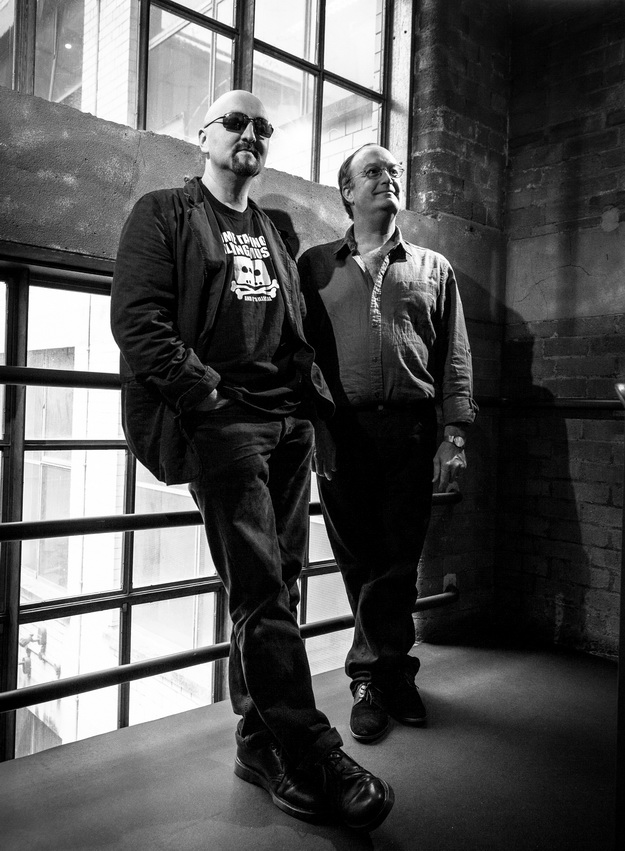
Burnt Belief, the music project by Jon & Colin, is here with a new album to continue its ambient, gloomy, ethnic, progressive & fusion music journey. We caught up with the guitarist, songwriter and producer Jon Durant to get more details about the new album and the music in general…
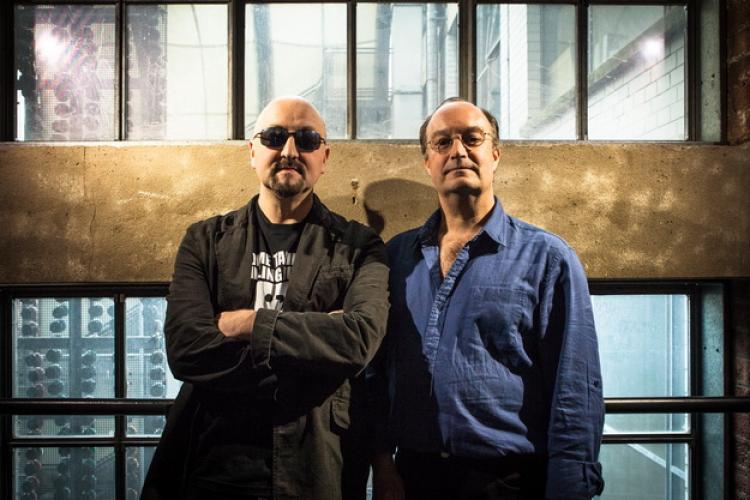
Hi Jon… you’re back with a new album entitled “Etymology” after 2 years. What’s the story behind it?
J: “Etymology” is the result of Colin and I continuing to find new and interesting ways of combining our unique musical voices. After we did “Burnt Belief”, Colin got me involved in a project he was doing with a group of Ukranian folk singers called Astarta/Ewdin. What began as one track with some textural guitar slowly turned into a full album’s worth of material. In the summer of 2013, the group played at a major festival in Kiev, and I was invited to join them and it turned out really well. We also played a festival in London a couple months later. One of the things that came out of these gigs was that Colin and I really enjoyed working live together (we’d recorded “Shadow Planets” live in the studio) and wanted to really convey that spirit much more this time around. So when we began writing this album, it was very much with that in mind.
What does the title “Etymology” declare? You say that it’s a metaphor of your working methodology… but are you also aware that “Etymology” comes from the Greek word “Etymologia” – which has to do with the roots of each word – the true first meaning of a word… briefly.
J: Yes, the idea of how a word evolves into another one, while maintaining the original part is very much how our pieces evolve. One of us may have an idea and when the other adds to it, it takes on a different character, while still maintaining the starting kernel from which it began.
Is the cover artwork related with the album’s title in any way?
J: The cover is less related to the title, and more to the musical vibe that we’re putting forth. I wanted to convey both the spatial, atmospheric side and the very aggressive aspect as well. So, I chose a cityscape as an image, but a very atmospheric one. Astute readers will recognize that it’s the Hawthorne Bridge in Portland, OR, where much of my musical contributions began.
What is the thing that both of you (Colin & Jon) wanted to achieve with this project? By the way is “Burnt Belief” the project’s name from now on?
J: Yes, we kind of expected that Burnt Belief would be the band name from the time it came up on the last record. We made our live debut under that moniker at Progtoberfest in Chicago recently. Musically, we really wanted to stretch beyond what we’d done on “Burnt Belief” and my album “Dance of the Shadow Planets” before it. We definitely wanted a more live, and aggressive vibe than we’d shown previously.
What are the new elements that you introduce with “Etymology”?
J: The most obvious factor is the use of drum kit, rather than just using hand percussion as we had on the last two records. It becomes very apparent as soon as the drums kick in on “Chromatique” that the vibe is very different. Jerry Leake (who played percussion on the last two albums) is really amazing, and quite energetic, but there is something really visceral and powerful about the drum kit.
Is there a music story behind each track title? Some words perhaps?
J: “Chromatique”: This piece began with the weird descending chromatic clouds. Colin wasn’t sure how to approach this piece, so it sat for a while. A little after our initial sessions, I re-evaluated it and came up with the basic structure and vibe of the piece. When Vinny Sabatino added his drums, the whole piece completely opened up.
“Dissemble”: Steve Bingham added a wonderful sense of texture and vibe to this piece. It began as an ambient cloudscape that Colin turned into an interesting rhythmic bit that drove the pace.
“Précis”: This piece, to me, sums up Burnt Belief in one cool, fairly short package. Interesting textures, cool melody, wicked bass and drum grooves.
“Hraunfossar”: This is one of the more “ECM” styled pieces. I had done a long cloud scape that Colin built a couple rhythm tracks around. From there, I developed the guitar-trumpet/ney (guitar synth) dialog, cascading guitar rhythms and the melody, which is actually pulled from the melody in the clouds.
“Convergence”: A little different from the rest of the record, this one rocks out pretty hard. I love Colin’s bass lines in this one, and specifically held back from writing a big melody to allow them to fully bloom.
“Rivulet”: Another ECM-ish piece, written around the fretless bass melody. José Duque’s drumming is a really nice bit of color and texture more than groove on this one.
“White Keys”: This track began as a cloud scape that centered around the notes that are the white keys on the piano. Colin generated the basic bass/drum rhythms, and I suddenly heard it in a whole different light, and created melody/chords that stray from they’re original place, while the bass holds down the original tonality.
“Not Indifferent”: A big, long piece that started life as a long, dark cloud scape. Colin hard the big picture in mind from the start, and built most of the structure before sending it back to me for melodic content. Vinny’s drumming really made this one jump.
“Hover”: This is a pretty little guitar/upright bass duet. A nice refreshing breath after the mayhem that precedes it.
“Chimera”: Colin took my ambient clouds and ran them through a slicer to generate the fascinating rhythmic illusions that make this piece. Also, the guitar solo is played entirely with an ebow, including all the rhythmic bits. Another great bit of drumming from Vinny, really locked in the weird 3 against 4 pulse.
“Squall”: This is the darkest piece on the record, again beginning life as a cloud that Colin rhythmatised. I love the way the melody and bass lines play off each other in the middle, and the nasty swirling cloud that permeates the piece. More great viin from Steve Bingham!
There’s also the bonus track “Charlatan” – tell us about it too. Is it part of the 5 bonus tracks that only the first 200 who pre-ordered the album got? How will the others get the chance to listen to them?
J: When we were mixing the record, we realized we had more material than was needed for an album. Indeed, it’s a pretty long record even without it. For whatever reason, when we looked at choices to leave off, this was the one that maybe felt unnecessary. Still, there’s some very cool stuff, interesting rhythms, great melody, great drums from Vinny. We included it in our set at our live debut recently, and it was great fun to play that way. The other tracks include one older track of mine from my album “Silent Extinction Beyond the Zero” which features Tony Levin, and a couple pieces of Colin’s that he’d had kicking around for a bit.
What’s the basic songwriting & recording formula that you follow for Burnt Belief?
J: While there are no hard and fast rules, as often as not I begin by recording cloud scapes and send them off to Colin. He will very often run them through a slicer to get interesting rhythms, and come up with bass lines and drum programming off of them. There are a few where he didn’t do the slicer, and simply left them to drift and he came up with ideas around the sections of the cloud scapes. In the case of “Précis” and “Convergence”, Colin had bass/drum ideas with no form or structure, and sent them to me to try to find a way to make them work.
How did you choose the persons to cooperate with in every album? Tell us a bit about each one of this album’s guest appearances: Steve Bingham (No-Man) on electric violin and Vinny Sabatino, Dean McCormick & Jose Duque on drums?
J: Colin suggested getting Steve involved on a couple pieces, having worked with him in Tim Bowness’ band, and he’d worked on the Astarta/Edwin project with us as well. He was a great additional voice for the couple pieces he played on. As for the drummers, we’d had a day in the studio with Dean McCormick and managed to get a couple of the early pieces completed with him. Colin has done a fair bit of work with him over the years. José Duque is a drummer I’d worked with when he was playing in my brother Kingsley’s trio in NH. We really enjoy working together and I’d played on a record of his and he reciprocated by playing on Rivulet. He’s much more into the ECM type textural drumming than Vinny, so he was the perfect choice for that one. Vinny Sabatino and I have worked together for years, and he’s played on many of my records. He’s best known as Boston’s top funk drummer, and he’s had a chance to stretch himself on this one. He has also taken on the role as drummer in the live band, and is really exciting to work with.
How would you describe Burnt Belief’s music style?
J: The best thing about Burnt Belief is also the hardest thing to market. It doesn’t fit into any category. If I say “progressive ethno ambient fusion music” would that make sense? There are elements of progressive rock, jazz fusion, ethnic music and ambient bits as well.
What can we expect from Burnt Belief in the future?
J: Having successfully shown that we can do this live, we are very much looking to do more of it. We’re trying to secure some bookings for 2015, both in the US and in Europe.
What about your personal music endeavors? Are you working on something right now? What’s your own music plans?
J: As always, I’m constantly exploring various ideas. Hoping to get some film work, which I think is the logical extension of what I do.
It’s time for our “weird questions”!!! How did you come up with the name Burnt Belief initially?
J: The name came from Colin’s reading of the classic book “When Prophecy Fails” about the psychology behind a UFO cult in the 1950s. We’re both fascinated by belief systems and the cognitive dissonance that goes on when end of the world cults inevitably face disconfirmation of their beliefs.
Do you believe that thought-provoking, artistic, progressive instrumental albums can still find their way in today’s world of “superficial” music and pop-trash shit which have taken over all social media and TV?
J: Well, I’d like to think so. And the success of, say, Sigur Ros or Explosions in the Sky tells me that contrary to popular belief, young people are willing to explore something that takes some effort. The problem is getting them to hear it, especially when it’s not format driven.
Which is the record you wish you had written and why?
J: There are so many over the years, it’s impossible to pick one. But I’ll throw Terje Rypdal’s “Wave” out there, just because it meant so much to me when I was first becoming a musician. Brilliant melodies, wonderful space and textures, great harmonies.
Is the “free downloading issue” the main reason why the music industry has taken the downhill or there are others more important reasons for that?
J: I think it’s a huge part of it. People on the whole simply don’t want to buy something, especially when they can get it for free. The thing I knew as soon as iTunes hit was that we’d returned to a singles market, and the fact is you can’t recoup what it costs to make and market a record in that environment. But it’s also incredibly hard to make money live now – many clubs want bands to pay to play, and even the Super Bowl has gone that way, which tells the clubs it’s legit. I think the combination is really quite toxic for the future of music.
Is music art? Or it used to be? What has changed since the “old days”? (60, 70s, 80s)
J: I certainly think so! I don’t know that anything has changed other than the fact that technology has made it possible for everyone to have first rate recording in their home computer. So there are now too many choices, and not enough editing.
What do you think about this “Views, tweets & Likes” mania of our time?
J: Ugh!
Top 3 sci-fi movies of any era?
J: Not a big sci-fi fan, to be honest!
Top 3 Horror movies of all time?
J: Or horror... Sorry!
Which of the Seven Deadly Sins do you reckon is the one, that’s more likely to send you straight to Hell, in the afterlife?
J: I’m a major foodie, so I guess that would be gluttony?
Imagine that your wife is selling your whole album-collection just to buy an expensive ring for herself. How would you react? J
J: Ha! My wife has no interest in jewelry, so I guess I would know something was really amiss!
Before we close add anything you like. Thank you for talking to Grande Rock, Jon… Thx for the music… take care!
J: Thanks, I hope people will take the time to explore the music. There’s a lot there to take in, but hopefully the rewards will be there!
J: “Etymology” is the result of Colin and I continuing to find new and interesting ways of combining our unique musical voices. After we did “Burnt Belief”, Colin got me involved in a project he was doing with a group of Ukranian folk singers called Astarta/Ewdin. What began as one track with some textural guitar slowly turned into a full album’s worth of material. In the summer of 2013, the group played at a major festival in Kiev, and I was invited to join them and it turned out really well. We also played a festival in London a couple months later. One of the things that came out of these gigs was that Colin and I really enjoyed working live together (we’d recorded “Shadow Planets” live in the studio) and wanted to really convey that spirit much more this time around. So when we began writing this album, it was very much with that in mind.
What does the title “Etymology” declare? You say that it’s a metaphor of your working methodology… but are you also aware that “Etymology” comes from the Greek word “Etymologia” – which has to do with the roots of each word – the true first meaning of a word… briefly.
J: Yes, the idea of how a word evolves into another one, while maintaining the original part is very much how our pieces evolve. One of us may have an idea and when the other adds to it, it takes on a different character, while still maintaining the starting kernel from which it began.
Is the cover artwork related with the album’s title in any way?
J: The cover is less related to the title, and more to the musical vibe that we’re putting forth. I wanted to convey both the spatial, atmospheric side and the very aggressive aspect as well. So, I chose a cityscape as an image, but a very atmospheric one. Astute readers will recognize that it’s the Hawthorne Bridge in Portland, OR, where much of my musical contributions began.
What is the thing that both of you (Colin & Jon) wanted to achieve with this project? By the way is “Burnt Belief” the project’s name from now on?
J: Yes, we kind of expected that Burnt Belief would be the band name from the time it came up on the last record. We made our live debut under that moniker at Progtoberfest in Chicago recently. Musically, we really wanted to stretch beyond what we’d done on “Burnt Belief” and my album “Dance of the Shadow Planets” before it. We definitely wanted a more live, and aggressive vibe than we’d shown previously.
What are the new elements that you introduce with “Etymology”?
J: The most obvious factor is the use of drum kit, rather than just using hand percussion as we had on the last two records. It becomes very apparent as soon as the drums kick in on “Chromatique” that the vibe is very different. Jerry Leake (who played percussion on the last two albums) is really amazing, and quite energetic, but there is something really visceral and powerful about the drum kit.
Is there a music story behind each track title? Some words perhaps?
J: “Chromatique”: This piece began with the weird descending chromatic clouds. Colin wasn’t sure how to approach this piece, so it sat for a while. A little after our initial sessions, I re-evaluated it and came up with the basic structure and vibe of the piece. When Vinny Sabatino added his drums, the whole piece completely opened up.
“Dissemble”: Steve Bingham added a wonderful sense of texture and vibe to this piece. It began as an ambient cloudscape that Colin turned into an interesting rhythmic bit that drove the pace.
“Précis”: This piece, to me, sums up Burnt Belief in one cool, fairly short package. Interesting textures, cool melody, wicked bass and drum grooves.
“Hraunfossar”: This is one of the more “ECM” styled pieces. I had done a long cloud scape that Colin built a couple rhythm tracks around. From there, I developed the guitar-trumpet/ney (guitar synth) dialog, cascading guitar rhythms and the melody, which is actually pulled from the melody in the clouds.
“Convergence”: A little different from the rest of the record, this one rocks out pretty hard. I love Colin’s bass lines in this one, and specifically held back from writing a big melody to allow them to fully bloom.
“Rivulet”: Another ECM-ish piece, written around the fretless bass melody. José Duque’s drumming is a really nice bit of color and texture more than groove on this one.
“White Keys”: This track began as a cloud scape that centered around the notes that are the white keys on the piano. Colin generated the basic bass/drum rhythms, and I suddenly heard it in a whole different light, and created melody/chords that stray from they’re original place, while the bass holds down the original tonality.
“Not Indifferent”: A big, long piece that started life as a long, dark cloud scape. Colin hard the big picture in mind from the start, and built most of the structure before sending it back to me for melodic content. Vinny’s drumming really made this one jump.
“Hover”: This is a pretty little guitar/upright bass duet. A nice refreshing breath after the mayhem that precedes it.
“Chimera”: Colin took my ambient clouds and ran them through a slicer to generate the fascinating rhythmic illusions that make this piece. Also, the guitar solo is played entirely with an ebow, including all the rhythmic bits. Another great bit of drumming from Vinny, really locked in the weird 3 against 4 pulse.
“Squall”: This is the darkest piece on the record, again beginning life as a cloud that Colin rhythmatised. I love the way the melody and bass lines play off each other in the middle, and the nasty swirling cloud that permeates the piece. More great viin from Steve Bingham!
There’s also the bonus track “Charlatan” – tell us about it too. Is it part of the 5 bonus tracks that only the first 200 who pre-ordered the album got? How will the others get the chance to listen to them?
J: When we were mixing the record, we realized we had more material than was needed for an album. Indeed, it’s a pretty long record even without it. For whatever reason, when we looked at choices to leave off, this was the one that maybe felt unnecessary. Still, there’s some very cool stuff, interesting rhythms, great melody, great drums from Vinny. We included it in our set at our live debut recently, and it was great fun to play that way. The other tracks include one older track of mine from my album “Silent Extinction Beyond the Zero” which features Tony Levin, and a couple pieces of Colin’s that he’d had kicking around for a bit.
What’s the basic songwriting & recording formula that you follow for Burnt Belief?
J: While there are no hard and fast rules, as often as not I begin by recording cloud scapes and send them off to Colin. He will very often run them through a slicer to get interesting rhythms, and come up with bass lines and drum programming off of them. There are a few where he didn’t do the slicer, and simply left them to drift and he came up with ideas around the sections of the cloud scapes. In the case of “Précis” and “Convergence”, Colin had bass/drum ideas with no form or structure, and sent them to me to try to find a way to make them work.
How did you choose the persons to cooperate with in every album? Tell us a bit about each one of this album’s guest appearances: Steve Bingham (No-Man) on electric violin and Vinny Sabatino, Dean McCormick & Jose Duque on drums?
J: Colin suggested getting Steve involved on a couple pieces, having worked with him in Tim Bowness’ band, and he’d worked on the Astarta/Edwin project with us as well. He was a great additional voice for the couple pieces he played on. As for the drummers, we’d had a day in the studio with Dean McCormick and managed to get a couple of the early pieces completed with him. Colin has done a fair bit of work with him over the years. José Duque is a drummer I’d worked with when he was playing in my brother Kingsley’s trio in NH. We really enjoy working together and I’d played on a record of his and he reciprocated by playing on Rivulet. He’s much more into the ECM type textural drumming than Vinny, so he was the perfect choice for that one. Vinny Sabatino and I have worked together for years, and he’s played on many of my records. He’s best known as Boston’s top funk drummer, and he’s had a chance to stretch himself on this one. He has also taken on the role as drummer in the live band, and is really exciting to work with.
How would you describe Burnt Belief’s music style?
J: The best thing about Burnt Belief is also the hardest thing to market. It doesn’t fit into any category. If I say “progressive ethno ambient fusion music” would that make sense? There are elements of progressive rock, jazz fusion, ethnic music and ambient bits as well.
What can we expect from Burnt Belief in the future?
J: Having successfully shown that we can do this live, we are very much looking to do more of it. We’re trying to secure some bookings for 2015, both in the US and in Europe.
What about your personal music endeavors? Are you working on something right now? What’s your own music plans?
J: As always, I’m constantly exploring various ideas. Hoping to get some film work, which I think is the logical extension of what I do.
It’s time for our “weird questions”!!! How did you come up with the name Burnt Belief initially?
J: The name came from Colin’s reading of the classic book “When Prophecy Fails” about the psychology behind a UFO cult in the 1950s. We’re both fascinated by belief systems and the cognitive dissonance that goes on when end of the world cults inevitably face disconfirmation of their beliefs.
Do you believe that thought-provoking, artistic, progressive instrumental albums can still find their way in today’s world of “superficial” music and pop-trash shit which have taken over all social media and TV?
J: Well, I’d like to think so. And the success of, say, Sigur Ros or Explosions in the Sky tells me that contrary to popular belief, young people are willing to explore something that takes some effort. The problem is getting them to hear it, especially when it’s not format driven.
Which is the record you wish you had written and why?
J: There are so many over the years, it’s impossible to pick one. But I’ll throw Terje Rypdal’s “Wave” out there, just because it meant so much to me when I was first becoming a musician. Brilliant melodies, wonderful space and textures, great harmonies.
Is the “free downloading issue” the main reason why the music industry has taken the downhill or there are others more important reasons for that?
J: I think it’s a huge part of it. People on the whole simply don’t want to buy something, especially when they can get it for free. The thing I knew as soon as iTunes hit was that we’d returned to a singles market, and the fact is you can’t recoup what it costs to make and market a record in that environment. But it’s also incredibly hard to make money live now – many clubs want bands to pay to play, and even the Super Bowl has gone that way, which tells the clubs it’s legit. I think the combination is really quite toxic for the future of music.
Is music art? Or it used to be? What has changed since the “old days”? (60, 70s, 80s)
J: I certainly think so! I don’t know that anything has changed other than the fact that technology has made it possible for everyone to have first rate recording in their home computer. So there are now too many choices, and not enough editing.
What do you think about this “Views, tweets & Likes” mania of our time?
J: Ugh!
Top 3 sci-fi movies of any era?
J: Not a big sci-fi fan, to be honest!
Top 3 Horror movies of all time?
J: Or horror... Sorry!
Which of the Seven Deadly Sins do you reckon is the one, that’s more likely to send you straight to Hell, in the afterlife?
J: I’m a major foodie, so I guess that would be gluttony?
Imagine that your wife is selling your whole album-collection just to buy an expensive ring for herself. How would you react? J
J: Ha! My wife has no interest in jewelry, so I guess I would know something was really amiss!
Before we close add anything you like. Thank you for talking to Grande Rock, Jon… Thx for the music… take care!
J: Thanks, I hope people will take the time to explore the music. There’s a lot there to take in, but hopefully the rewards will be there!