
Telergy are back with their third full-length album, which deals with a very delicate story of the past. This time the producer, composer and multi-instrumentalist Robert McClung deals with the somehow unknown story of the philosopher, mathematician and astronomer Hypatia, who lived around 450 BC in Alexandria. The whole story is wonderfully dressed with Robert’s music themes… but let’s see what Robert has to say about Hypatia, the music and the guest appearances of the album…
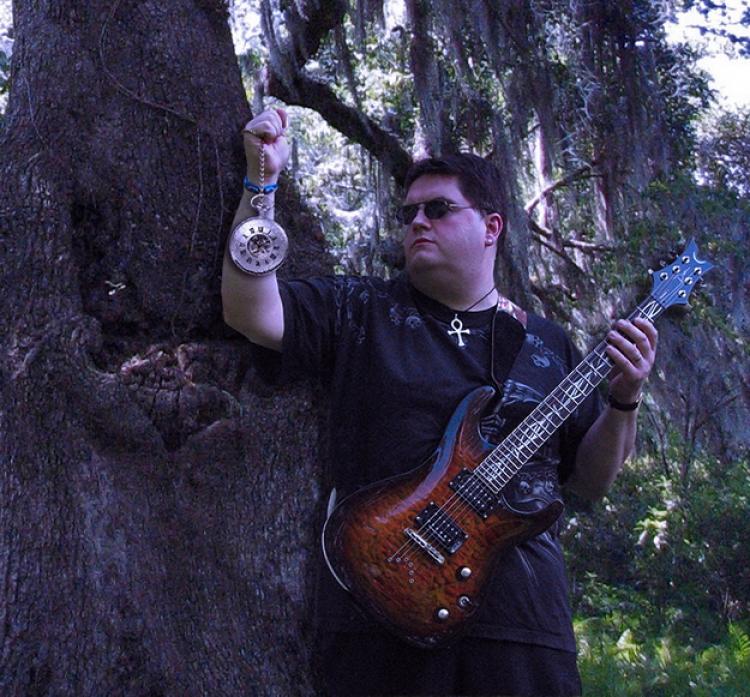
Hi Robert… I was quite surprised when I saw that you’re dealing with Hypatia on your new album, since she is one of my favorite (AD) philosophers in general…
R: Her story is so incredible and dramatic, and few people know about her. She doesn’t get the attention that others like Plato and Socrates do. I saw this as a good opportunity to bring her story to a wider audience.
First of all, tell us… which are the musical differences and alterations of your new album “Hypatia” compared to your previous ones?
R: Each album gives me a chance to explore new musical concepts and ideas. With this album I was able to incorporate some interesting electronica and jazz concepts to the symphonic metal base that Telergy is cemented in.
How did you decide to deal with such a delicate matter such as the philosopher, mathematician and teacher Hypatia?
R: A close friend of mine recommended the story. After a little reading and research on my own I was hooked. I reached out to Professor Michael A.B. Deakin, who wrote the definitive biography on Hypatia in 2007. He was upset that the movie “Agora” had taken some creative liberties with the story and that they had not consulted him for the production. He was very helpful in helping me construct the form that I would use for the script.
What was the part out of Hypatia’s story which intrigued you the most and gave you the push to deal further with her life?
R: Even with the limited resources available, it is quite evident that Hypatia was an incredibly strong, well learned and intelligent woman. At a time when most women weren’t educated at all. She was a bit of a rebel. I guess I can identify with that to some extent. There’s also an air of mystery surrounding her. We know so little beyond the letters between her and Synesius. And other accounts that reference her are clearly a bit bias and skewed in their interpretations. Getting to the truth is a bit difficult. I like that kind of challenge.
Do you believe that more and more people should know about Hypatia, her life and her sudden and violent death too?
R: Absolutely. I think it’s tragic that you don’t see her mentioned in high school textbooks. She deserves the same attention that all the other great ancient scholars do. I think she is a great role model for women, mathematicians, philosophers and astronomers alike.
How important are the “talking part” scenes as you call them for the better understanding of Hypatia’s story?
R: Very important. They serve as guideposts to inform the listener what the music they are about to hear represents. There was a time when music that told stories through notes alone, without lyrics, was very common. Good examples would be Gershwin’s “An American in Paris” or Mussorgsky’s “Pictures at an Exhibition”. But that is an art form that seems to have completely fallen out of favor in popular culture. I wanted to revive that style with Telergy, but I knew I needed some type of worded description to help the listener understand what they are listening to. I come from a theater background, so using spoken word scenes similar to an old time radio play made perfect sense.
I took a lot of criticism with the first Telergy album “The Exodus” for the spoken sections. People just didn’t seem to understand why they had to listen to two minutes of people talking before they could hear any music. But I’m stubborn and wasn’t about to give up my artistic vison just because some critic on the other side of the planet didn’t like it.
However, with the next album “The Legend of Goody Cole” I put the spoken sections on separate tracks from the musical pieces. People who didn’t want to hear them could just skip over them if they chose to do so. It seemed to work. No one complained about the spoken sections on that album. So I did the same with “Hypatia”.
How did you approach each musical theme which “tells” a part of Hypatia’s story? Did you want to connect each music part with specific feelings or something like that?
R: Yes. Rather than laying her story out in a completely chronological way, I chose to focus each part on an aspect of her character. So themes like “Mathematician” and “Philosopher” allowed me the focus I needed to concentrate on those concepts.
Have you ever thought of adding vocals to your music? Is it possible for that to happen in the future?
R: Maybe. “The Legend of Goody Cole” had some limited vocals. But the entire concept behind Telergy was to use music, without lyrics, to tell stories. I would like to stick to that as much as possible. Artistically I have been drawn more and more to instrumental music. Nothing against great lyrics, but I have to go where the muse guides me.
How important a role did your guest musicians play in order to achieve the best final outcome?
R: Telergy is all about creating something that no one person could do alone. Each player adds his or her unique color to the palette. I could never achieve such a massive, diverse sound all by myself. And it’s such an incredible thrill to collaborate with artists who were influential to my development as a musician. To have their participation and support gives me such validation that what I’m doing is artistically worthwhile. And that means far more to me that commercial success or fame.
Is it easy or not to get on with such renowned musicians like the ones who have participated in your latest release?
R: Very easy! They are all top notch professionals, and they understand their role in the bigger picture. They take direction very well and do their best to add their own unique voice to the production without distracting from the overall vibe. I would be honored to work with every one of them again in the future.
Did you take care of the album’s recording all by yourself? At which point did you decide to fund the album through a crowd funding platform? Is it better to get involved with your fans right away without any middleman?
R: Yes, I produced the bulk of the album at my home studio. Many artist recorded their parts in their own studios or studios closer to their location and emailed me the files for final mixing. One piece, “Martyr”, a cello duet, was actually recorded live in a cathedral in Newburyport Massachusetts. I would like to do more of that. After mixing, the final master was done by Emmanuel De Saint Meen in France.
I crowd funded the last album “The Legend of Goody Cole”, so I knew the idea could work. Eliminating record companies and connecting with fans directly offers artists like me far more freedom. I’ve been approached by a couple labels, and I’m open to the idea of signing on to one at some point. But I have yet to be offered a deal that I feel gives me the creative freedom I enjoy now.
Did you have a plan B in case you didn’t reach the goal? Crowd-funding platforms are fine but what happens when an artist or band does not reach their goal?
R: With all the notable musicians involved with Telergy, I was fairly certain I would reach the goal. Which I did. But even if I hadn’t reached it I would have gone forward with production. It just would have come out of my own pocket.
Do you plan to release a lyric or a concept video at some point?
R: No. But I’m open to the idea. I have always thought that some type of animated video would work well with Telergy music. I have no knowledge or experience in that area, so someone else would need to take the reins for that to happen.
What’s the message that you want to give to the people with your new album “Hypatia”?
R: Stay true to your beliefs and who you are to the very end. There will always be forces at play that will try and stop you and hold you down. Hypatia’s voice still rings loud and true after hundreds of years of people trying to silence her. I think that’s very inspirational.
How did you come up with the idea of donating the album’s profit to Cross Roads House?
R: I have been involved with Cross Roads House for many years. I play Santa at their Christmas party every year. I buy toys for all the children at the shelter. It always tears at my heart to see children have to suffer like that. I’m certainly not rich by any means, but the people at the shelter need the money far more than I do.
Time for our “weird questions”!!! How did you come up with the name Telergy initially?
R: The word Telergy is described as “The influence one brain is thought to exercise over another, from a distance, by means of some hypothetical mental energy”. I think telling a story through music, without lyrics, plays into that description, as music could be considered a powerful energy of its own. I read the word and its description in a dictionary somewhere. It seemed to fit my vision for what I wanted my musical project to be.
Which are those things that inspire you to write music in general?
R: Almost everything. The gears are always turning in my brain. I might hear a song or rhythm and start to tear it apart and re-arrange it in my head. And I’m constantly reading stories that inspire musical thoughts and ideas.
What do you think of religions in general and their leaders who talk about love, tolerance and forgiveness and they do the opposite to those who do not agree with them?
R: I think it’s very sad. I know it sounds corny, but why can’t we all just get along?!?! I don’t think religion, in general, is a bad thing. But to judge others or try to impose your own religious based morality on others who believe differently is horrible. As long as those people aren’t hurting you, what business of yours is it to judge their beliefs of lifestyle?
Does music have anything to do with religion or is it a kind of “religion” itself?
R: Both. For hundreds of years music has been used to spread various religious ideals. And for many musicians like myself, music is the core that grounds us to the universe.
Is music a gift from the Gods as the ancient Hellenes used to believe?
R: Sure. It is definitely a gift from somewhere.
Top 3 sci-fi movies of any era?
R: Star Wars, Close encounters of the Third Kind, Guardians of the Galaxy.
If you could be any historical person, which one would you be and why?
R: Close call between Nostradamus and Edgar Cayce. To have that depth of vision and line into the deeper universe would be incredible.
Machines vs Humans… is humanity doomed to fall by their own hand eventually?
R: We are certainly doomed, but not by machines. We are doomed by what we are doing to our environment.
Which is the record you wish you had written and why?
R: Pink Floyd “Dark Side of the Moon”. That album was revolutionary. The depth of songwriting and experimentation was like nothing that had come before. The Beatles had their moments for sure. But for me “Dark Side of the Moon” was the pinnacle of progressive sound. Paving the way for all that came after.
What would the word be like without religions… can you imagine?
R: We might stop killing and judging each other? That would be nice.
Thx for doing this interview Robert. Say anything you feel like saying before we close. Thx for the music too… take care!
R: My pleasure. To quote Hypatia “Reserve your right to think, for even to think wrongly, is better than not to think at all”.
R: Her story is so incredible and dramatic, and few people know about her. She doesn’t get the attention that others like Plato and Socrates do. I saw this as a good opportunity to bring her story to a wider audience.
First of all, tell us… which are the musical differences and alterations of your new album “Hypatia” compared to your previous ones?
R: Each album gives me a chance to explore new musical concepts and ideas. With this album I was able to incorporate some interesting electronica and jazz concepts to the symphonic metal base that Telergy is cemented in.
How did you decide to deal with such a delicate matter such as the philosopher, mathematician and teacher Hypatia?
R: A close friend of mine recommended the story. After a little reading and research on my own I was hooked. I reached out to Professor Michael A.B. Deakin, who wrote the definitive biography on Hypatia in 2007. He was upset that the movie “Agora” had taken some creative liberties with the story and that they had not consulted him for the production. He was very helpful in helping me construct the form that I would use for the script.
What was the part out of Hypatia’s story which intrigued you the most and gave you the push to deal further with her life?
R: Even with the limited resources available, it is quite evident that Hypatia was an incredibly strong, well learned and intelligent woman. At a time when most women weren’t educated at all. She was a bit of a rebel. I guess I can identify with that to some extent. There’s also an air of mystery surrounding her. We know so little beyond the letters between her and Synesius. And other accounts that reference her are clearly a bit bias and skewed in their interpretations. Getting to the truth is a bit difficult. I like that kind of challenge.
Do you believe that more and more people should know about Hypatia, her life and her sudden and violent death too?
R: Absolutely. I think it’s tragic that you don’t see her mentioned in high school textbooks. She deserves the same attention that all the other great ancient scholars do. I think she is a great role model for women, mathematicians, philosophers and astronomers alike.
How important are the “talking part” scenes as you call them for the better understanding of Hypatia’s story?
R: Very important. They serve as guideposts to inform the listener what the music they are about to hear represents. There was a time when music that told stories through notes alone, without lyrics, was very common. Good examples would be Gershwin’s “An American in Paris” or Mussorgsky’s “Pictures at an Exhibition”. But that is an art form that seems to have completely fallen out of favor in popular culture. I wanted to revive that style with Telergy, but I knew I needed some type of worded description to help the listener understand what they are listening to. I come from a theater background, so using spoken word scenes similar to an old time radio play made perfect sense.
I took a lot of criticism with the first Telergy album “The Exodus” for the spoken sections. People just didn’t seem to understand why they had to listen to two minutes of people talking before they could hear any music. But I’m stubborn and wasn’t about to give up my artistic vison just because some critic on the other side of the planet didn’t like it.
However, with the next album “The Legend of Goody Cole” I put the spoken sections on separate tracks from the musical pieces. People who didn’t want to hear them could just skip over them if they chose to do so. It seemed to work. No one complained about the spoken sections on that album. So I did the same with “Hypatia”.
How did you approach each musical theme which “tells” a part of Hypatia’s story? Did you want to connect each music part with specific feelings or something like that?
R: Yes. Rather than laying her story out in a completely chronological way, I chose to focus each part on an aspect of her character. So themes like “Mathematician” and “Philosopher” allowed me the focus I needed to concentrate on those concepts.
Have you ever thought of adding vocals to your music? Is it possible for that to happen in the future?
R: Maybe. “The Legend of Goody Cole” had some limited vocals. But the entire concept behind Telergy was to use music, without lyrics, to tell stories. I would like to stick to that as much as possible. Artistically I have been drawn more and more to instrumental music. Nothing against great lyrics, but I have to go where the muse guides me.
How important a role did your guest musicians play in order to achieve the best final outcome?
R: Telergy is all about creating something that no one person could do alone. Each player adds his or her unique color to the palette. I could never achieve such a massive, diverse sound all by myself. And it’s such an incredible thrill to collaborate with artists who were influential to my development as a musician. To have their participation and support gives me such validation that what I’m doing is artistically worthwhile. And that means far more to me that commercial success or fame.
Is it easy or not to get on with such renowned musicians like the ones who have participated in your latest release?
R: Very easy! They are all top notch professionals, and they understand their role in the bigger picture. They take direction very well and do their best to add their own unique voice to the production without distracting from the overall vibe. I would be honored to work with every one of them again in the future.
Did you take care of the album’s recording all by yourself? At which point did you decide to fund the album through a crowd funding platform? Is it better to get involved with your fans right away without any middleman?
R: Yes, I produced the bulk of the album at my home studio. Many artist recorded their parts in their own studios or studios closer to their location and emailed me the files for final mixing. One piece, “Martyr”, a cello duet, was actually recorded live in a cathedral in Newburyport Massachusetts. I would like to do more of that. After mixing, the final master was done by Emmanuel De Saint Meen in France.
I crowd funded the last album “The Legend of Goody Cole”, so I knew the idea could work. Eliminating record companies and connecting with fans directly offers artists like me far more freedom. I’ve been approached by a couple labels, and I’m open to the idea of signing on to one at some point. But I have yet to be offered a deal that I feel gives me the creative freedom I enjoy now.
Did you have a plan B in case you didn’t reach the goal? Crowd-funding platforms are fine but what happens when an artist or band does not reach their goal?
R: With all the notable musicians involved with Telergy, I was fairly certain I would reach the goal. Which I did. But even if I hadn’t reached it I would have gone forward with production. It just would have come out of my own pocket.
Do you plan to release a lyric or a concept video at some point?
R: No. But I’m open to the idea. I have always thought that some type of animated video would work well with Telergy music. I have no knowledge or experience in that area, so someone else would need to take the reins for that to happen.
What’s the message that you want to give to the people with your new album “Hypatia”?
R: Stay true to your beliefs and who you are to the very end. There will always be forces at play that will try and stop you and hold you down. Hypatia’s voice still rings loud and true after hundreds of years of people trying to silence her. I think that’s very inspirational.
How did you come up with the idea of donating the album’s profit to Cross Roads House?
R: I have been involved with Cross Roads House for many years. I play Santa at their Christmas party every year. I buy toys for all the children at the shelter. It always tears at my heart to see children have to suffer like that. I’m certainly not rich by any means, but the people at the shelter need the money far more than I do.
Time for our “weird questions”!!! How did you come up with the name Telergy initially?
R: The word Telergy is described as “The influence one brain is thought to exercise over another, from a distance, by means of some hypothetical mental energy”. I think telling a story through music, without lyrics, plays into that description, as music could be considered a powerful energy of its own. I read the word and its description in a dictionary somewhere. It seemed to fit my vision for what I wanted my musical project to be.
Which are those things that inspire you to write music in general?
R: Almost everything. The gears are always turning in my brain. I might hear a song or rhythm and start to tear it apart and re-arrange it in my head. And I’m constantly reading stories that inspire musical thoughts and ideas.
What do you think of religions in general and their leaders who talk about love, tolerance and forgiveness and they do the opposite to those who do not agree with them?
R: I think it’s very sad. I know it sounds corny, but why can’t we all just get along?!?! I don’t think religion, in general, is a bad thing. But to judge others or try to impose your own religious based morality on others who believe differently is horrible. As long as those people aren’t hurting you, what business of yours is it to judge their beliefs of lifestyle?
Does music have anything to do with religion or is it a kind of “religion” itself?
R: Both. For hundreds of years music has been used to spread various religious ideals. And for many musicians like myself, music is the core that grounds us to the universe.
Is music a gift from the Gods as the ancient Hellenes used to believe?
R: Sure. It is definitely a gift from somewhere.
Top 3 sci-fi movies of any era?
R: Star Wars, Close encounters of the Third Kind, Guardians of the Galaxy.
If you could be any historical person, which one would you be and why?
R: Close call between Nostradamus and Edgar Cayce. To have that depth of vision and line into the deeper universe would be incredible.
Machines vs Humans… is humanity doomed to fall by their own hand eventually?
R: We are certainly doomed, but not by machines. We are doomed by what we are doing to our environment.
Which is the record you wish you had written and why?
R: Pink Floyd “Dark Side of the Moon”. That album was revolutionary. The depth of songwriting and experimentation was like nothing that had come before. The Beatles had their moments for sure. But for me “Dark Side of the Moon” was the pinnacle of progressive sound. Paving the way for all that came after.
What would the word be like without religions… can you imagine?
R: We might stop killing and judging each other? That would be nice.
Thx for doing this interview Robert. Say anything you feel like saying before we close. Thx for the music too… take care!
R: My pleasure. To quote Hypatia “Reserve your right to think, for even to think wrongly, is better than not to think at all”.