
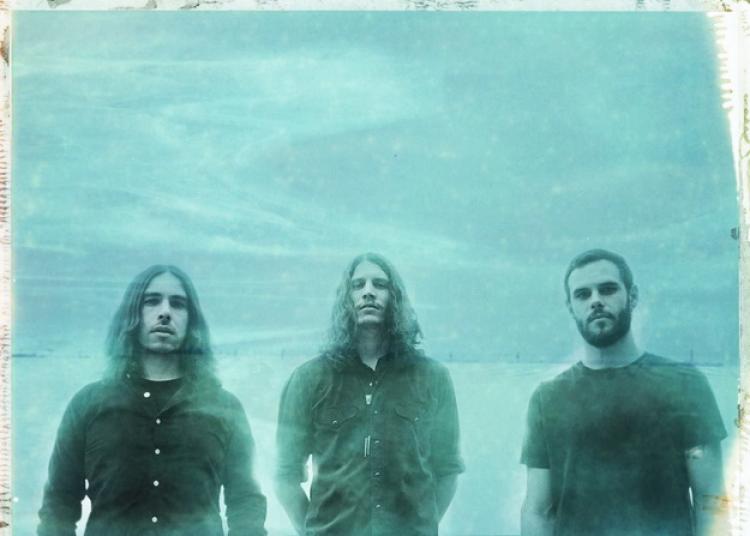
Blaak Heat (formerly known as Blaak Heat Shujaa) is a French-American instrumental psychedelic rock trio founded by Thomas Bellier and Antoine Morel-Vulliez in 2008 in Paris while they were both students. After the later relocated to LA, in 2012, the band suffered a few lineup shifts, with bassists coming and going and tours were done both stateside and in Europe to promote the albums, with “Shifting Mirrors”, the band’s most concentrated exotic and heavy as well as heady effort, being produced by Grammy Award-winning producer Matt Hyde. Grande Rock got all curious and so we contacted Thomas Bellier to ask a few questions to them “braves”...
Hi Thomas, welcome to Grande Rock. First of all, do tell us why Blaak Heat Shujaa became Blaak Heat? What’s with the “blaak” spelling and how did you come up with the name initially?
T: We decided to drop the “Shujaa” because it was too hard to explain the name to drunk guys at bars.
Apart from the name change, are there any changes on the band’s music approach or on other aspects as well?
T: We’re the kind of band that keeps evolving from album to album. The new record fully embraces the Middle Eastern influence that was dormant in our past releases.
Do you believe that your new album “Shifting Mirrors” is a continuation of your previous two or since the name changed it can be regarded as “your debut”?
T: I think that “Shifting Mirrors” is the logical continuation of what we started in 2010 with the self-titled “Blaak Heat Shujaa”. As musicians, we keep searching for new sounds, new scales, new influences, new techniques… The evolution of our sound reflects this everyday urge we have to become better musicians.
You’ve also signed to Svart Records. Will Svart Records handle the European part and Tee Pee Records the US one?
T: Exactly.
Hence, what does “Shifting Mirrors” declare? Is there any hidden meaning behind it?
T: “Shifting Mirrors” is a concept developed by Jorge-Luis Borges in the short story, “The Approach to Al-Mu’tasim”, which is also the name of a track on the album. The story is about a law student from Bombay, who sets off on a journey to meet Al’Mu-tasim, a higher spiritual being. Much like the birds from “The Conference of the Birds”, the law student realizes that he himself has become the higher being through his long voyage. This concept applies to the creative process that gave birth to our new album. We tried to reproduce Middle Eastern sounds, but intentionally or not, we were really reinterpreting them through our own cultural prism, therefore creating something new, different, and deeply personal.
You seem to draw your inspiration from Middle Eastern folk music mostly. What are those things that intricate you so much about Middle Eastern music and you seem to be fully under their spell?
T: Discovering traditional Middle Eastern music in my early twenties was a musical epiphany. I wanted to include the intensity and vividness of these foreign sounds into psychedelic rock. After some travels to North Africa and Turkey, I started exploring Middle Eastern scales and tones. I recently started studying the baglama, a traditional Turkish instrument. This appetite for Middle Eastern music quickly grew into a curiosity for all forms of art emerging from the East. I’m particularly interested in the aesthetic relationships that East and West have developed over the years, and how they each created a mystique of each other. The cover art for “Shifting Mirrors” is a Ronald Balfour illustration for the 1920 edition of Omar Khayyam’s “Rubaiyat”. Much like the illustrations for the “Arabian Nights”, Balfour’s work is a very Western take on the aesthetics of the Middle East, conveying ideas of mysticism, eroticism and general exoticism.
Do give us a hint about each track…
T: “Anatolia”: Eastern psychedelic madness.
“Sword of Hakim”: We still like our riffs heavy and our solos Scorpions-y.
“The Approach to Al-Mu’Tasim”: A journey into finding oneself, a nod to the « “Conference of the Birds”.
“Taqsim”: Timothy Maloof performed this solo piece for us.
“Ballad of Zeta Brown”: A psychedelic spaghetti ballad in three phases influenced by the writings of Oscar Acosta.
“Black Hawk”: A heavy dark song for a heavy dark subject: American imperialism.
“Mola Mamad Djan” (how did you choose to cover the specific Afghan folk song?): Western rockers tackling an Eastern standard.
“Tamazgha”: Opening credits for a clash of the titans between Nietzsche and Omar Sharif at the top of the highest mount in Afghanistan.
“The Peace Within”: Finding inner peace by removing yourself from the sensible world.
“Danse Nomade”: The soundtrack for an imaginary acid Western set in rural Turkey.
The album was mixed, mastered & produced by Grammy Award-winner Matt Hyde (Deftones, Slayer) and co-produced by you. How did the cooperation with Matt occur and are you fully satisfied with the final outcome?
T: “Shifting Mirrors” is by far the most ambitious album we’ve ever attempted, so we needed an established, seasoned producer to help us tackle such a challenge, but whose mind was twisted enough to “get” the Blaak Heat sound. I’ve known Matt for over three years now, and he is well aware of the weird, left field music we’re into, which was the key in understanding where we were coming from with our demos. It was pretty stimulating for everybody involved to be crafting something new, taking the Blaak Heat sound to a whole new level. Matt managed to blend loud fuzz guitars along with traditional acoustic instruments in a beautiful, compelling manner. We called it the “Arabian fuzz”.
There’s a new video for “Sword of Hakim” already out. Will there be any other concept or lyric video out anytime soon?
T: Probably not. Maybe some live stuff, though, since we’re on tour. We also did a live performance of “Anatolia” before the album came out.
As far as I know there’s a European Tour on the pipeline and it will start in a couple of weeks from now. Apart from that are there any plans to go on tour in Fall or Autumn 2016?
T: We’ve been on tour since early April 2016 and have performed on two continents. As I type this, we are on our way from Reverence Festival (Portugal), where we played last night, to WOS Festival (Spain). We have about 20 European shows left, through the beginning of October.
What are your expectation from the new album “Shifting Mirrors” and what are your long-term plans for Blaak Heat?
T: We’re hoping that the album will touch as many people as possible. We will start pre-production on the next record in October.
How would you describe your band’s music style to someone that has never heard of your before?
T: Experimental acid Middle Eastern psychedelic spaghetti prog.
OK, time for our “weird questions”!!! If you found a genie in a bottle and you only had 3 wishes what would they be?
T: I only have one: that people stopped listening to horrible music that turns their brain into mush and actually paid attention to art.
If you were an animal, which animal would you be and why?
T: The ram, because my last name means ram in French.
Top 3 sci-fi movies of any era?
T: “Twilight Zone”, “Sun Ra’s Space Is The Place” & “2001 A Space Odyssey”…
Which are the top 3 Middle Eastern psychedelic rock albums of all time according to you?
T: Anything from Selda’s early period; Anything from Ersen’s early period and The Devil’s Anvil – “Hard Rock from the Middle East”…
Fill in the phrase… “Psychedelic rock music wouldn’t have evolved the way it did, if it hadn’t been for…”
T: Free jazz.
If you could “erase” one thing from modern music, what would it be?
T: Music.
Which is that band that you’d like to be part of (any time & era)?
T: Amon Düül II.
Were you obliged to give just one album to extraterrestrials that would represent the whole human music, which album would it be and from which band/artist?
T: Carl Sagan’s Voyager Golden Record.
You have the chance to have sex with the movie-celebrity/porn-star of your choice. Who would it be & why?
T: Ron Jeremy, because of the mustache.
Which character from the “Game of Thrones” would you have been – if you lived in the Seven Kingdoms? The other guys from the band?
T: Sorry, I don’t watch television.
Imagine that your girlfriend/wife is selling your whole album-collection just to buy an expensive ring for herself. How would you react?
T: I wouldn’t care, I love my lady too much.
We’re done Thomas. Thx for talking to Grande Rock. Say anything you feel like saying before we close. Take care dude!
T: Cheers, we hope to tour Greece soon!
T: We decided to drop the “Shujaa” because it was too hard to explain the name to drunk guys at bars.
Apart from the name change, are there any changes on the band’s music approach or on other aspects as well?
T: We’re the kind of band that keeps evolving from album to album. The new record fully embraces the Middle Eastern influence that was dormant in our past releases.
Do you believe that your new album “Shifting Mirrors” is a continuation of your previous two or since the name changed it can be regarded as “your debut”?
T: I think that “Shifting Mirrors” is the logical continuation of what we started in 2010 with the self-titled “Blaak Heat Shujaa”. As musicians, we keep searching for new sounds, new scales, new influences, new techniques… The evolution of our sound reflects this everyday urge we have to become better musicians.
You’ve also signed to Svart Records. Will Svart Records handle the European part and Tee Pee Records the US one?
T: Exactly.
Hence, what does “Shifting Mirrors” declare? Is there any hidden meaning behind it?
T: “Shifting Mirrors” is a concept developed by Jorge-Luis Borges in the short story, “The Approach to Al-Mu’tasim”, which is also the name of a track on the album. The story is about a law student from Bombay, who sets off on a journey to meet Al’Mu-tasim, a higher spiritual being. Much like the birds from “The Conference of the Birds”, the law student realizes that he himself has become the higher being through his long voyage. This concept applies to the creative process that gave birth to our new album. We tried to reproduce Middle Eastern sounds, but intentionally or not, we were really reinterpreting them through our own cultural prism, therefore creating something new, different, and deeply personal.
You seem to draw your inspiration from Middle Eastern folk music mostly. What are those things that intricate you so much about Middle Eastern music and you seem to be fully under their spell?
T: Discovering traditional Middle Eastern music in my early twenties was a musical epiphany. I wanted to include the intensity and vividness of these foreign sounds into psychedelic rock. After some travels to North Africa and Turkey, I started exploring Middle Eastern scales and tones. I recently started studying the baglama, a traditional Turkish instrument. This appetite for Middle Eastern music quickly grew into a curiosity for all forms of art emerging from the East. I’m particularly interested in the aesthetic relationships that East and West have developed over the years, and how they each created a mystique of each other. The cover art for “Shifting Mirrors” is a Ronald Balfour illustration for the 1920 edition of Omar Khayyam’s “Rubaiyat”. Much like the illustrations for the “Arabian Nights”, Balfour’s work is a very Western take on the aesthetics of the Middle East, conveying ideas of mysticism, eroticism and general exoticism.
Do give us a hint about each track…
T: “Anatolia”: Eastern psychedelic madness.
“Sword of Hakim”: We still like our riffs heavy and our solos Scorpions-y.
“The Approach to Al-Mu’Tasim”: A journey into finding oneself, a nod to the « “Conference of the Birds”.
“Taqsim”: Timothy Maloof performed this solo piece for us.
“Ballad of Zeta Brown”: A psychedelic spaghetti ballad in three phases influenced by the writings of Oscar Acosta.
“Black Hawk”: A heavy dark song for a heavy dark subject: American imperialism.
“Mola Mamad Djan” (how did you choose to cover the specific Afghan folk song?): Western rockers tackling an Eastern standard.
“Tamazgha”: Opening credits for a clash of the titans between Nietzsche and Omar Sharif at the top of the highest mount in Afghanistan.
“The Peace Within”: Finding inner peace by removing yourself from the sensible world.
“Danse Nomade”: The soundtrack for an imaginary acid Western set in rural Turkey.
The album was mixed, mastered & produced by Grammy Award-winner Matt Hyde (Deftones, Slayer) and co-produced by you. How did the cooperation with Matt occur and are you fully satisfied with the final outcome?
T: “Shifting Mirrors” is by far the most ambitious album we’ve ever attempted, so we needed an established, seasoned producer to help us tackle such a challenge, but whose mind was twisted enough to “get” the Blaak Heat sound. I’ve known Matt for over three years now, and he is well aware of the weird, left field music we’re into, which was the key in understanding where we were coming from with our demos. It was pretty stimulating for everybody involved to be crafting something new, taking the Blaak Heat sound to a whole new level. Matt managed to blend loud fuzz guitars along with traditional acoustic instruments in a beautiful, compelling manner. We called it the “Arabian fuzz”.
There’s a new video for “Sword of Hakim” already out. Will there be any other concept or lyric video out anytime soon?
T: Probably not. Maybe some live stuff, though, since we’re on tour. We also did a live performance of “Anatolia” before the album came out.
As far as I know there’s a European Tour on the pipeline and it will start in a couple of weeks from now. Apart from that are there any plans to go on tour in Fall or Autumn 2016?
T: We’ve been on tour since early April 2016 and have performed on two continents. As I type this, we are on our way from Reverence Festival (Portugal), where we played last night, to WOS Festival (Spain). We have about 20 European shows left, through the beginning of October.
What are your expectation from the new album “Shifting Mirrors” and what are your long-term plans for Blaak Heat?
T: We’re hoping that the album will touch as many people as possible. We will start pre-production on the next record in October.
How would you describe your band’s music style to someone that has never heard of your before?
T: Experimental acid Middle Eastern psychedelic spaghetti prog.
OK, time for our “weird questions”!!! If you found a genie in a bottle and you only had 3 wishes what would they be?
T: I only have one: that people stopped listening to horrible music that turns their brain into mush and actually paid attention to art.
If you were an animal, which animal would you be and why?
T: The ram, because my last name means ram in French.
Top 3 sci-fi movies of any era?
T: “Twilight Zone”, “Sun Ra’s Space Is The Place” & “2001 A Space Odyssey”…
Which are the top 3 Middle Eastern psychedelic rock albums of all time according to you?
T: Anything from Selda’s early period; Anything from Ersen’s early period and The Devil’s Anvil – “Hard Rock from the Middle East”…
Fill in the phrase… “Psychedelic rock music wouldn’t have evolved the way it did, if it hadn’t been for…”
T: Free jazz.
If you could “erase” one thing from modern music, what would it be?
T: Music.
Which is that band that you’d like to be part of (any time & era)?
T: Amon Düül II.
Were you obliged to give just one album to extraterrestrials that would represent the whole human music, which album would it be and from which band/artist?
T: Carl Sagan’s Voyager Golden Record.
You have the chance to have sex with the movie-celebrity/porn-star of your choice. Who would it be & why?
T: Ron Jeremy, because of the mustache.
Which character from the “Game of Thrones” would you have been – if you lived in the Seven Kingdoms? The other guys from the band?
T: Sorry, I don’t watch television.
Imagine that your girlfriend/wife is selling your whole album-collection just to buy an expensive ring for herself. How would you react?
T: I wouldn’t care, I love my lady too much.
We’re done Thomas. Thx for talking to Grande Rock. Say anything you feel like saying before we close. Take care dude!
T: Cheers, we hope to tour Greece soon!